Can Snakes See Infrared? A 2010 Study Traced It to Heat
In one sentence
Snakes do not see infrared with their eyes; a 2010 study found that pit vipers sense it as heat, through a membrane in each facial pit whose nerve endings carry TRPA1, a channel opened by warmth, and signal the optic tectum.
- How it was asked
- Gracheva and colleagues, 2010: which gene is switched on in the nerves that serve the pits but not in the nerves that serve the body, and does the channel it makes open with heat?
- Key study read as
- full text Gracheva et al. 2010, Nature 464: 1006–1011 (PMC2855400)
- Sample
- nerve tissue and cloned channels from western diamondback rattlesnakes, royal pythons, Amazon tree boas and snakes with no pit organ; laboratory tests, not field trials
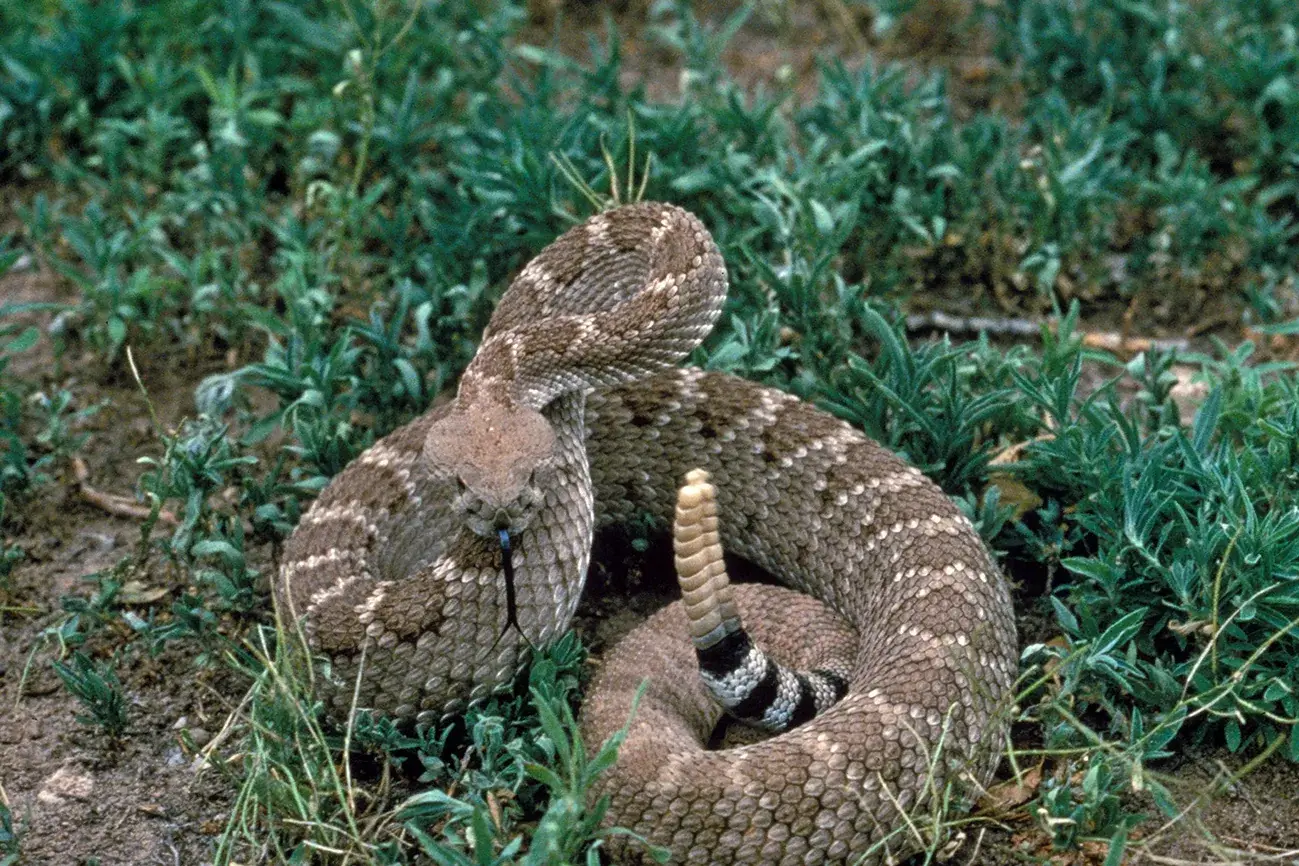
A western diamondback rattlesnake, the pit viper whose heat channel the 2010 study cloned; at this size its pits are hard to make out.
“Western Diamondback Rattlesnake (Crotalus atrox) in New Mexico”, Gary Stolz, U.S. Fish and Wildlife Service; public domain.
Full credit
"Western Diamondback Rattlesnake (Crotalus atrox) in New Mexico" by Gary Stolz, U.S. Fish and Wildlife Service — https://commons.wikimedia.org/wiki/File:Crotalus_atrox_USFWS.jpg — Public domain (work of a US federal employee (U.S. Fish and Wildlife Service) made in the course of official duties, 17 U.S.C. §105; file page template PD-USGov-FWS; outside the US: rests on the same federal public-domain status as tagged on the file page, no separate agency statement read; upstream not traced (USFWS National Digital Library)); modified: the Commons file is a version edited from Gary Stolz's original by Pharaoh Hound (uploaded 25 November 2006, per the file page), cropped to 3:2 (1299 x 866, centered; 8 px off the top and 9 px off the bottom, 1 px off the right edge) for the card; saved as WebP, no resizing
Between a rattlesnake's eye and nostril sits a small pit with a thin membrane stretched across it. That membrane allows a pit viper to register warm-blooded prey up to about 1 meter away, by the estimate a 2010 study cites. It works by heat rather than by sight: the study found no genes for light-catching eye pigments active in the nerves that serve the pit.
What is a pit organ?
Pit vipers, the group that includes rattlesnakes, carry two of these pits, one on each side of the face. The 2010 study by Elena Gracheva, David Julius and colleagues describes each pit as a hollow chamber. A thin membrane hangs inside it, rich in mitochondria and blood vessels and densely threaded with nerve fibers.
A pit viper is venomous and dangerous at close range, so close-up photographs like the one below are the sensible way to examine a pit, with no reason to approach a live snake.
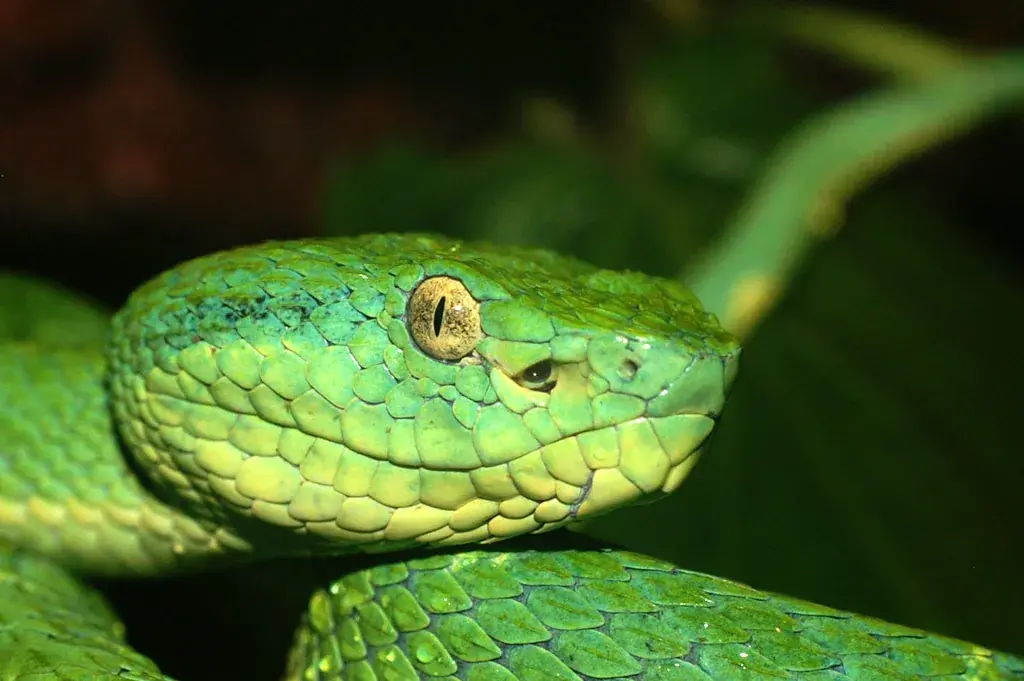
A palm pit viper, Bothriechis lateralis according to the file page: the dark pit sits below and in front of the eye, with the smaller nostril closer to the snout tip.
"Groengele groefkopadder (striped palm pitviper)" by Patrick Gijsbers — https://commons.wikimedia.org/wiki/File:Groengele-groefkopadder-5.jpg — CC BY-SA 4.0 (https://creativecommons.org/licenses/by-sa/4.0/); modified: converted to WebP at the original 1024 px width; no crop
Some other snakes have a heat sense too: the same paper notes that some pythons and boas also detect infrared, through labial pits scattered over the snout. Those pits are simpler and less densely supplied with nerves. By the paper's account, pythons and boas are 5 to 10 times less sensitive to infrared than pit vipers.
How does the pit detect heat?
The paper defines infrared as radiation with wavelengths from 750 nanometers to 1 millimeter. In principle, a detector could catch it in two ways. It could absorb the light directly, the way pigments in an eye do, or it could sense the warmth the light causes.
Because the pit's nerves belong to the somatosensory system, which handles touch and temperature, rather than to the visual system, heat was the likelier route. To find the sensor, the team compared the genes active in the rattlesnake's trigeminal ganglia, the nerve clusters that serve the face and pits, with those in the ganglia that serve the trunk.
Put loosely, and only as a figure of speech, that comparison asked the snake one question: what do the pit's nerves need that the rest of the body does not? One gene stood out, coding for TRPA1, an ion channel; its RNA was about 400 times more abundant in the face ganglia than in the trunk ganglia.
In mammals, TRPA1 is known as the wasabi receptor, a sensor mainly for chemical irritants. The rattlesnake's version behaved differently when the team made it in frog egg cells for testing. It opened with heat above about 28 degrees Celsius. The same channel from a rat snake, a species without pits, needed about 37 degrees.
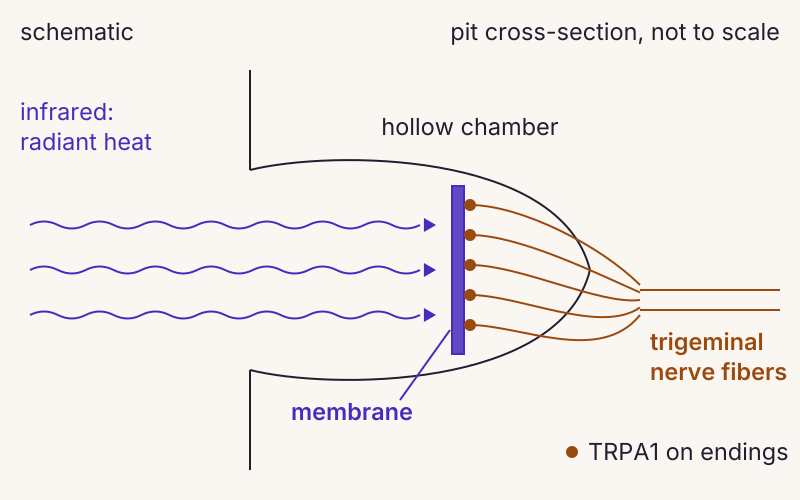
A schematic of a pit organ, drawn from the description in the 2010 study by Gracheva and colleagues: heat crosses the chamber and warms the suspended membrane, where nerve endings carry the TRPA1 channel.
How the figure was made schematic; pit cross-section drawn from the text of Gracheva et al. 2010: hollow chamber, suspended membrane, trigeminal nerve fibers with TRPA1 on their endings; not to scale
"Inside a pit organ" by Animal Brainwork, https://animalbrainwork.com/extra-senses/pit-viper-infrared/. Licensed under CC BY 4.0: https://creativecommons.org/licenses/by/4.0/
Data: Drawn from the description in Gracheva EO et al. (2010), Molecular basis of infrared detection by snakes, Nature 464: 1006-1011, https://pmc.ncbi.nlm.nih.gov/articles/PMC2855400/ (no figure reproduced)
The authors concluded that the membrane serves as “a passive antenna for radiant heat.” Warmth from a body heats the thin membrane, and TRPA1 channels on the nerve endings inside it open. That makes calling the pit a thermal camera a comparison, not a description.
The camera comparison is a borrowed umwelt: this site's name for the human assumptions that slip in when another animal's world, its umwelt, is pictured through human senses. Honeybees catch a different slice of the spectrum with pigments in their eyes. The pit, by the 2010 study's account, catches its slice by heating tissue.
Where does the heat signal go?
The nerve fibers in the membrane come from the trigeminal nerve, which serves the face. According to the 2010 paper, they carry the pit's signals to the optic tectum of the brain, where the heat signal converges with input from other senses.
The paper's opening summary adds that thermal and visual information is superimposed in the snake's brain. That overlap, it says, allows the snake to track animals quickly and precisely. Among the studies the paper cites for the convergence in the optic tectum is a 1981 report by E. A. Newman and P. H. Hartline whose title describes neurons in the rattlesnake optic tectum that integrate visual and infrared information. This page knows it only from the 2010 paper's reference list bibliographic.
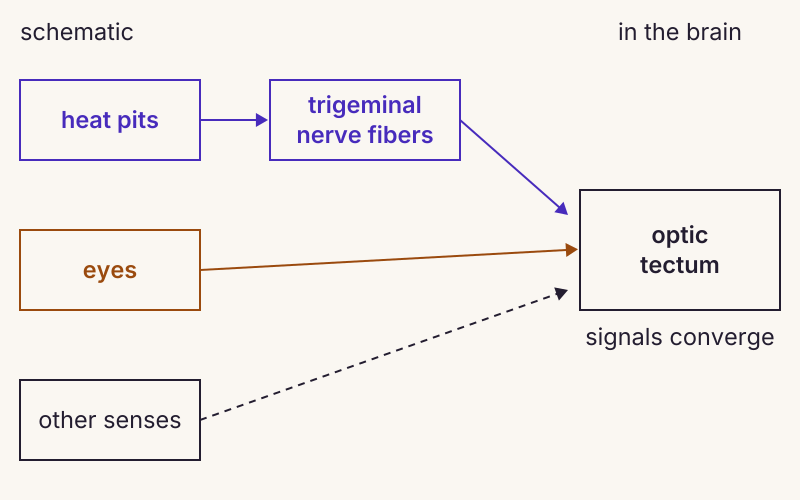
A schematic of the route described in the 2010 study: nerve fibers from the pits carry the heat signal to the optic tectum, where it meets input from other senses.
How the figure was made schematic; pit -> trigeminal nerve fibers -> optic tectum, where inputs from other senses converge (Gracheva et al. 2010); eye input drawn as one more arrow
The figure in words
- Heat pits: the membrane's nerve endings pick up warmth.
- Trigeminal nerve fibers: carry the heat signal from the pits toward the brain.
- Optic tectum: receives the heat signal.
- Eyes and other senses: their input also reaches the optic tectum, where the signals converge.
"Where the heat signal goes" by Animal Brainwork, https://animalbrainwork.com/extra-senses/pit-viper-infrared/. Licensed under CC BY 4.0: https://creativecommons.org/licenses/by/4.0/
Data: Drawn from the description in Gracheva EO et al. (2010), Molecular basis of infrared detection by snakes, Nature 464: 1006-1011, https://pmc.ncbi.nlm.nih.gov/articles/PMC2855400/ (no figure reproduced)
Other animals rely on senses that people lack. A bird's magnetoreception responds to Earth's magnetic field. In a 2012 study, rays and sawfish turned toward weak electric fields, sensed through the ampullae of Lorenzini. The star-nosed mole hunts by touch instead of heat.
How far away can a pit viper sense warmth?
Biophysical studies suggest the pit viper's system can detect prey at distances up to 1 meter, according to the 2010 paper's summary of earlier work. That figure comes from the studies it cites, because the 2010 experiments themselves worked on genes, nerve cells and cloned channels, not on how far a snake can sense.
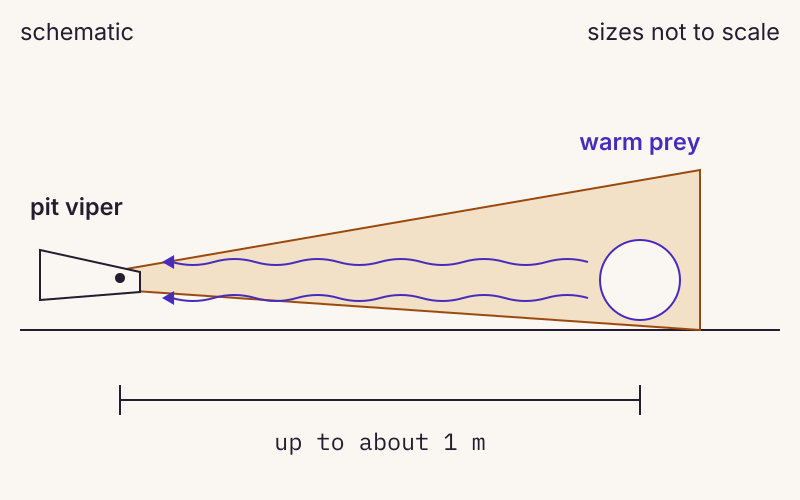
A schematic of the working distance: the biophysical studies cited in the 2010 paper suggest pit vipers can detect prey up to about 1 meter away. Head and prey sizes are not to scale.
How the figure was made schematic; detection distance up to about 1 m as cited in Gracheva et al. 2010 from earlier biophysical studies; head and prey sizes not to scale
"How far the heat sense reaches" by Animal Brainwork, https://animalbrainwork.com/extra-senses/pit-viper-infrared/. Licensed under CC BY 4.0: https://creativecommons.org/licenses/by/4.0/
Data: Drawn from the description in Gracheva EO et al. (2010), Molecular basis of infrared detection by snakes, Nature 464: 1006-1011, https://pmc.ncbi.nlm.nih.gov/articles/PMC2855400/ (no figure reproduced)
Sensitivity differs among the heat-sensing snakes. The python and boa channels also opened with heat, at about 33 degrees Celsius in the royal python and about 30 in the Amazon tree boa. The authors read this as consistent with the snakes' lower infrared sensitivity. Their family tree of the channel suggests that pythons and boas on one branch, and pit vipers on another, adapted TRPA1 for sensing infrared independently.
The 2010 study identified the sensor, not the whole sense. Its tests ran on nerve tissue and on channels expressed in cultured cells and frog eggs, from a handful of species. How finely the pits locate warmth, and how the brain weighs heat against sight, lay outside what it measured.
Still unsettled
- How sharp is the heat picture a pit viper gets? The 2010 study describes how the membrane senses warmth, but it did not test how precisely a snake can tell where heat comes from. Answering that takes behavioral tests, which the study did not run.
- How does the brain combine heat with sight? The paper states that heat signals meet input from other senses in the optic tectum and that thermal and visual images overlap in the brain, but it adds no new brain recordings. The 1981 tectum study is known here only by its title bibliographic.
- Is TRPA1 the whole story? Pit vipers sense infrared 5 to 10 times better than boas, yet their channels' heat thresholds differ by only about 2 degrees. The authors suggest that other cellular or anatomical factors contribute, and which ones remains open.
Studies cited
- Gracheva EO, Ingolia NT, Kelly YM, Cordero-Morales JF, Hollopeter G, Chesler AT, Sánchez EE, Perez JC, Weissman JS, Julius D (2010). Molecular basis of infrared detection by snakes. Nature 464(7291): 1006–1011. doi:10.1038/nature08943 pmc.ncbi.nlm.nih.gov/articles/PMC2855400/Read as: full text; author manuscript read in full (PMC version); paraphrased, one short quote
- Newman EA, Hartline PH (1981). Integration of visual and infrared information in bimodal neurons in the rattlesnake optic tectum. Science 213: 789-791. doi:10.1126/science.7256281 doi.org/10.1126/science.7256281Read as: bibliographic; known from the reference list of Gracheva et al. 2010
Cite this page
“Can Snakes See Infrared? A 2010 Study Traced It to Heat.” Animal Brainwork, published November 24, 2026. https://animalbrainwork.com/extra-senses/pit-viper-infrared/. Accessed the day you read it.
How each claim is traced Retrials: every correction, dated Report an error on this page (contact@animalbrainwork.com)
Nearby questions in Extra Senses
Sense and mechanism

Magnetoreception: In Cage Tests, Robins Read Field-Line Tilt
Picture credit
"European Robin (Erithacus rubecula)" by David Croad — https://commons.wikimedia.org/wiki/File:European_Robin_Erithacus_rubecula.jpg — CC BY 3.0 (https://creativecommons.org/licenses/by/3.0/); modified: cropped to 3:2 (top and bottom grass trimmed, bird whole), resized to 1440 px wide and converted to WebP
Sense and mechanism
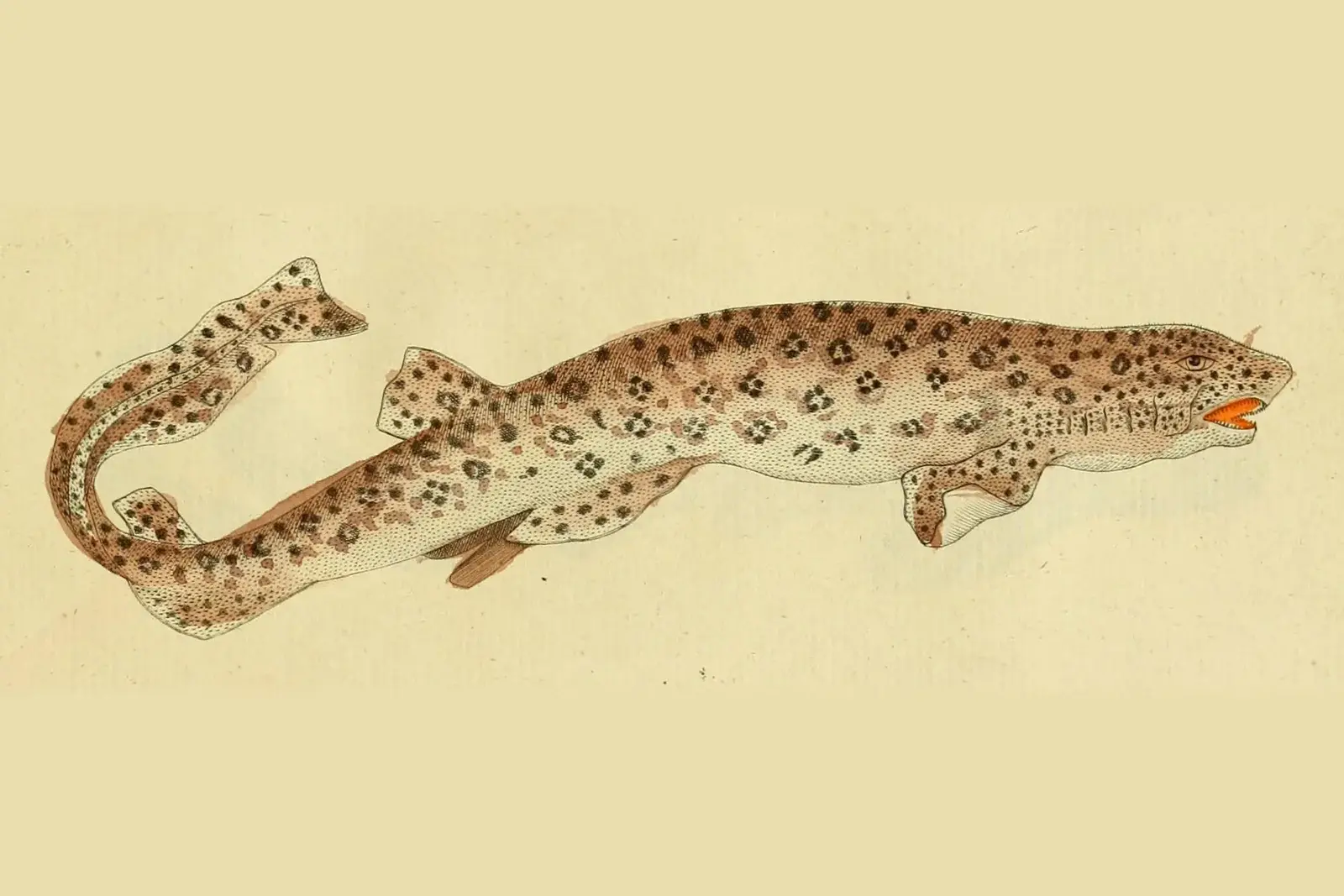
Ampullae of Lorenzini: Tank Rays Turned at 5 to 80 nV per cm
Picture credit
"Squalus canicula (Ichthyologie, plate 112)" by Marcus Elieser Bloch — https://commons.wikimedia.org/wiki/File:Ichthyologie;_ou,_Histoire_naturelle_des_poissons_(Plate_112)_(6918377788).jpg — Public domain (published 1796 in Bloch's Ichthyologie, ou Histoire naturelle des poissons; public domain in the US (published before 1931); EU: Bloch's death year not verified from a library or Project Gutenberg catalog record, so this rests on publication in 1796 and the file page's PD-old-100-expired tag; scan tagged PD-scan (and CC BY 2.0) on the file page; upstream not traced); modified: cropped (box 110,335,2190,1110 of the 2,283 x 1,342 px original) to remove the plate number, the title lettering at top right and the engraver's line at bottom left; the whole fish is inside the crop, padded above and below with a flat fill of the plate's paper color (RGB 235,221,174, the median of the crop's outer rows; 24 edge rows blended into it) to 3:2 (2,080 x 1,387 px); the plate itself is not retouched, resized to 1600 x 1067 px WebP
Sense and mechanism
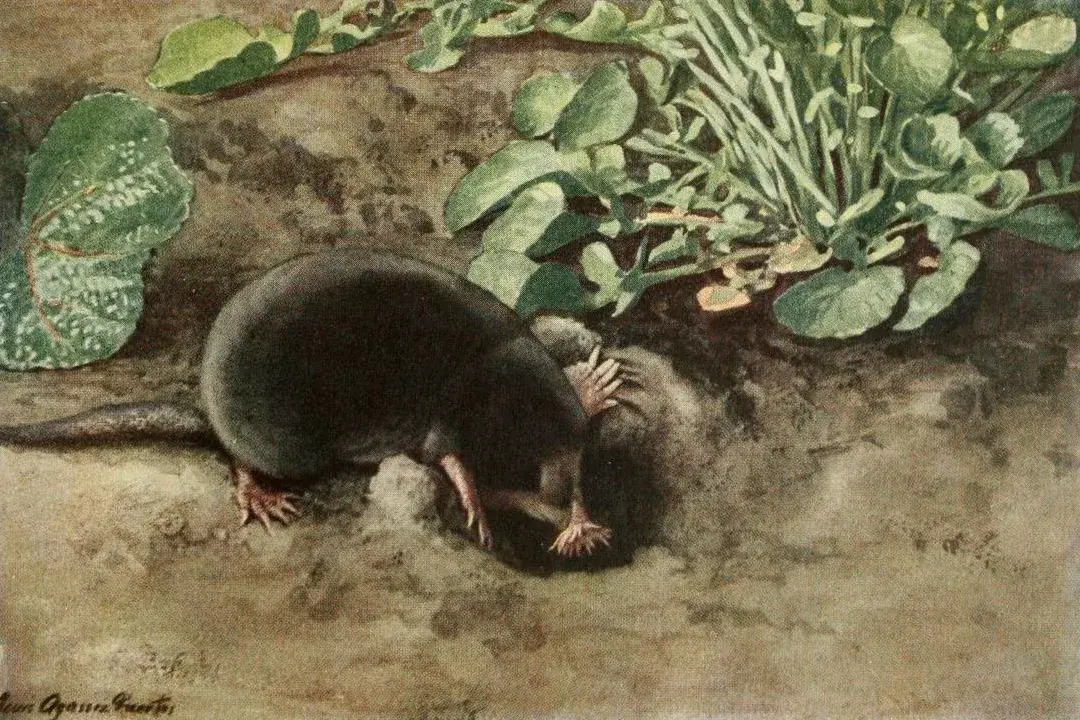
Star-Nosed Mole: The Star on Its Nose Is a Touch Organ
Picture credit
"Star-nosed mole, Condylura cristata (Wild Animals of North America, page 563), card crop" by Louis Agassiz Fuertes, in E. W. Nelson, Wild Animals of North America (National Geographic Society, 1918); scan from the Biodiversity Heritage Library — https://commons.wikimedia.org/wiki/File:Condylura_cristata_(Wild_animals_of_North_America_-_Page_563).jpg — Public domain (published 1918 in E. W. Nelson's Wild Animals of North America (National Geographic Society, Washington); public domain in the US (published before 1931); EU: the painter, Louis Agassiz Fuertes, died in 1927 per the Project Gutenberg catalog record for this book (eBook #59475: Fuertes, Louis Agassiz, 1874-1927, illustrator), so the life-plus-70 term ended at the end of 1997; file page also tags PD-old-70-expired and PD-scan; upstream not traced); modified: crop of the whole plate star-nosed-mole-fuertes-1918 (the page's first image): cropped to 3:2 (1080 x 720 px from the 1158 x 845 px file) to remove the printed plate title and the plate border; saved as WebP; no color change