Star-Nosed Mole: The Star on Its Nose Is a Touch Organ
In one sentence
The star-nosed mole's star is a touch organ, not a smell organ: its 22 rays carry about 25,000 touch domes, and Catania's 2011 review times its quickest find-and-eat at about 120 milliseconds.
- How it was asked
- Kenneth Catania's research on foraging moles, reviewed in 2011: anatomy of the star, recordings from nerves and brain, and high-speed video of moles touching objects and prey.
- Key study read as
- full text Catania 2011, Philosophical Transactions of the Royal Society B 366: 3016–3025 (PMC3172592)
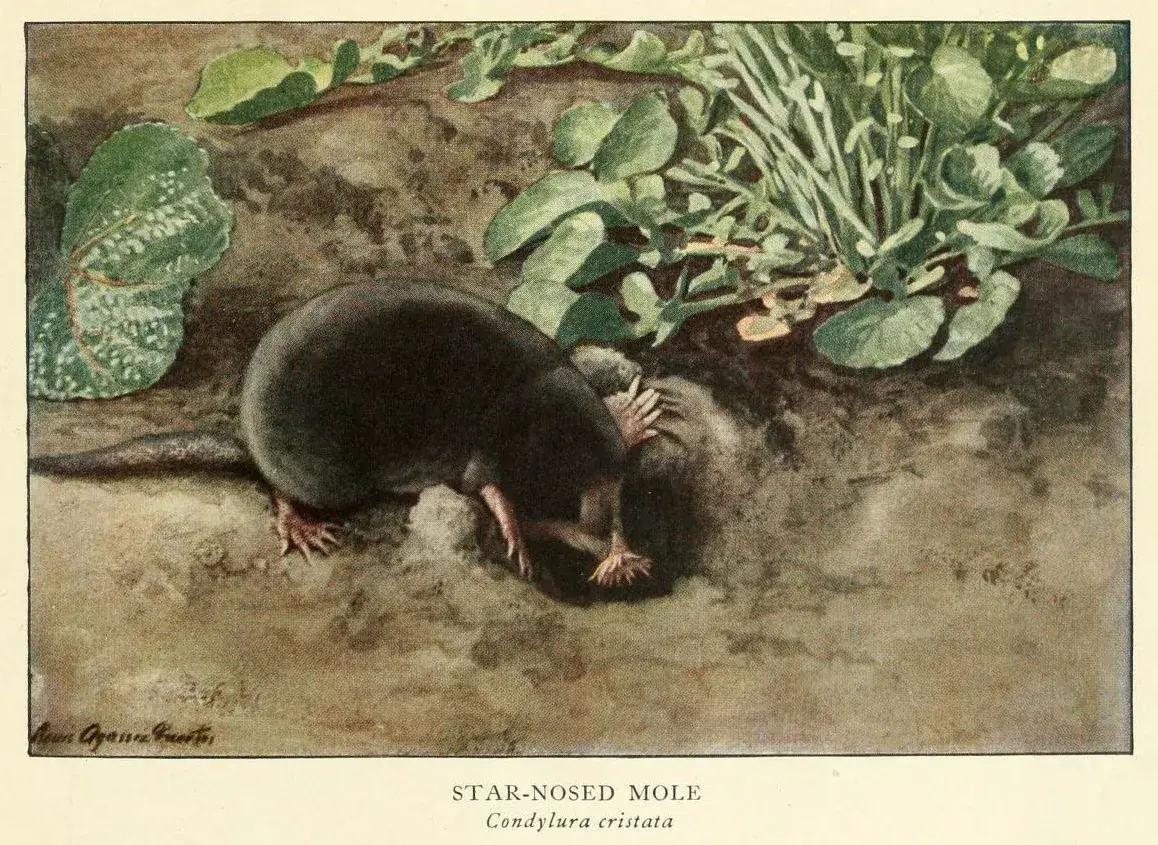
A star-nosed mole at the mouth of its burrow, painted by Louis Agassiz Fuertes and printed in 1918; the star itself is pressed into the soil.
“Star-nosed mole, Condylura cristata (Wild Animals of North America, page 563)”, Louis Agassiz Fuertes, in E. W. Nelson, Wild Animals of North America (National Geographic Society, 1918); scan from the Biodiversity Heritage Library; public domain.
Full credit
"Star-nosed mole, Condylura cristata (Wild Animals of North America, page 563)" by Louis Agassiz Fuertes, in E. W. Nelson, Wild Animals of North America (National Geographic Society, 1918); scan from the Biodiversity Heritage Library — https://commons.wikimedia.org/wiki/File:Condylura_cristata_(Wild_animals_of_North_America_-_Page_563).jpg — Public domain (published 1918 in E. W. Nelson's Wild Animals of North America (National Geographic Society, Washington); public domain in the US (published before 1931); EU: the painter, Louis Agassiz Fuertes, died in 1927 per the Project Gutenberg catalog record for this book (eBook #59475: Fuertes, Louis Agassiz, 1874-1927, illustrator), so the life-plus-70 term ended at the end of 1997; file page also tags PD-old-70-expired and PD-scan; upstream not traced); modified: saved as WebP at the original 1158 px width; no crop, no color change
Card and share picture, cropped from this picture: "Star-nosed mole, Condylura cristata (Wild Animals of North America, page 563), card crop" by Louis Agassiz Fuertes, in E. W. Nelson, Wild Animals of North America (National Geographic Society, 1918); scan from the Biodiversity Heritage Library — https://commons.wikimedia.org/wiki/File:Condylura_cristata_(Wild_animals_of_North_America_-_Page_563).jpg — Public domain (published 1918 in E. W. Nelson's Wild Animals of North America (National Geographic Society, Washington); public domain in the US (published before 1931); EU: the painter, Louis Agassiz Fuertes, died in 1927 per the Project Gutenberg catalog record for this book (eBook #59475: Fuertes, Louis Agassiz, 1874-1927, illustrator), so the life-plus-70 term ended at the end of 1997; file page also tags PD-old-70-expired and PD-scan; upstream not traced); modified: crop of the whole plate star-nosed-mole-fuertes-1918 (the page's first image): cropped to 3:2 (1080 x 720 px from the 1158 x 845 px file) to remove the printed plate title and the plate border; saved as WebP; no color change
Twenty-two fleshy rays ring the nostrils of the star-nosed mole. They sit around the nose but are not a nose in the usual sense. In a 2011 review, the Vanderbilt University biologist Kenneth Catania describes the star as covered entirely in one kind of touch organ, with no taste buds or other receptor organs among them. The rays are in constant motion while the mole explores, tapping the mud of its wetland home.
What are the 22 rays on its nose?
The star-nosed mole, Condylura cristata, is a small mammal of 40 to 50 grams. The species record of the Integrated Taxonomic Information System lists that scientific name as valid and places it in the mole family, Talpidae. By Catania's account, the whole star is roughly a centimeter across, slightly smaller than a typical human fingertip.
Researchers number the rays from 1 to 11 on each side of the face, which gives the star 11 matching pairs. Ray 11 is small, but it does most of the close inspection, as the speed section below shows.
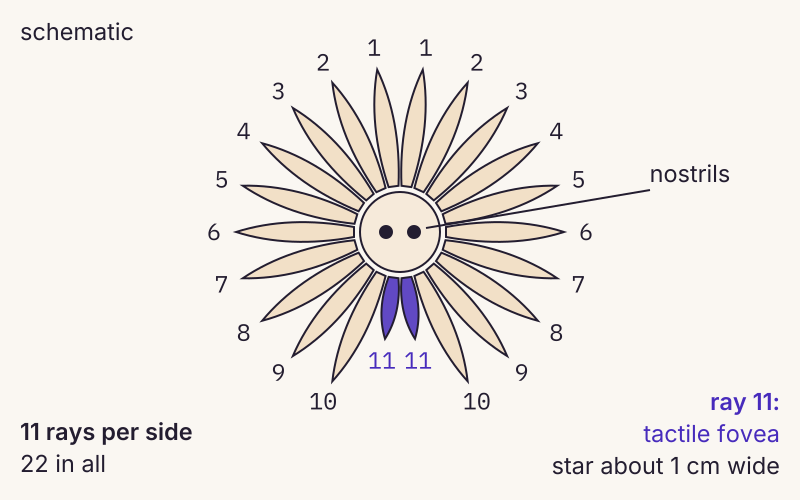
A schematic of the star: 22 rays in matching halves of 11 around the nostrils, with ray 11 highlighted as the touch fovea. Positions and lengths are illustrative.
How the figure was made schematic; 22 rays, 11 per side, numbered 1-11 on each side (order around the ring illustrative); ray 11 drawn shorter; ray count and numbering from Catania 2011; not traced from a paper
"The 22 rays of the star" by Animal Brainwork, https://animalbrainwork.com/extra-senses/star-nosed-mole/. Licensed under CC BY 4.0: https://creativecommons.org/licenses/by/4.0/
Data: Drawn from the description in Catania KC (2011), The sense of touch in the star-nosed mole: from mechanoreceptors to the brain, Philosophical Transactions of the Royal Society B 366: 3016-3025, https://pmc.ncbi.nlm.nih.gov/articles/PMC3172592/ (no figure reproduced)
Calling the star a nose invites a guess that it smells. That guess is a borrowed umwelt: the human assumptions that slip in when another animal's world, its umwelt, is pictured through human senses. Catania's review reports that the star is made only of touch organs; nothing on the rays is described as sampling odor.
The review ties the star's shape to where the animal lives: star-nosed moles, it notes, are the only moles living in the moist, muddy soil of wetlands. Soft mud wears down thin, sensitive skin less than dry soil does, and wetlands hold small prey that a finer touch surface can find. The review offers this as a likely scenario, not a tested result.
Why does ray 11 get so much of the brain?
In counts the review gives as means from four animals, ray 11 carries an average of 870 touch organs, while most other rays carry over 1,000. Yet, according to the review, it takes up about 25 percent of the star's map in the primary touch area of the mole's brain. Rays 1 to 9 average about four nerve fibers per organ, against 5.5 for ray 10 and 7 for ray 11.
Catania's review compares this to the fovea of an eye, the small patch of the retina that handles fine detail and gets an outsized share of the visual brain. The comparison is the review's. It describes how the brain allots space and makes no claim that the mole sees with its nose. The review also reports three separate maps of the star in the mole's brain, where related shrews appear to have two touch areas.
What is an Eimer's organ?
The star's skin is made of small raised domes called Eimer's organs. A typical star carries approximately 25,000 of them, according to Catania's 2011 review, and each dome is about 30 to 50 micrometers wide. Nearly all of the roughly 30 mole species have Eimer's organs on the snout. What is unique to this species is the star's shape and size.
Each organ is built around a column of skin cells. At the column's base sits a Merkel cell–neurite complex, a type of touch ending. Below it lies a lamellated corpuscle, a layered capsule. A set of free nerve endings runs up through the column and ends in a ring of small swellings just under the surface.
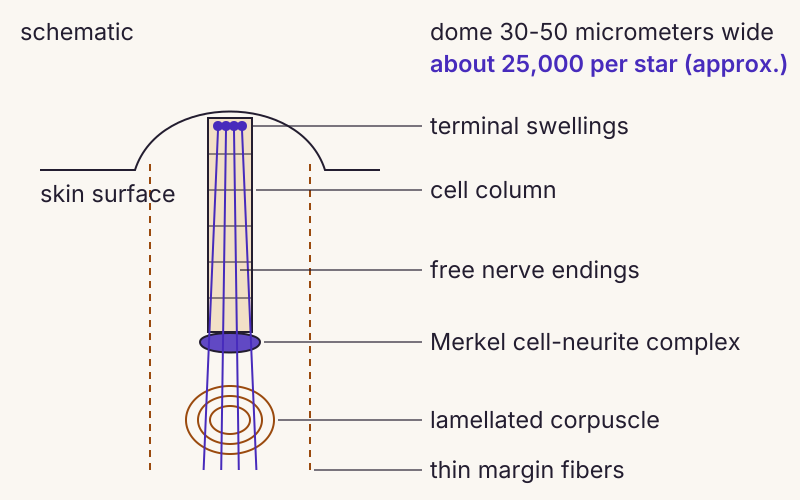
A schematic of one Eimer's organ, drawn from the description in Catania's 2011 review; about 25,000 of these domes cover one star. Not to scale.
How the figure was made schematic; one Eimer's organ in cross-section, parts from the text of Catania 2011; dome 30-50 micrometers wide; about 25,000 organs per star (approx.); not to scale
"Inside one Eimer's organ" by Animal Brainwork, https://animalbrainwork.com/extra-senses/star-nosed-mole/. Licensed under CC BY 4.0: https://creativecommons.org/licenses/by/4.0/
Data: Drawn from the description in Catania KC (2011), The sense of touch in the star-nosed mole: from mechanoreceptors to the brain, Philosophical Transactions of the Royal Society B 366: 3016-3025, https://pmc.ncbi.nlm.nih.gov/articles/PMC3172592/ (no figure reproduced)
The case that these domes sense touch rests on recordings. In the work the review summarizes, 97 percent of 145 active neurons in the mole's primary touch cortex responded to light touches on the star, with a mean delay of 11.6 milliseconds. Recordings from nerve fibers in a related species, the coast mole, found that 15 of 17 fibers responded more strongly to pushes from some directions than others.
Catania offers one model of how the organs might tell rough from smooth: different surfaces could bend the ring of nerve endings in different directions. The review labels this a hypothetical role. It remains a proposal.
How fast does the mole handle prey?
Star-nosed moles are the fastest known foragers among mammals, as Catania reported in 2011. A foraging mole can touch 10 to 15 different places a second, the review notes. Each touch lasts 20 to 30 milliseconds.
The video shows a fixed sequence. One of the large rays, usually from 1 to 9, meets a possible prey item, the star shifts so that ray 11 touches it, and the food goes into the mouth. In the review's words, the mole is “able to identify and consume a small prey item in 120 ms.” The full text adds that 120 ms is the quickest case, and that the average is 227 ms.
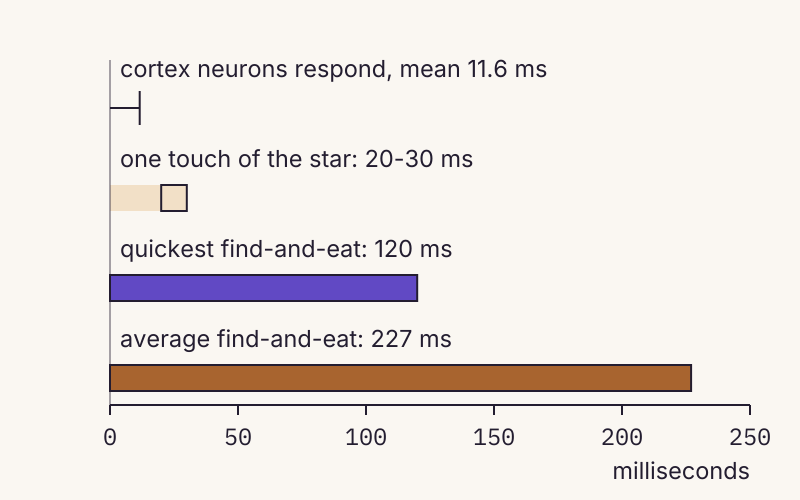
Timings from Catania's 2011 review, on one scale: how quickly brain cells respond to a touch, how long one touch lasts, and how long the quickest and the average find-and-eat sequences take.
How the figure was made bars from Catania 2011: cortex response 11.6 ms (mean), one touch 20-30 ms, quickest find-and-eat 120 ms, average 227 ms; axis 0-250 ms, 2.56 units per ms
The figure in words
- Touch cortex neurons respond to a touch on the star after 11.6 ms on average.
- One touch of the star lasts 20 to 30 ms.
- The quickest find-and-eat sequence takes 120 ms.
- The average find-and-eat sequence takes 227 ms.
"How fast a star-nosed mole handles prey" by Animal Brainwork, https://animalbrainwork.com/extra-senses/star-nosed-mole/. Licensed under CC BY 4.0: https://creativecommons.org/licenses/by/4.0/
Data: Catania KC (2011), The sense of touch in the star-nosed mole: from mechanoreceptors to the brain, Philosophical Transactions of the Royal Society B 366: 3016-3025, https://pmc.ncbi.nlm.nih.gov/articles/PMC3172592/ (numbers redrawn; no figure reproduced)
Where do the timings come from?
The review takes the quickest and average find-and-eat times from a 2005 study by Catania and F. E. Remple, which this page knows only from the review's reference list bibliographic. The cortex delay comes from separate brain recordings that the review cites. The review also reports, citing separate work, that in all of hundreds of trials analyzed with high-speed video, the mole moved ray 11 onto a food item while exploring it. In some trials it also touched rubber decoys with ray 11 and then left them.
If an experiment is a question put to an animal, a figure of speech used across this site, the high-speed camera asked the mole what it does with a possible meal after the first contact. The answer, by this account, was a further touch with ray 11 in all of those trials.
Other senses in this branch work through different receptors. A pit viper, according to a 2010 study, is a snake that senses prey by warmth, through heat-sensing pits on its face. Some fish sense prey by its electric field, through the ampullae of Lorenzini tested with rays in a 2012 study. A bird's magnetoreception reads the planet rather than prey, and honeybees, whose eyes carry three receptor types peaking in the ultraviolet, blue and green, sort the world by color instead of touch.
The review mostly summarizes one laboratory's work on anatomy, brain maps and filmed foraging. It explains what the star is built from and how quickly it is used. What it does not show is how the organs turn a touch into a sense of shape, or how wild moles spend their foraging time. A vivid comparison needs the same check against what was actually counted elsewhere too, as with the question of how many brains an octopus has.
Still unsettled
- How do Eimer's organs tell shapes and textures apart so fast? Catania's 2011 review lists this as an open question. Its own model, in which rough and smooth surfaces bend the ring of nerve endings differently, is offered as a hypothesis, not a demonstrated mechanism.
- How did the star evolve? The review points to the coast mole, whose snout resembles an early stage of the star's development, and to the soft soil of wetlands. Both are comparative clues; the review describes no direct record of the change.
- Do the filmed speeds match foraging in the wild? The 120 ms and 227 ms timings come from high-speed video of moles handling small prey, and this page has the original 2005 study only at the bibliographic level. How often wild moles meet prey small enough for the quickest sequence is not covered in the review.
Studies cited
- Catania KC (2011). The sense of touch in the star-nosed mole: from mechanoreceptors to the brain. Philosophical Transactions of the Royal Society B 366(1581): 3016–3025. doi:10.1098/rstb.2011.0128 pmc.ncbi.nlm.nih.gov/articles/PMC3172592/Read as: full text; review read in full (PMC version); paraphrased, one short quote
- Integrated Taxonomic Information System (ITIS). Condylura cristata (Linnaeus, 1758), TSN 179964 (valid; Star-nosed Mole). itis.gov/servlet/SingleRpt/SingleRptRead as: abstract or record; database record (ITIS single report page), not a full textText license:CC0 1.0 (terms)
- Catania KC, Remple FE (2005). Asymptotic prey profitability drives star-nosed moles to the foraging speed limit. Nature 433: 519–522. doi:10.1038/nature03250 doi.org/10.1038/nature03250Read as: bibliographic; known from the reference list of Catania 2011
Cite this page
“Star-Nosed Mole: The Star on Its Nose Is a Touch Organ.” Animal Brainwork, published November 24, 2026. https://animalbrainwork.com/extra-senses/star-nosed-mole/. Accessed the day you read it.
How each claim is traced Retrials: every correction, dated Report an error on this page (contact@animalbrainwork.com)
Nearby questions in Extra Senses
Sense and mechanism

Magnetoreception: In Cage Tests, Robins Read Field-Line Tilt
Picture credit
"European Robin (Erithacus rubecula)" by David Croad — https://commons.wikimedia.org/wiki/File:European_Robin_Erithacus_rubecula.jpg — CC BY 3.0 (https://creativecommons.org/licenses/by/3.0/); modified: cropped to 3:2 (top and bottom grass trimmed, bird whole), resized to 1440 px wide and converted to WebP
Sense and mechanism
Ampullae of Lorenzini: Tank Rays Turned at 5 to 80 nV per cm
Picture credit
"Squalus canicula (Ichthyologie, plate 112)" by Marcus Elieser Bloch — https://commons.wikimedia.org/wiki/File:Ichthyologie;_ou,_Histoire_naturelle_des_poissons_(Plate_112)_(6918377788).jpg — Public domain (published 1796 in Bloch's Ichthyologie, ou Histoire naturelle des poissons; public domain in the US (published before 1931); EU: Bloch's death year not verified from a library or Project Gutenberg catalog record, so this rests on publication in 1796 and the file page's PD-old-100-expired tag; scan tagged PD-scan (and CC BY 2.0) on the file page; upstream not traced); modified: cropped (box 110,335,2190,1110 of the 2,283 x 1,342 px original) to remove the plate number, the title lettering at top right and the engraver's line at bottom left; the whole fish is inside the crop, padded above and below with a flat fill of the plate's paper color (RGB 235,221,174, the median of the crop's outer rows; 24 edge rows blended into it) to 3:2 (2,080 x 1,387 px); the plate itself is not retouched, resized to 1600 x 1067 px WebP
Sense and mechanism
Can Snakes See Infrared? A 2010 Study Traced It to Heat
Picture credit
"Western Diamondback Rattlesnake (Crotalus atrox) in New Mexico" by Gary Stolz, U.S. Fish and Wildlife Service — https://commons.wikimedia.org/wiki/File:Crotalus_atrox_USFWS.jpg — Public domain (work of a US federal employee (U.S. Fish and Wildlife Service) made in the course of official duties, 17 U.S.C. §105; file page template PD-USGov-FWS; outside the US: rests on the same federal public-domain status as tagged on the file page, no separate agency statement read; upstream not traced (USFWS National Digital Library)); modified: the Commons file is a version edited from Gary Stolz's original by Pharaoh Hound (uploaded 25 November 2006, per the file page), cropped to 3:2 (1299 x 866, centered; 8 px off the top and 9 px off the bottom, 1 px off the right edge) for the card; saved as WebP, no resizing