Magnetoreception: In Cage Tests, Robins Read Field-Line Tilt
In one sentence
Magnetoreception is the sense of Earth's magnetic field, and in the cage tests reviewed in 2014, the European robin's magnetic compass read the tilt of the field lines, telling poleward from equatorward rather than north from south, and it worked only under short-wavelength light.
- How it was asked
- Robins in round orientation cages, with the field turned or flipped by coils: does the compass follow the field's polarity or the tilt of its lines? (reviewed by Wiltschko and Wiltschko, 2014)
- Key study read as
- full text Wiltschko & Wiltschko 2014, Biosensors 4(3): 221–242 (PMC4264356)
- Sample
- many repeated cage experiments, mostly with migrating songbirds, reviewed in 2014
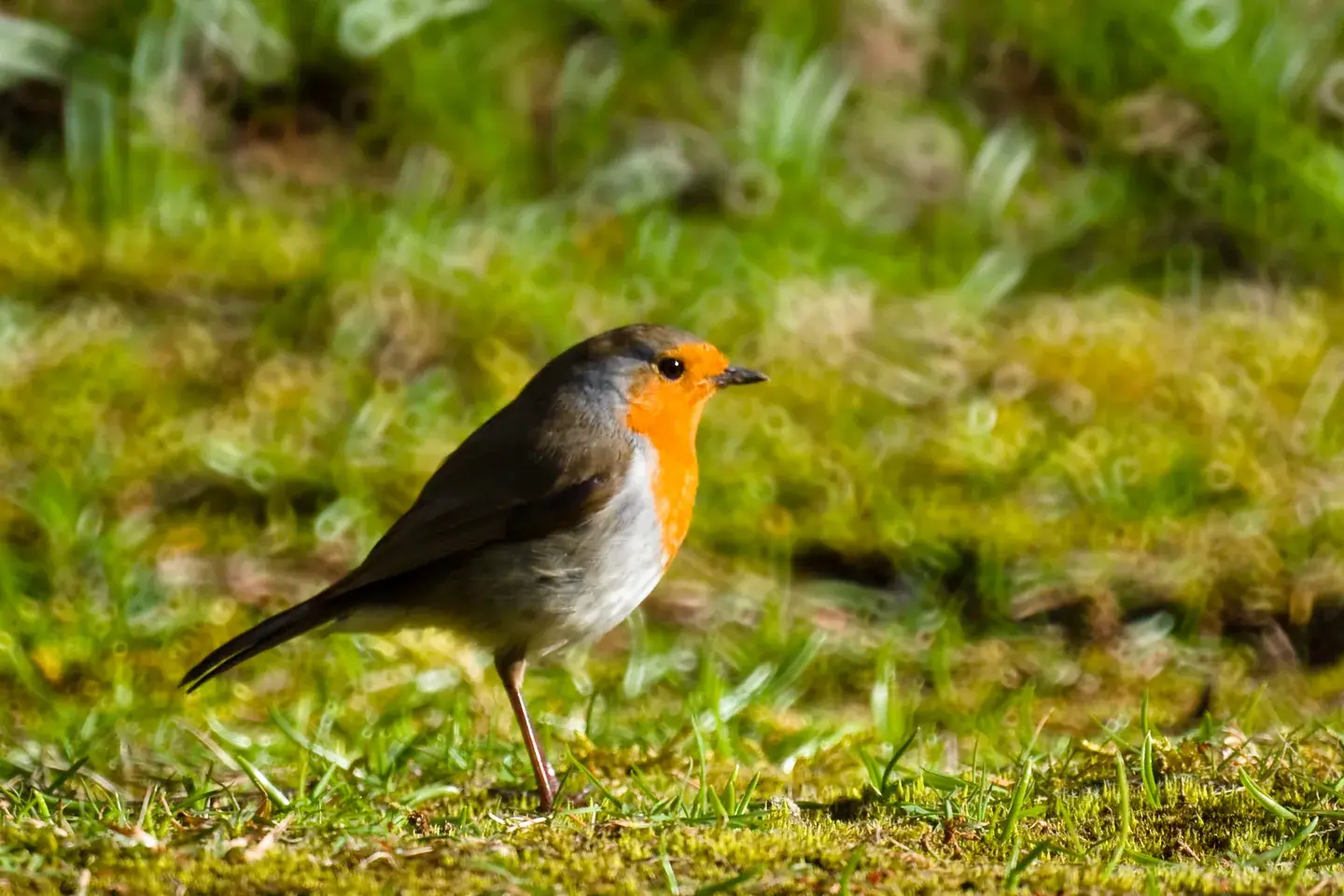
A European robin, the species used in the cage tests that revealed the inclination compass.
"European Robin (Erithacus rubecula)" by David Croad — https://commons.wikimedia.org/wiki/File:European_Robin_Erithacus_rubecula.jpg — CC BY 3.0 (https://creativecommons.org/licenses/by/3.0/); modified: cropped to 3:2 (top and bottom grass trimmed, bird whole), resized to 1440 px wide and converted to WebP
In a simple model of Earth's field, the lines at 50 degrees north dip about 67 degrees into the ground. That slope is what a migrating robin's magnetic sense seems to use. In the tests gathered in a 2014 review by Roswitha and Wolfgang Wiltschko, the robins ignored which end of the field was which and steered by the tilt of the lines. They also needed light from the short-wavelength end of the spectrum, ultraviolet to green.
“Compass” is a comparison here, not an organ. It names a sense that gives a direction, and no needle is involved. The test itself can be pictured, loosely and only as an image, as a question put to the bird: which way do you want to fly?
The review explains the setup. A captive migrant in a round cage hops and flutters toward its migratory direction, and its activity is recorded. Usually a group of 10 to 15 birds is tested one at a time, several times each.
What does a bird's magnetic compass read?
To find out if birds use the field at all, researchers turned magnetic north with a coil system. Then they checked whether the birds' heading turned with it. The robins were tested at Frankfurt am Main, where the local field measured 46 microtesla and dipped at 66 degrees, according to the review.
The decisive test flipped only the vertical part of the field, so that it pointed up, as it does in the southern hemisphere. The horizontal part still pointed north, so a hiking compass would have shown no change. In spring, the robins then headed south instead of north.
The Wiltschkos call the robin's sense an “inclination compass,” one “not based on the polarity of the magnetic field, but the axial course of the field lines.” The birds do not tell magnetic north from magnetic south. They tell “poleward,” where the lines point down into the ground, from “equatorward,” where the lines point up. The review reports this kind of compass in all the bird species tested for it so far.
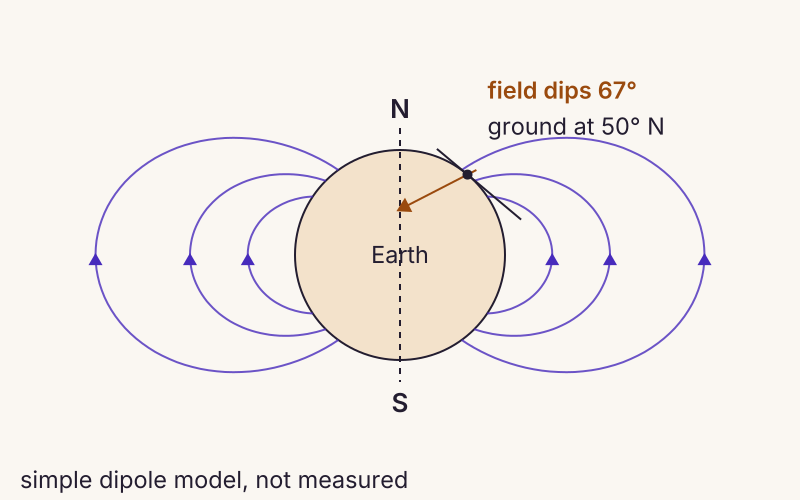
Side view of a simple dipole model, not measured: at 50 degrees north the field lines enter the ground at about 67 degrees, the kind of slope an inclination compass reads.
How the figure was made simple dipole model; field lines r = L cos^2(latitude), L = 1.45, 2.0, 2.9; dip at 50 N: tan(I) = 2 tan(50 deg), I = 67 deg
"Dipole field lines, side view" by Animal Brainwork, https://animalbrainwork.com/extra-senses/magnetoreception/. Licensed under CC BY 4.0: https://creativecommons.org/licenses/by/4.0/
Data: site computation
How does the tilt change from place to place?
The tilt is called inclination, or dip. It is 0 degrees where the field runs level and 90 degrees where it points straight down. A simple dipole model follows one rule: tan(inclination) = 2 tan(latitude). The lines run level at the equator, dip about 67 degrees at 50 degrees north, and stand upright at the poles.
Earth's real field is lumpier. The chart below sets the dipole curve against five cities, with values from the World Magnetic Model 2025, developed by NOAA's National Centers for Environmental Information and the British Geological Survey.
Singapore sits just north of the equator, yet its field points 12.7 degrees upward, where the dipole rule gives a slight downward 2.7. New York's field dips 5.7 degrees more steeply than the dipole predicts.
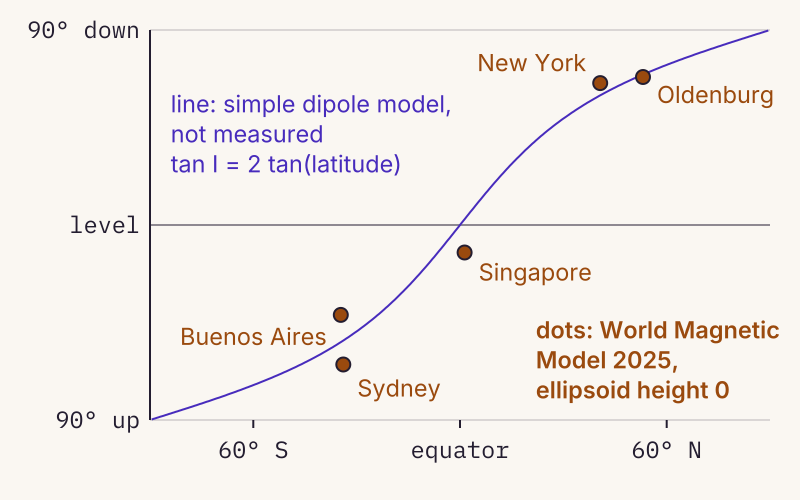
Field-line dip by latitude: the simple dipole model, not measured (line), against the World Magnetic Model 2025, at zero height above the reference ellipsoid (close to sea level), for five cities (dots). World Magnetic Model values computed here match all 12 official NCEI test values (inclination within 0.005 degrees). The model is from NOAA NCEI and the British Geological Survey; the U.S. Government material in it is not subject to copyright protection in the United States (17 U.S.C. 403 notice).
How the figure was made tan(I) = 2 tan(latitude); WMM 2025 at zero height above the reference ellipsoid (close to sea level), 2026.9; Oldenburg, New York, Singapore, Buenos Aires, Sydney
"Magnetic dip by latitude" by Animal Brainwork, https://animalbrainwork.com/extra-senses/magnetoreception/. Licensed under CC BY 4.0: https://creativecommons.org/licenses/by/4.0/
Data: World Magnetic Model 2025, NOAA NCEI and British Geological Survey; the U.S. Government material in it is not subject to copyright protection in the United States (17 U.S.C. 403 notice), https://www.ncei.noaa.gov/products/world-magnetic-model; dipole curve: site computation
Dip at zero height above the reference ellipsoid (close to sea level) for 2026.9, computed for this page (positive means the field points down; the dipole column is a simple dipole model, not measured):
| City | Latitude | WMM 2025 dip | Dipole dip | WMM minus dipole |
|---|---|---|---|---|
| Oldenburg, Germany | 53.14° N | 68.3° | 69.5° | −1.2° |
| New York, USA | 40.71° N | 65.5° | 59.8° | 5.7° |
| Singapore | 1.35° N | −12.7° | 2.7° | −15.4° |
| Buenos Aires, Argentina | 34.60° S | −41.5° | −54.1° | 12.6° |
| Sydney, Australia | 33.87° S | −64.4° | −53.3° | −11.1° |
This table as CSV (dip-0003-cities.csv) (source and license notes) Data: World Magnetic Model 2025, NOAA NCEI and British Geological Survey; the U.S. Government material in it is not subject to copyright protection in the United States (17 U.S.C. 403 notice), https://www.ncei.noaa.gov/products/world-magnetic-model
The dipole curve itself, one row per 10 degrees of latitude, is in a separate file.
This table as CSV (magnetoreception-dipole-curve.csv) (source and license notes) Data: site computation
How the model values were checked is set out in Tracing each claim. Whether the same tilt can serve an animal as a map, not only a compass, is taken up in Sea Turtle Navigation.
Why does the compass need light?
For the light tests, the cages stood inside a cylinder topped with light-emitting diodes. Robins and other songbirds held their migratory heading under 373-nanometer ultraviolet, 424 blue, 502 turquoise and 565 green light. Under 590 yellow and 635 and 645 red light, they were disoriented, according to the review.
The working light was dim. Under blue, turquoise and green, it matched a clear evening about 45 minutes after sunset at 50 degrees north, and the ultraviolet was dimmer still. Under brighter narrow-band light, the birds' responses were no longer controlled by the inclination compass. In darkness, migratory birds could no longer orient in their migratory direction.
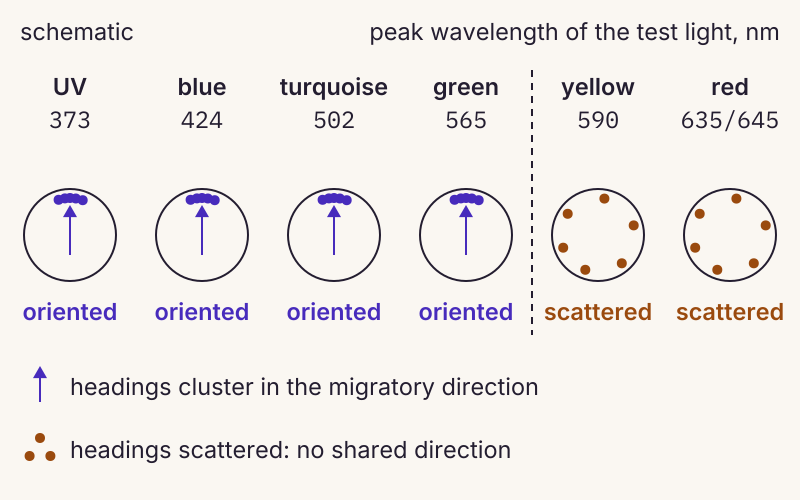
A schematic of the light tests described in the 2014 review: robins kept a migratory heading under ultraviolet, blue, turquoise and green light and lost it under yellow and red.
How the figure was made schematic; robins tested in round cages under narrow-band light; oriented: 373, 424, 502, 565 nm; disoriented: 590, 635, 645 nm; light about 8 x 10^15 quanta/s/m^2 (UV 0.8 x 10^15); dot positions illustrative
The figure in words
- Ultraviolet, 373 nm: oriented in the migratory direction.
- Blue, 424 nm: oriented.
- Turquoise, 502 nm: oriented.
- Green, 565 nm: oriented.
- Yellow, 590 nm: disoriented.
- Red, 635 and 645 nm: disoriented.
"Light color and the robin's magnetic compass" by Animal Brainwork, https://animalbrainwork.com/extra-senses/magnetoreception/. Licensed under CC BY 4.0: https://creativecommons.org/licenses/by/4.0/
Data: Wiltschko R, Wiltschko W (2014), Sensing magnetic directions in birds, Biosensors 4(3): 221-242, CC BY 3.0, https://pmc.ncbi.nlm.nih.gov/articles/PMC4264356/
The radical-pair model
The review favors the radical-pair model. Light hits a receptor molecule and moves an electron. That leaves a pair of molecules with unpaired electrons, called a radical pair. The balance between the pair's two spin states depends on how the molecule lines up with the field.
The review points out that this reaction responds to the axis of the field lines, not to their polarity. That matches the inclination compass. The review argues that mechanisms built on permanently magnetic material do not fit, because they respond to polarity.
The candidate molecule is a cryptochrome called Cry1a. It sits in the cones that sense ultraviolet in robins and violet in chickens. These cones make up only about 9 percent of the cones. In chickens, Cry1a showed up in its activated form after ultraviolet, blue and turquoise light, in smaller amounts after green and yellow, and not after red.
Because the proposed sensor sits in the eye, a popular phrase says that birds “see” the field. That phrase is a borrowed umwelt: this site's name for the human assumptions that slip in when another animal's world, its umwelt, is pictured through human senses. The review describes a pattern of chemical products spread across the retina. It also states that how this signal is kept apart from vision, and handled in the brain, was still unclear.
Can weak radio waves upset the compass?
The review describes radio-frequency fields in the megahertz range as a diagnostic test for radical pairs. Such fields can interfere with the spin states. In the tests the review describes, fields of 1.315 and 7 megahertz at 470 nanotesla were added to the Frankfurt field.
Added parallel to the field lines, these fields left orientation intact. Added at 24 or 48 degrees to the lines, they left the robins disoriented. The same field disrupted the birds or not depending on its angle, so the review rules out a general disturbance.
The sharpest result came at 1.315 megahertz, the electron's Larmor frequency in the local field. There, a field of only 15 nanotesla, about one three-thousandth of the 46-microtesla background field, disrupted orientation. When the static field was doubled to 92 microtesla, the sensitive frequency moved to 2.63 megahertz. The review reads these results as support for a radical-pair mechanism, not as proof of one.
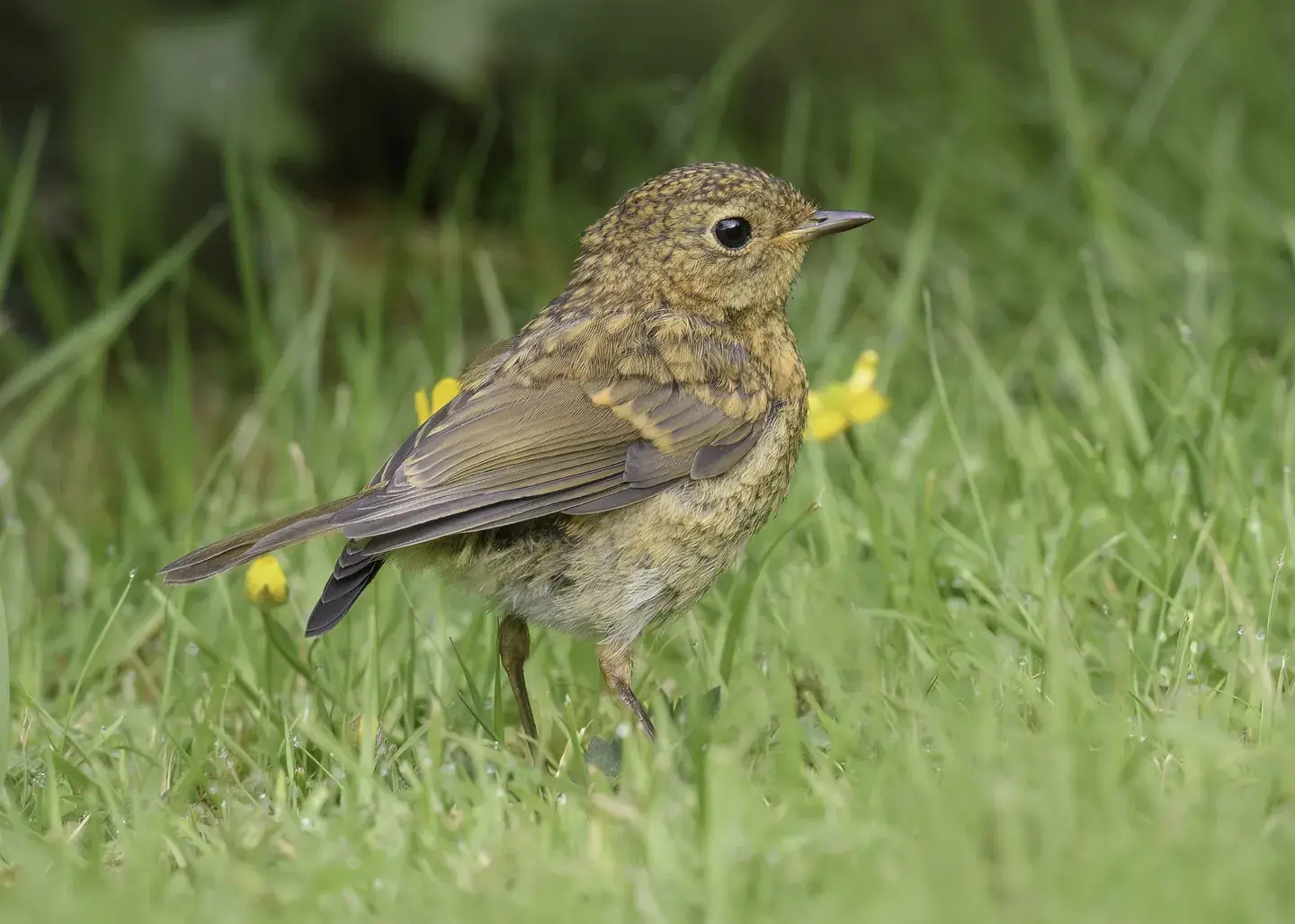
A young European robin in speckled plumage; according to the file page, a juvenile. The radio-frequency tests in the review used caged migrants.
"European Robin - Erithacus rubecula - Juvenile" by caroline legg — https://commons.wikimedia.org/wiki/File:European_Robin_-_Erithacus_rubecula_-_Juvenile.jpg — CC BY 2.0 (https://creativecommons.org/licenses/by/2.0/); modified: resized to 1440 px wide and converted to WebP
The review notes a magnetic compass in more than 20 other bird species, and in members of all vertebrate classes, insects, crustaceans and mollusks. Other senses humans lack work on other principles: one, as a 2010 study of pit vipers showed, is tuned to heat, and another works by touch at the tip of a nose.
The compass tests above come from caged songbirds, mostly robins, tested at one site in Frankfurt. The receptor findings come from the eyes of chickens and robins. The review adds that magnetoreception is not one uniform mechanism, even among vertebrates, so the robin's light-dependent inclination compass may belong to birds alone.
Still unsettled
- Where does the magnetic signal begin and end? Cry1a in the ultraviolet- and violet-sensitive cones is the review's leading candidate. But as of the 2014 review, how a radical pair turns into a nerve signal was still speculation, and where the brain processes the direction was poorly known.
- Why does yellow light activate Cry1a but not the compass? In chickens, some Cry1a was activated under yellow light, yet robins tested under yellow did not orient. The review states that the reasons are unclear.
- How does the magnetic compass share the work with the sky on a real migration? Cage tests isolate one cue at a time. The review read here covers the magnetic compass alone, not how it is weighed against the star compass or the sun in flight.
Studies cited
- Wiltschko R, Wiltschko W (2014). Sensing magnetic directions in birds: radical pair processes involving cryptochrome. Biosensors 4(3): 221–242. doi:10.3390/bios4030221 pmc.ncbi.nlm.nih.gov/articles/PMC4264356/Read as: full text; review read in full (PMC version)Text license:CC BY 3.0 (terms)
- NOAA NCEI Geomagnetic Modeling Team; British Geological Survey (2024). World Magnetic Model 2025. NOAA National Centers for Environmental Information. doi:10.25921/aqfd-sd83. The U.S. Government material in it is not subject to copyright protection in the United States (17 U.S.C. 403 notice). www.ncei.noaa.gov/products/world-magnetic-modelRead as: full text; product page and official test values
Cite this page
“Magnetoreception: In Cage Tests, Robins Read Field-Line Tilt.” Animal Brainwork, published November 24, 2026. https://animalbrainwork.com/extra-senses/magnetoreception/. Accessed the day you read it.
How each claim is traced Retrials: every correction, dated Report an error on this page (contact@animalbrainwork.com)
Nearby questions in Extra Senses
Sense and mechanism
Ampullae of Lorenzini: Tank Rays Turned at 5 to 80 nV per cm
Picture credit
"Squalus canicula (Ichthyologie, plate 112)" by Marcus Elieser Bloch — https://commons.wikimedia.org/wiki/File:Ichthyologie;_ou,_Histoire_naturelle_des_poissons_(Plate_112)_(6918377788).jpg — Public domain (published 1796 in Bloch's Ichthyologie, ou Histoire naturelle des poissons; public domain in the US (published before 1931); EU: Bloch's death year not verified from a library or Project Gutenberg catalog record, so this rests on publication in 1796 and the file page's PD-old-100-expired tag; scan tagged PD-scan (and CC BY 2.0) on the file page; upstream not traced); modified: cropped (box 110,335,2190,1110 of the 2,283 x 1,342 px original) to remove the plate number, the title lettering at top right and the engraver's line at bottom left; the whole fish is inside the crop, padded above and below with a flat fill of the plate's paper color (RGB 235,221,174, the median of the crop's outer rows; 24 edge rows blended into it) to 3:2 (2,080 x 1,387 px); the plate itself is not retouched, resized to 1600 x 1067 px WebP
Sense and mechanism
Can Snakes See Infrared? A 2010 Study Traced It to Heat
Picture credit
"Western Diamondback Rattlesnake (Crotalus atrox) in New Mexico" by Gary Stolz, U.S. Fish and Wildlife Service — https://commons.wikimedia.org/wiki/File:Crotalus_atrox_USFWS.jpg — Public domain (work of a US federal employee (U.S. Fish and Wildlife Service) made in the course of official duties, 17 U.S.C. §105; file page template PD-USGov-FWS; outside the US: rests on the same federal public-domain status as tagged on the file page, no separate agency statement read; upstream not traced (USFWS National Digital Library)); modified: the Commons file is a version edited from Gary Stolz's original by Pharaoh Hound (uploaded 25 November 2006, per the file page), cropped to 3:2 (1299 x 866, centered; 8 px off the top and 9 px off the bottom, 1 px off the right edge) for the card; saved as WebP, no resizing
Sense and mechanism
Star-Nosed Mole: The Star on Its Nose Is a Touch Organ
Picture credit
"Star-nosed mole, Condylura cristata (Wild Animals of North America, page 563), card crop" by Louis Agassiz Fuertes, in E. W. Nelson, Wild Animals of North America (National Geographic Society, 1918); scan from the Biodiversity Heritage Library — https://commons.wikimedia.org/wiki/File:Condylura_cristata_(Wild_animals_of_North_America_-_Page_563).jpg — Public domain (published 1918 in E. W. Nelson's Wild Animals of North America (National Geographic Society, Washington); public domain in the US (published before 1931); EU: the painter, Louis Agassiz Fuertes, died in 1927 per the Project Gutenberg catalog record for this book (eBook #59475: Fuertes, Louis Agassiz, 1874-1927, illustrator), so the life-plus-70 term ended at the end of 1997; file page also tags PD-old-70-expired and PD-scan; upstream not traced); modified: crop of the whole plate star-nosed-mole-fuertes-1918 (the page's first image): cropped to 3:2 (1080 x 720 px from the 1158 x 845 px file) to remove the printed plate title and the plate border; saved as WebP; no color change