Dung Beetle Milky Way: One Species Shown Using It as of 2017
In one sentence
African ball-rolling dung beetles can roll straight by the Milky Way: in planetarium tests described in a 2013 abstract, the band alone worked as well as a full starry sky, and a 2017 study suggests they compare its brighter and dimmer arms.
- How it was asked
- Marie Dacke and colleagues, 2013, according to the abstract: would ball-rolling dung beetles hold a straight path in a planetarium when only the Milky Way was shown?
- Key study read as
- abstract or record Dacke et al. 2013, Current Biology (university repository record)
- Sample
- not stated in the 2013 abstract; 20 to 40 beetles per test condition in the 2017 light tests
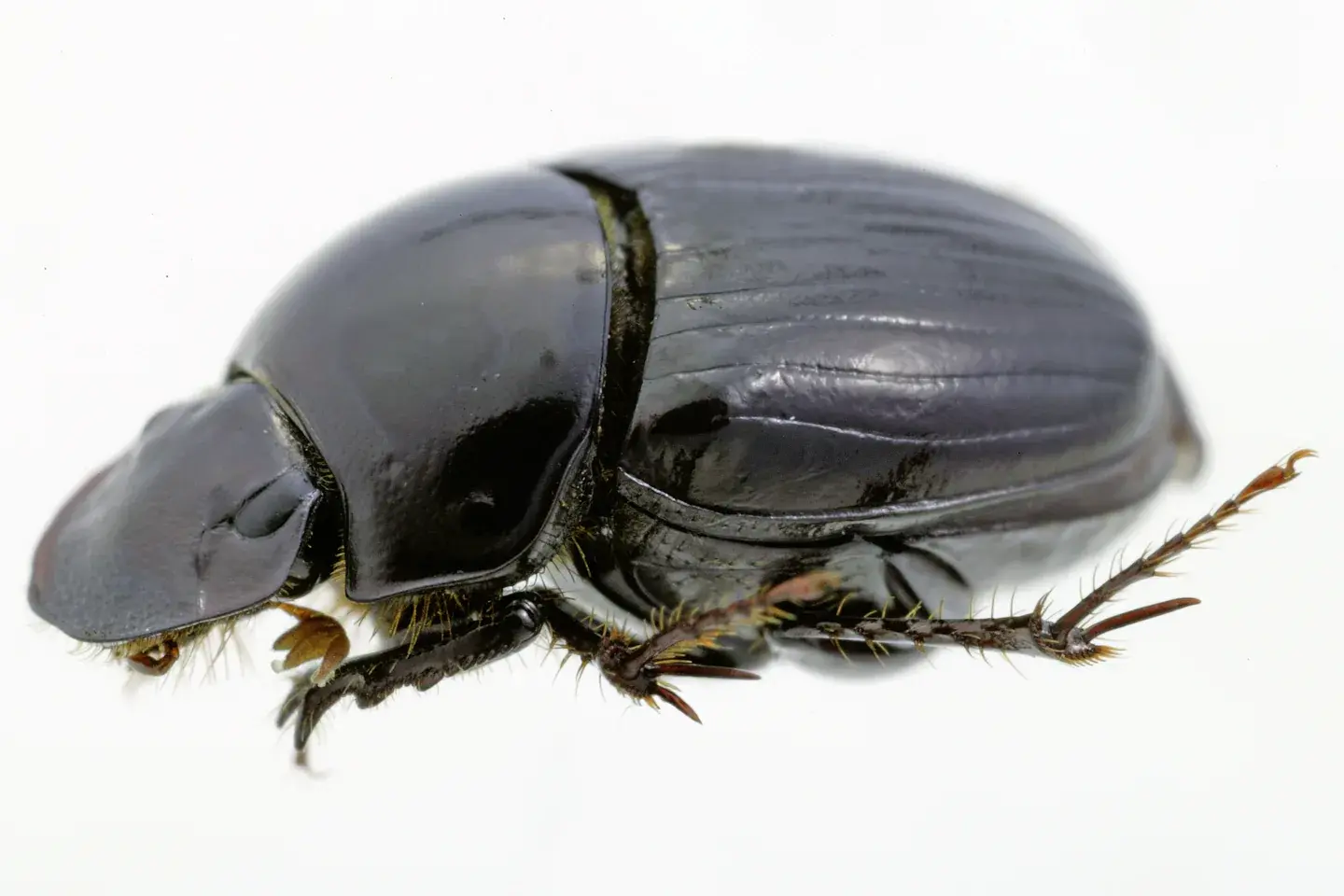
A dung beetle photographed on a white background, Onthophagus chepara as named on the photo's file page: a different genus from the ball-rolling beetles in the Milky Way tests.
“Onthophagus chepara - Dung Beetle”, David McClenaghan / CSIRO; CC BY 3.0.
Full credit
"Onthophagus chepara - Dung Beetle" by David McClenaghan / CSIRO — https://commons.wikimedia.org/wiki/File:CSIRO_ScienceImage_273_Onthophagus_chepara_Dung_Beetle.jpg — CC BY 3.0 (https://creativecommons.org/licenses/by/3.0/); modified: side margins cropped to 3:2 (2194 x 1463 px from the 2338 x 1463 file; whole beetle kept), downscaled to 1440 x 960 px WebP, cropped by Materialscientist: the current Commons version, uploaded by Materialscientist on 20 September 2014 (comment "crop"), crops the 2,657 x 1,768 px CSIRO upload of 17 September 2014 (File Upload Bot) to 2,338 x 1,463 px, per the file history; that version is the one used
Only one animal had been shown to steer by the Milky Way as of 2017: a nocturnal dung beetle. A 2017 study by James Foster and colleagues in Philosophical Transactions of the Royal Society B described the beetle Scarabaeus satyrus, at that time, as “the only animals that have been demonstrated to use the Milky Way” for reliable orientation.
The beetle does not use the band for a long journey. It uses it for a few minutes, to push a ball of dung away from a crowded pile in a straight line.
The planetarium tests were published earlier, in 2013. According to the abstract of that study, by Marie Dacke and colleagues in Current Biology, the beetles oriented equally well in a planetarium under a full starry sky and under a sky with only the Milky Way. The 2017 study asked what in the band the beetles use, and its light tests pointed to brightness: one part of the band is brighter than another.
Why does a dung beetle roll in a straight line?
At a fresh dung pile, a ball-rolling beetle shapes a ball and rolls it in a straight line away from the pile and from competing beetles, according to the 2017 paper. Once it is far enough away, it buries the ball and eats it undisturbed. Both sexes feed this way.
The abstract of the 2013 study gives the same reason in brief: straight paths take the beetles away from heavy competition at the dung pile. In the schematic below, a path of the same length that keeps curving ends much closer to the pile.
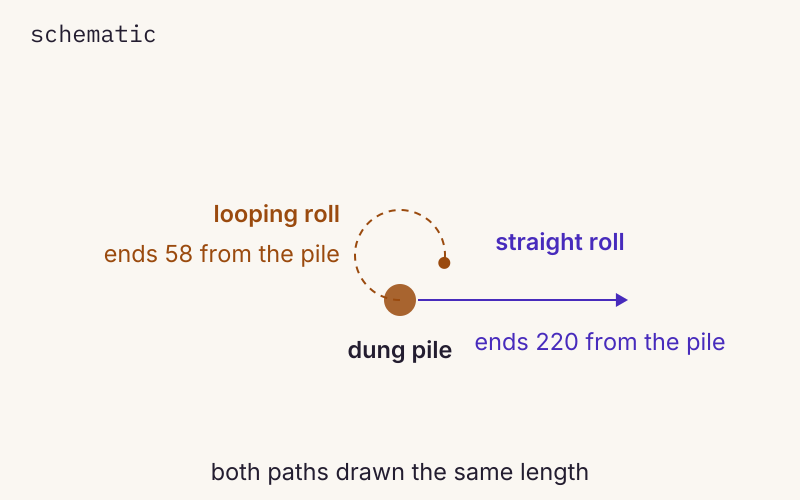
A schematic, not data: two paths of the same drawn length leave a dung pile, and only the straight one carries the ball well away from it.
How the figure was made schematic, not data; pile at center; both paths 220 units long; straight path ends 220 units out; looping path turns at constant radius 45 and ends 58 units from the pile, 2 x 45 x sin(220 / 90)
The figure in words
- Both paths start at the dung pile and are drawn the same length, 220 units.
- The straight roll ends 220 units from the pile.
- The looping roll keeps turning and ends 58 units from the pile.
"Straight roll versus looping roll" by Animal Brainwork, https://animalbrainwork.com/navigators/dung-beetle-milky-way/. Licensed under CC BY 4.0: https://creativecommons.org/licenses/by/4.0/
Data: site computation
The beetles already have several sky cues for this. The 2013 abstract lists the sun, the moon and the pattern of polarized light in the sky, and says many beetles still roll straight on clear moonless nights. An earlier paper by Dacke and colleagues, on insect orientation to polarized moonlight, appeared in Nature in 2003 bibliographic; this page has seen only its reference entry.
What happened under the planetarium sky?
Read the planetarium as a question put to the beetles, as a figure of speech only: which part of the night sky is enough? According to the abstract of the 2013 study, the beetles rolled along straight paths under a starlit sky and lost that ability under overcast skies. In the planetarium, they oriented equally well with a full starry sky and with only the Milky Way showing.
The abstract calls this the first documented use of the Milky Way for orientation by any animal. It also names birds, seals and humans as the only animals known before then to use stars.
This page has read only that abstract, kept in a university repository record, because the journal's own site is not one this site reads. The abstract gives no sample sizes, error angles or details of the planetarium, so none appear here.
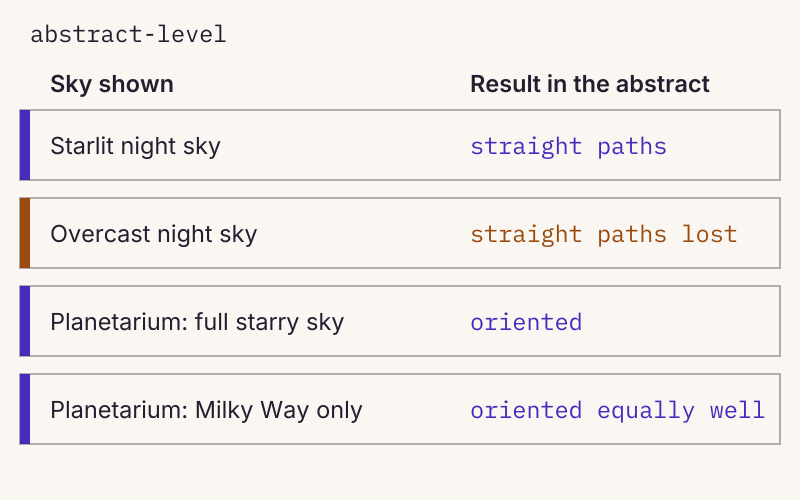
The four sky conditions named in the abstract of the 2013 study by Dacke and colleagues, with the result the abstract reports for each; abstract-level, so no numbers are drawn.
How the figure was made abstract-level; four sky conditions and results as worded in the abstract of Dacke et al. 2013; no values drawn
The figure in words
| Sky shown (abstract-level, Dacke et al. 2013) | Result as the abstract states it |
|---|---|
| Starlit night sky | Rolled along straight paths |
| Overcast night sky | Lost the ability to roll straight |
| Planetarium, full starry sky | Oriented |
| Planetarium, Milky Way only | Oriented as well as under the full starry sky |
"Sky conditions in the 2013 dung beetle tests" by Animal Brainwork, https://animalbrainwork.com/navigators/dung-beetle-milky-way/. Licensed under CC BY 4.0: https://creativecommons.org/licenses/by/4.0/
Data: Dacke et al. 2013, Current Biology 23(4): 298-300, abstract as kept in the Lund University Publications record
How can a band of light work as a compass?
“Compass” is a comparison here, not an organ. The puzzle, as the 2017 paper set it out, is symmetry. On moonless nights in South Africa the main band of the Milky Way often crosses the zenith, the point straight overhead, so it looks much the same from either end. A beetle reading only its shape could end up rolling 180 degrees the wrong way.
Foster's team first measured the real sky. Calibrated fisheye photographs taken at a field site in South Africa, blurred to match a range of possible beetle eyesight, showed the southern arm of the band brighter than the northern arm. In all but one of the blurred images, the largest difference sat near a bright patch around the constellation Crux, with peak contrasts between 12.6 and 41.1 percent depending on the blur.
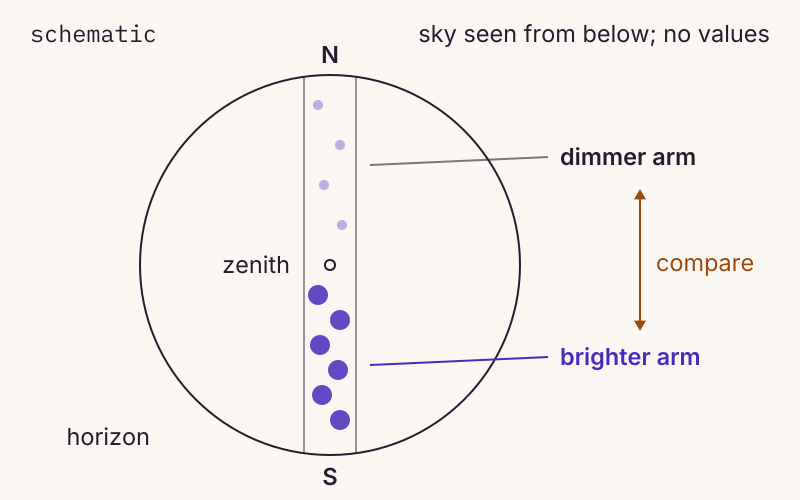
A schematic of the night sky seen from below with the Milky Way crossing overhead: the 2017 study suggests the beetles compare the brighter arm with the dimmer one. It shows the principle only, with no measured values.
How the figure was made schematic; sky as a circle with the horizon at its edge; band north-south through the zenith; south arm drawn brighter than north arm; no values from Foster et al. 2017 drawn
The figure in words
- The circle is the night sky seen from below, with the horizon at its edge and the zenith at its center.
- The Milky Way band runs north to south through the zenith.
- The southern arm is drawn brighter than the northern arm; an arrow between the labels marks the comparison.
"Two arms of the Milky Way band compared" by Animal Brainwork, https://animalbrainwork.com/navigators/dung-beetle-milky-way/. Licensed under CC BY 4.0: https://creativecommons.org/licenses/by/4.0/
Data: site computation
What did the light tests show?
Next came tests in a 1-meter arena under artificial lights, in Sweden and South Africa, with 20 to 40 beetles per condition. Each beetle rolled twice, and in most tests the light display was turned between the two rolls. Two equally bright lights on opposite sides left the beetles no better oriented than no lights at all. When one of the pair was about ten times dimmer than the other, the beetles held their heading.
Bands of lights arranged in distinct patterns, with both sides about equally bright, did not orient them either. A band lit on one side only did.
Other trials varied how much brighter one side was. Beetles stayed clearly oriented at a contrast of 20.6 percent and above but not at 9.5 percent or below, and a fitted curve put the threshold near 13 percent. That is below the contrast the photographs showed between the two arms of the real Milky Way at all blur levels but the coarsest, where the two were about equal.
The authors propose that during its short orientation dance on top of the ball, a beetle records the direction of the brightest point or of the strongest brightness difference, then keeps matching it while it rolls. Their tests could not tell those two strategies apart. The paper adds that the beetle's eyes probably cannot resolve the gaps between bright stars in the band, so broad patches of light are what it has to work with.
How do other star users differ?
According to the same paper, migrating birds have been shown to orient to the sky's center of rotation, which they recognize from the stars there, and harbor seals can learn to swim toward a single star. The paper describes both as proposed pattern-matching strategies, suited to longer travel; night-migrating birds read the sky in that different way. A beetle's roll lasts minutes, during which the Milky Way barely turns.
By day, the paper notes, sun-based orientation has been studied in butterflies and bees, the subjects of monarch butterfly migration and the waggle dance. Some navigators do not look up at all, as sea turtle navigation shows.
What these studies support is narrow. One beetle species was tested in arenas and a planetarium, and the central 2013 result is read here only from an abstract. In the 2017 light tests, the lowest error on the fitted curve, about 59 degrees, was far larger than the beetles' errors under the real Milky Way, which the authors suggest may mean the beetles combine more than one cue. Why some night insects circle street lamps is a separate line of evidence and is not covered here.
Still unsettled
- Does the beetle steer by a brightest point or by a brightness gradient? The 2017 tests could not separate the two, and the authors call for experiments that hide parts of the real band and add artificial lights.
- Do other night-active insects steer by the stars? The 2017 paper lists star orientation as implied, with the strategy unclear, in one moth, the yellow underwing; as of November 2026 this site has not read a full study showing it in another insect.
- How does a beetle do under a light-polluted sky? The 2017 sky analysis blacked out everything below 20 degrees of elevation, including glow from distant settlements, so it gives no answer, and the 2013 abstract does not address it.
Studies cited
- Foster JJ, el Jundi B, Smolka J, Khaldy L, Nilsson D-E, Byrne MJ, Dacke M (2017). Stellar performance: mechanisms underlying Milky Way orientation in dung beetles. Philosophical Transactions of the Royal Society B 372(1717): 20160079. doi:10.1098/rstb.2016.0079 pmc.ncbi.nlm.nih.gov/articles/PMC5312028/Read as: full text; read in full (PMC version); paraphrased, one short quotation
- Dacke M, Baird E, Byrne M, Scholtz CH, Warrant EJ (2013). Dung beetles use the Milky Way for orientation. Current Biology 23(4): 298-300. doi:10.1016/j.cub.2012.12.034 lup.lub.lu.se/record/3438257Read as: abstract or record; repository record summary only (Lund University Publications)
- Dacke M, Nilsson D-E, Scholtz CH, Byrne M, Warrant EJ (2003). Insect orientation to polarized moonlight. Nature 424: 33. doi:10.1038/424033a doi.org/10.1038/424033aRead as: bibliographic; known from the reference list of Foster et al. 2017
Cite this page
“Dung Beetle Milky Way: One Species Shown Using It as of 2017.” Animal Brainwork, published November 24, 2026. https://animalbrainwork.com/navigators/dung-beetle-milky-way/. Accessed the day you read it.
How each claim is traced Retrials: every correction, dated Report an error on this page (contact@animalbrainwork.com)
Nearby questions in Navigators
Myth, retested
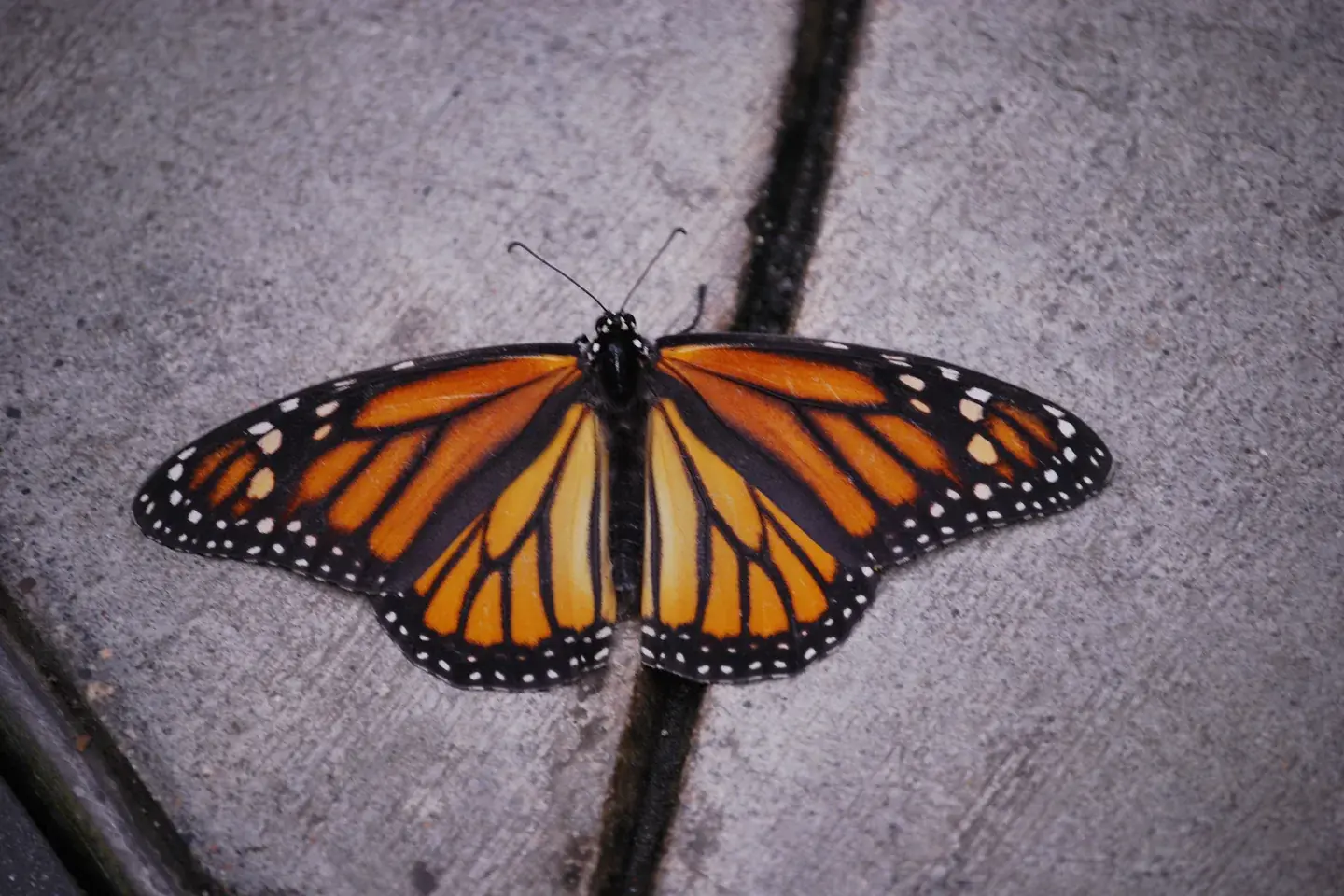
Monarch Butterfly Migration: A Sun Compass on Clock Time
Picture credit
"Monarch butterfly" by Cs california — https://commons.wikimedia.org/wiki/File:Monarch_butterfly.JPG — CC BY 3.0 (https://creativecommons.org/licenses/by/3.0/); modified: cropped to 3:2 (3870 x 2580 px centered in the 3872 x 2592 px original: 1 px off each side, 6 px off top and bottom; butterfly whole), resized to 1440 x 960 px and saved as WebP; no color change
Experiment story
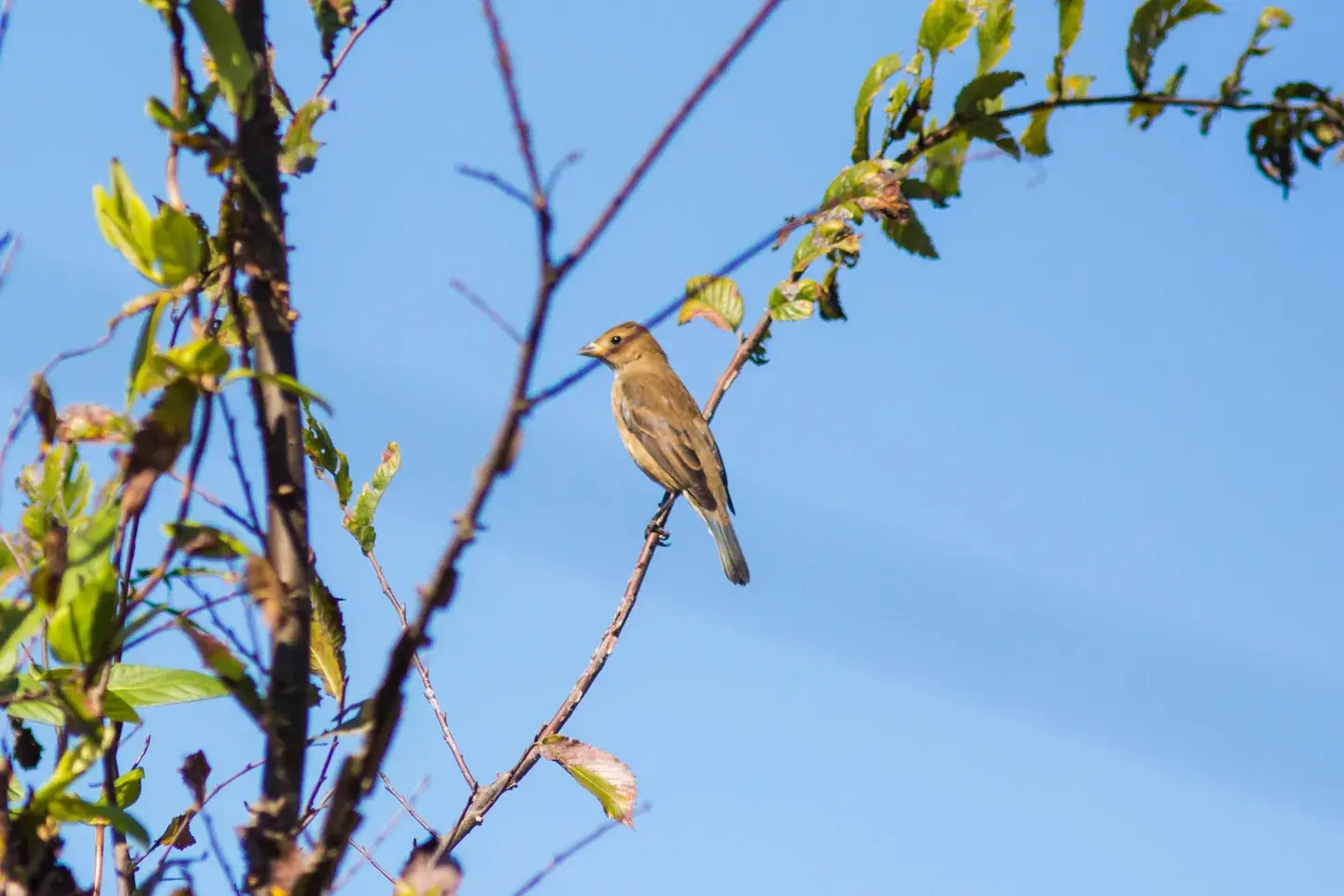
How Do Birds Navigate? A 2017 Review’s No-Clock Star Compass
Picture credit
"Indigo bunting" by Melissa McMasters from Memphis, TN, United States — https://commons.wikimedia.org/wiki/File:Indigo_bunting_(30223488245).jpg — CC BY 2.0 (https://creativecommons.org/licenses/by/2.0/); modified: cropped to 3:2 around the bird (2880 x 1920 px from the 5760 x 3840 original), downscaled to 1440 px wide WebP
Experiment story
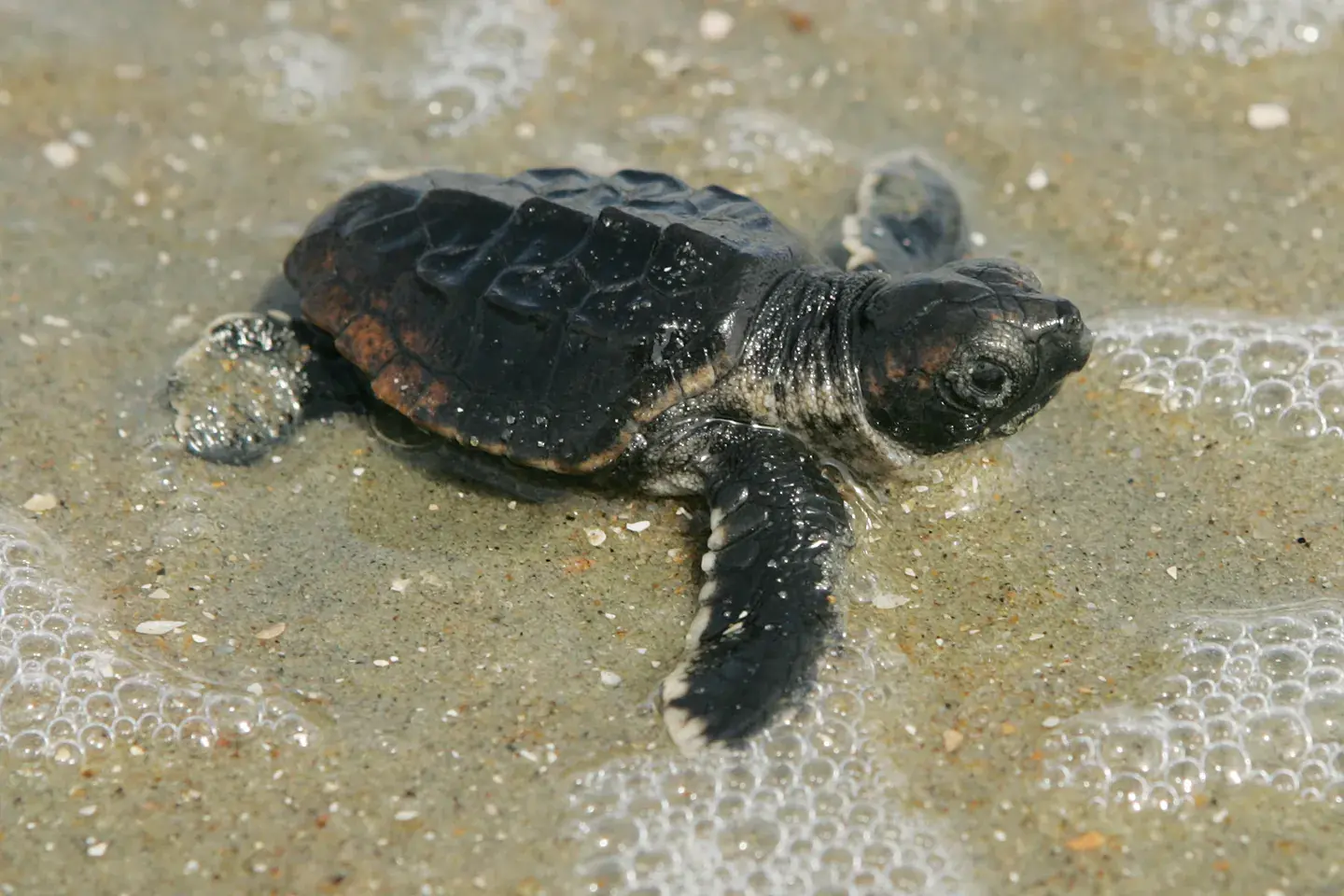
Sea Turtle Navigation: Coil Tests Point to Magnetic Cues
Picture credit
"Loggerhead hatchling at Cape Romain Refuge" by Steve Hillebrand/USFWS — https://www.fws.gov/media/loggerhead-hatchling-cape-romain-refuge-0 — Public domain (work of a US federal employee (U.S. Fish and Wildlife Service) made in the course of official duties, 17 U.S.C. §105; outside the US: the USFWS media page itself lists the license as Public Domain (read 2026-11-23), with the credit Steve Hillebrand/USFWS); modified: cropped to 3:2 (full width, rows 74 to 1426 of 1500), resized to 1440 px wide and saved as WebP