Monarch Butterfly Migration: A Sun Compass on Clock Time
In one sentence
For the eastern North American population, the trip to Mexico and back takes several generations, since USFWS describes four generations over the summer and a migrating super generation that lives up to eight months.
- How it was asked
- USFWS life-cycle account; Mouritsen & Frost 2002 shifted the butterflies' internal clocks and recorded their headings in a flight simulator; Merlin, Gegear & Reppert 2009 tested the antennae.
- Key study read as
- full text USFWS, The phenomenal monarch migration; the 2002 and 2009 studies were also read in full
- Sample
- 59 wild-caught fall migrants in the 2002 flight-simulator tests, in groups of 11 to 18; the 2009 study repeated the clock-shift result, not the overcast test
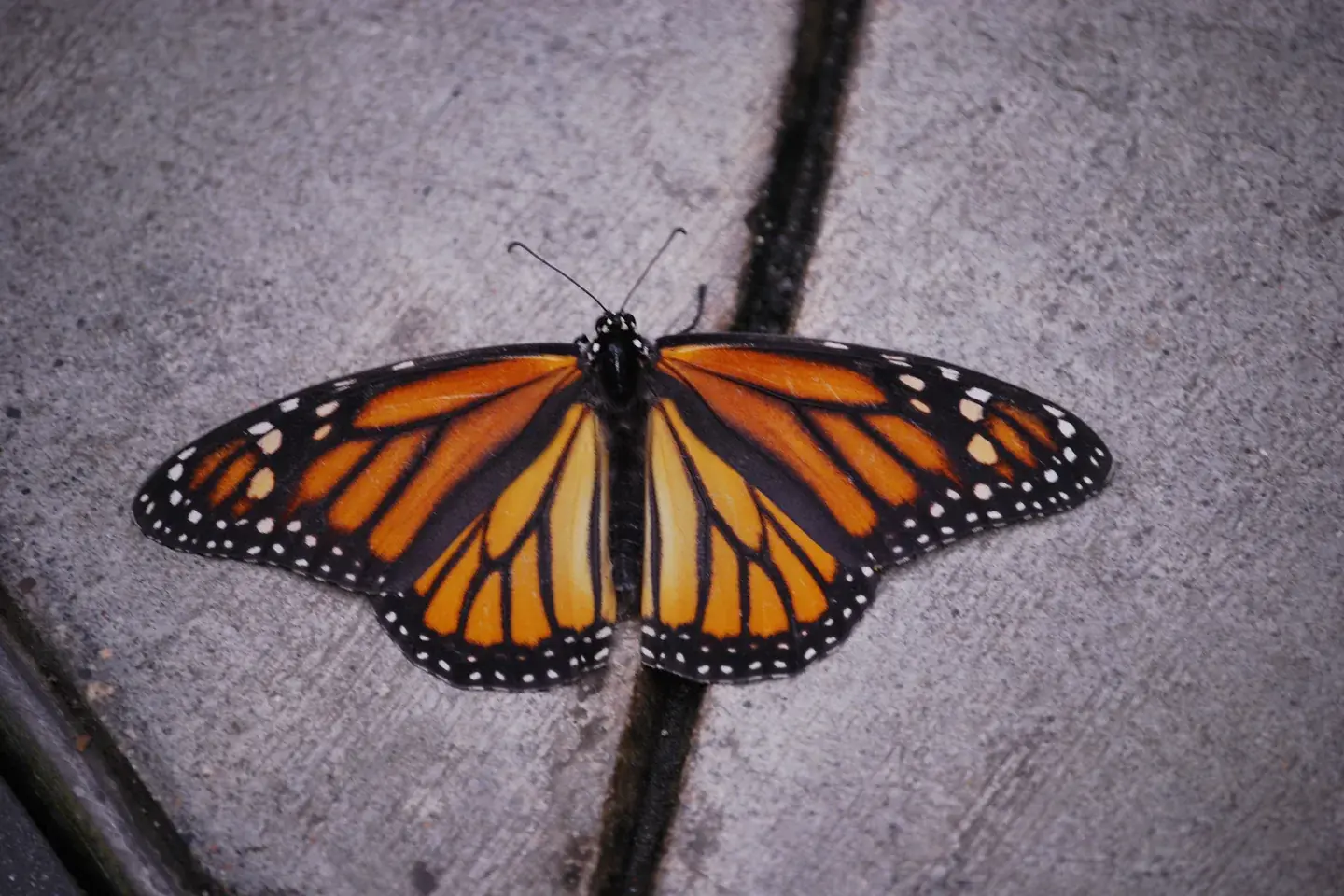
A monarch butterfly (Danaus plexippus) with its wings spread on pavement. According to the file page it was photographed at the Conservatory of Flowers in 2008, so it is not known to be a migrant.
"Monarch butterfly" by Cs california — https://commons.wikimedia.org/wiki/File:Monarch_butterfly.JPG — CC BY 3.0 (https://creativecommons.org/licenses/by/3.0/); modified: cropped to 3:2 (3870 x 2580 px centered in the 3872 x 2592 px original: 1 px off each side, 6 px off top and bottom; butterfly whole), resized to 1440 x 960 px and saved as WebP; no color change
The monarchs that head south each fall can live up to eight months. Their parents and grandparents lived far shorter lives: the U.S. Fish and Wildlife Service (USFWS) says each earlier summer generation completed its life cycle in four weeks full text. So does one butterfly fly the whole loop, from the summer range to Mexico and back? In the USFWS account, no. The round trip is a relay across generations.
The fall migrants also need a heading. They take it from the sun and correct for the time of day, which biologists call a time-compensated sun compass. Treat “compass” as a comparison for what the butterfly does, not an organ it has.
Does one monarch make the round trip?
The USFWS story lays out the relay for the monarchs that winter in Mexico. Each earlier generation completed its life cycle in four weeks and moved north, “resulting in four generations over the course of the summer.” The last generation is the one “that migrates south, often called the monarch super generation.”
Shorter days, cooler temperatures and aging food sources trigger that switch, according to USFWS. The super generation stores fat, waits until spring to mate, and lives “up to eight months,” which the agency puts at eight times longer than its parents and grandparents.
The agency gives the flight south as more than 3,000 miles (about 4,800 km) at about 50 miles a day, so on those two figures it takes on the order of 60 flying days. The two research papers below give shorter figures: more than 3,500 km for some journeys (2002) and up to 4,000 km (2009).
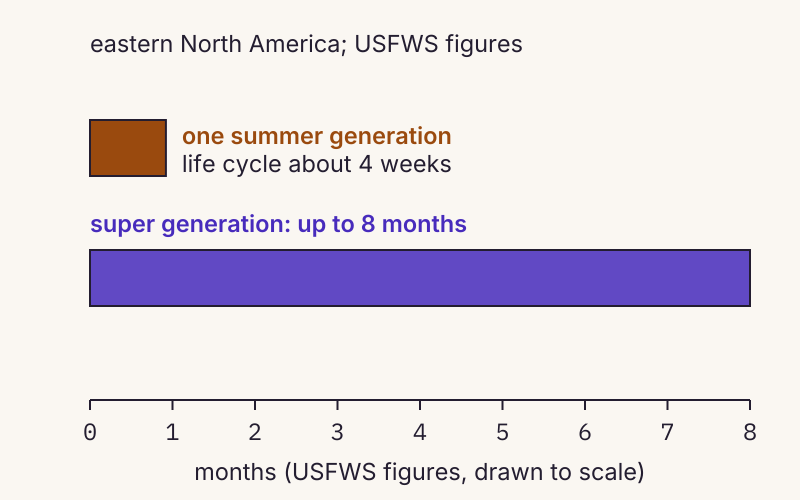
Lifespans drawn to scale from USFWS figures for the eastern North American population: one summer generation completes its life cycle in about four weeks, while the migrating super generation lives up to eight months.
How the figure was made bar lengths from USFWS: summer generation life cycle 4 weeks (28 days), super generation up to 8 months; 1 month = 30.44 days; eastern North American population
"Summer generation and super generation lifespans" by Animal Brainwork, https://animalbrainwork.com/navigators/monarch-migration/. Licensed under CC BY 4.0: https://creativecommons.org/licenses/by/4.0/
Data: U.S. Fish and Wildlife Service, The phenomenal monarch migration (U.S. federal work)
| Generation | Life span in the USFWS account | When |
|---|---|---|
| Each summer generation | life cycle completed in four weeks | spring and summer, moving north |
| Summer generations in all | four over the course of the summer | summer |
| Super generation | up to eight months | flies south from about mid-August; mates in spring |
Download the generations table (CSV) (source and license notes) Data: U.S. Fish and Wildlife Service, The phenomenal monarch migration (U.S. federal work)
The table follows the USFWS story for the eastern North American population. These are the agency's general figures, not counts for a particular year.
Tagging found where the migrants end up. Mouritsen and Frost, in a 2002 paper in PNAS, credit an extensive tagging program with the discovery of the overwintering areas in the mountains of central Mexico full text. The tagging work they cite is by F. A. and N. R. Urquhart in the Canadian Journal of Zoology in 1978 bibliographic. A relay is one answer to a long route; sea turtles that cross an ocean once and come back years later are another.
How do monarchs know which way is south?
The trouble with steering by the sun is that the sun moves. This page computed its bearing with the NOAA GML General Solar Position Calculations for latitude 45 degrees north on September 15. At 9:00 true solar time the sun stood at 122.9 degrees from north; at 15:00 it stood at 237.0 degrees. That is a swing of 114.1 degrees in six hours, fastest near noon (22.0 degrees in each hour either side of it) and slowest early and late (11.5 degrees between 7:00 and 8:00).
A butterfly that kept the sun at one fixed angle would therefore curve across the map. To hold a southwest heading on that date, the angle between its course and the sun has to change by about 114 degrees between 9:00 and 15:00. Mouritsen and Frost worked out the same kind of number for their own test site and dates: 91 to 115 degrees over six hours. The curve below is computed, not observed; never look at the sun to check it.
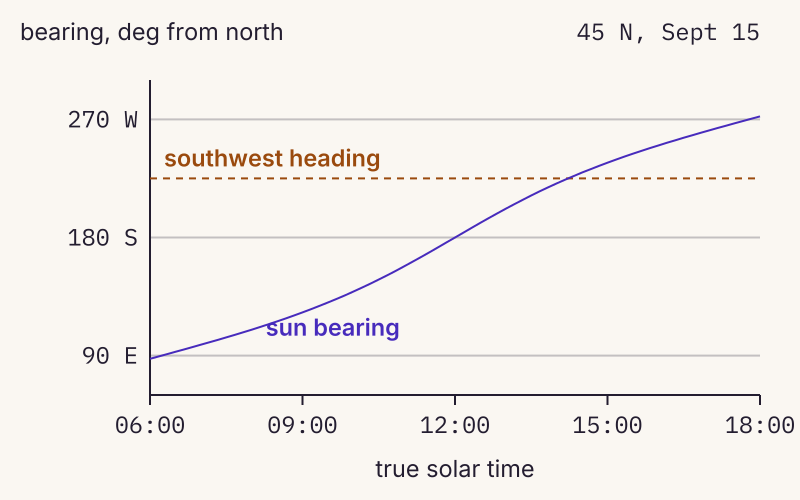
Sun bearing through one day at latitude 45 degrees north on September 15, 2026, computed with the NOAA GML General Solar Position Calculations, against a fixed southwest heading.
How the figure was made NOAA GML solar position; lat=45.0; 2026-09-15; true solar time 06:00-18:00, 10-minute steps; southwest heading 225 deg; NOAA approximate equations, accurate to about 0.5 deg
The figure in words
- 07:00 true solar time: sun at 98.3 degrees, just south of east.
- 09:00: 122.9 degrees.
- 12:00: 180.0 degrees, due south.
- 15:00: 237.0 degrees, just past the southwest heading.
- 17:00: 261.6 degrees, just south of west.
"Sun bearing through one day at 45 degrees north" by Animal Brainwork, https://animalbrainwork.com/navigators/monarch-migration/. Licensed under CC BY 4.0: https://creativecommons.org/licenses/by/4.0/
Data: NOAA Global Monitoring Laboratory, General Solar Position Calculations (U.S. federal work)
Download the hourly sun bearings (CSV) (source and license notes) Data: NOAA Global Monitoring Laboratory, General Solar Position Calculations (U.S. federal work)
Other navigators use other parts of the sky. Some dung beetles steer by the night sky instead of the sun, and migrating birds read the turning sky at night. Honeybees run the same sun-and-clock arithmetic inside a dark hive.
What happens when the butterfly's clock is shifted?
In the fall of 2001, Henrik Mouritsen and Barrie Frost put the question to monarchs directly, in a manner of speaking. They caught 59 migrants on the northern shore of Lake Ontario and flew each one in a flight simulator full text.
The butterfly was tethered to a direction sensor while air blew up from below, so it could fly in place and turn freely. Before the outdoor tests, groups lived indoors for at least five days under lights that matched the local day, ran six hours early, or ran six hours late.
Under sunny skies, butterflies on local time headed southwest, toward the wintering sites (17 butterflies). The group whose clock ran six hours ahead headed southeast (13), and the group six hours behind headed northwest (11). The two shifts, 89 and 110 degrees in opposite directions, matched what a sun compass corrected by an internal clock predicts. Each group was small, but the clock-shift effect turned up again in a separate 2009 study.
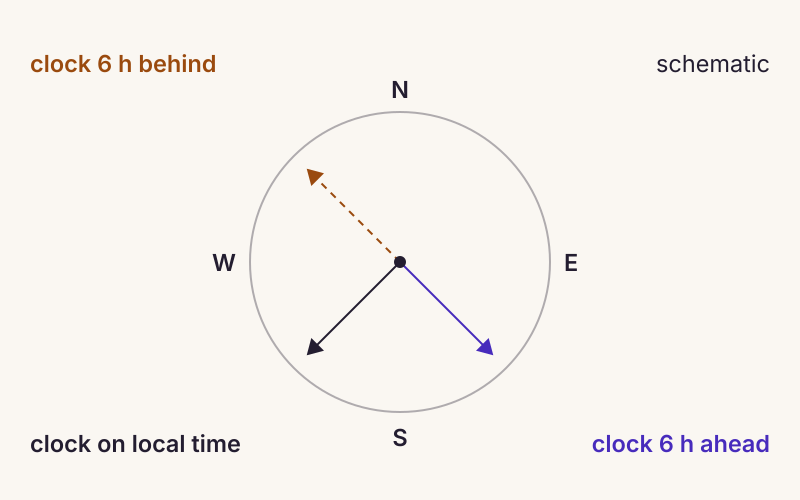
A schematic of the 2002 flight-simulator result: on local time the monarchs headed southwest; a clock set six hours ahead turned the heading toward the southeast, and one set six hours behind turned it toward the northwest.
How the figure was made schematic; arrows at compass octants SW, SE and NW, not the study's mean angles; groups as described in Mouritsen & Frost 2002
The figure in words
- Clock on local time: heading southwest, toward Mexico (17 butterflies).
- Clock six hours ahead: heading southeast (13 butterflies).
- Clock six hours behind: heading northwest (11 butterflies).
"Clock-shifted monarchs change heading" by Animal Brainwork, https://animalbrainwork.com/navigators/monarch-migration/. Licensed under CC BY 4.0: https://creativecommons.org/licenses/by/4.0/
Data: Schematic drawn by this site after the text of Mouritsen & Frost 2002, PNAS 99(15): 10162-10166 (directions only, no study values)
The same apparatus tested for a magnetic compass. Under a translucent cover that imitated full overcast, 18 butterflies showed no shared direction, and turning the magnetic field by 120 degrees produced no matching turn. The authors concluded that these tests gave no evidence that the migrants use a magnetic compass. That negative result rests on one group of 18 and was not repeated in the 2009 study.
Where does the clock sit?
In 2009, Christine Merlin, Robert Gegear and Steven Reppert tested whether the timing comes from the antennae full text. Migrants with the antennae removed still flew steadily one by one. As groups, though, they had no shared heading.
Painting the antennae black, which kept light from reaching them, threw the group heading far off course. Clear paint left both the normal heading and the normal response to a six-hour clock shift in place. The authors read this as evidence that clocks in the antennae likely supply the timing for the sun compass.
These experiments show how a fall migrant holds a southwest bearing through a day of flight. They do not show how it finds particular mountain sites in Mexico. Each study also tested migrants from a single fall, and the generation counts come from a general USFWS account rather than a count for any one year.
Still unsettled
- Does a magnetic sense take over on cloudy days? The 2002 overcast tests found no evidence of a magnetic compass, yet the same paper cites reports of monarchs holding course under clouds and suggests polarized light as one explanation. One apparatus in one season cannot settle it, and later experiments on the question are not covered here.
- How do the butterflies find the exact wintering sites? A sun compass supplies a direction, not a destination, and the studies above measured heading only.
- How many generations does the relay take in a given year? The USFWS figure of four summer generations is a general account; none of the sources here counted generations year by year or region by region.
Studies cited
- Koenig M. The phenomenal monarch migration: the monarch super generation and their phenomenal migration. U.S. Fish and Wildlife Service, Wildlife Wonders story (U.S. federal work). www.fws.gov/story/phenomenal-monarch-migrationRead as: full text
- Mouritsen H, Frost BJ (2002). Virtual migration in tethered flying monarch butterflies reveals their orientation mechanisms. Proceedings of the National Academy of Sciences of the USA 99(15): 10162-10166. doi:10.1073/pnas.152137299 pmc.ncbi.nlm.nih.gov/articles/PMC126641/Read as: full text; read in full (PMC version)
- NOAA Global Monitoring Laboratory, General Solar Position Calculations (U.S. federal work). gml.noaa.gov/grad/solcalc/solareqns.PDFRead as: full text
- Merlin C, Gegear RJ, Reppert SM (2009). Antennal circadian clocks coordinate sun compass orientation in migratory monarch butterflies. Science 325(5948): 1700-1704. doi:10.1126/science.1176221 pmc.ncbi.nlm.nih.gov/articles/PMC2754321/Read as: full text; author manuscript (PMC version)
- Urquhart FA, Urquhart NR (1978). Canadian Journal of Zoology 56: 1759-1764. pmc.ncbi.nlm.nih.gov/articles/PMC126641/Read as: bibliographic; known from the reference list of Mouritsen & Frost 2002
Cite this page
“Monarch Butterfly Migration: A Sun Compass on Clock Time.” Animal Brainwork, published November 24, 2026. https://animalbrainwork.com/navigators/monarch-migration/. Accessed the day you read it.
How each claim is traced Retrials: every correction, dated Report an error on this page (contact@animalbrainwork.com)
Nearby questions in Navigators
Sense and mechanism
Dung Beetle Milky Way: One Species Shown Using It as of 2017
Picture credit
"Onthophagus chepara - Dung Beetle" by David McClenaghan / CSIRO — https://commons.wikimedia.org/wiki/File:CSIRO_ScienceImage_273_Onthophagus_chepara_Dung_Beetle.jpg — CC BY 3.0 (https://creativecommons.org/licenses/by/3.0/); modified: side margins cropped to 3:2 (2194 x 1463 px from the 2338 x 1463 file; whole beetle kept), downscaled to 1440 x 960 px WebP, cropped by Materialscientist: the current Commons version, uploaded by Materialscientist on 20 September 2014 (comment "crop"), crops the 2,657 x 1,768 px CSIRO upload of 17 September 2014 (File Upload Bot) to 2,338 x 1,463 px, per the file history; that version is the one used
Experiment story
How Do Birds Navigate? A 2017 Review’s No-Clock Star Compass
Picture credit
"Indigo bunting" by Melissa McMasters from Memphis, TN, United States — https://commons.wikimedia.org/wiki/File:Indigo_bunting_(30223488245).jpg — CC BY 2.0 (https://creativecommons.org/licenses/by/2.0/); modified: cropped to 3:2 around the bird (2880 x 1920 px from the 5760 x 3840 original), downscaled to 1440 px wide WebP
Experiment story
Sea Turtle Navigation: Coil Tests Point to Magnetic Cues
Picture credit
"Loggerhead hatchling at Cape Romain Refuge" by Steve Hillebrand/USFWS — https://www.fws.gov/media/loggerhead-hatchling-cape-romain-refuge-0 — Public domain (work of a US federal employee (U.S. Fish and Wildlife Service) made in the course of official duties, 17 U.S.C. §105; outside the US: the USFWS media page itself lists the license as Public Domain (read 2026-11-23), with the credit Steve Hillebrand/USFWS); modified: cropped to 3:2 (full width, rows 74 to 1426 of 1500), resized to 1440 px wide and saved as WebP