How Do Birds Navigate? A 2017 Review’s No-Clock Star Compass
In one sentence
As a 2017 review describes it, migratory birds can take a heading at night from the point the whole sky turns around, which marks geographic north, and unlike a heading taken from the sun, this one needs no internal clock.
- How it was asked
- Migratory birds tested in circular orientation cages; the star results are summarized in a 2017 review by Susanne Åkesson and Giuseppe Bianco
- Key study read as
- full text Åkesson & Bianco 2017, Journal of Comparative Physiology A (PMC5522512)
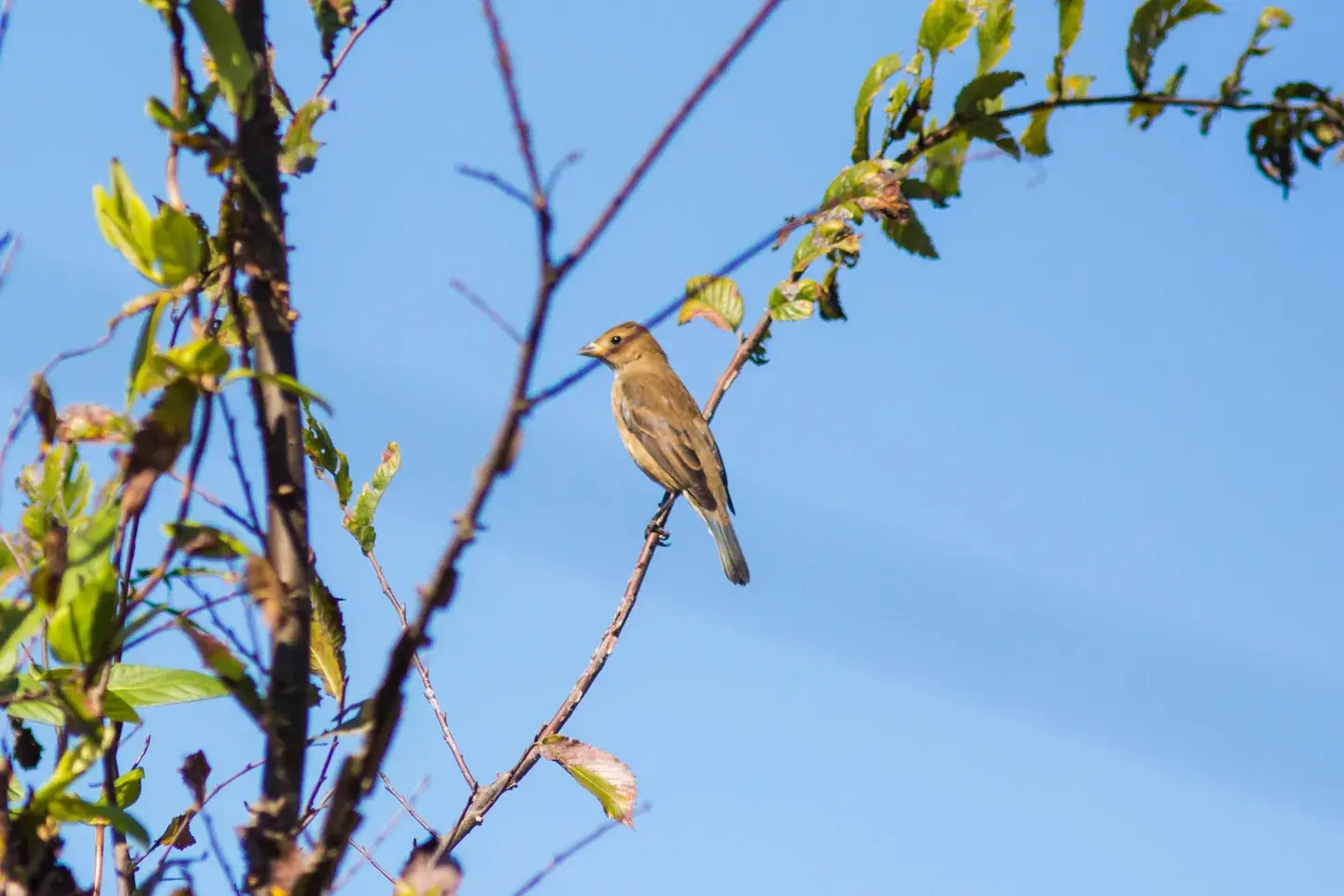
A bird labeled as an indigo bunting on its file page, photographed on October 1, 2016, according to that page: the species named in the title of the 1967 paper discussed below.
"Indigo bunting" by Melissa McMasters from Memphis, TN, United States — https://commons.wikimedia.org/wiki/File:Indigo_bunting_(30223488245).jpg — CC BY 2.0 (https://creativecommons.org/licenses/by/2.0/); modified: cropped to 3:2 around the bird (2880 x 1920 px from the 5760 x 3840 original), downscaled to 1440 px wide WebP
Watch the northern sky for an hour and the stars swing around one nearly fixed point. A window or a familiar yard is enough to see it. Stars close to that point trace small circles, and stars farther out sweep long arcs.
That turning point is the reference migrating birds use at night, according to a 2017 review by Susanne Åkesson and Giuseppe Bianco of Lund University. Researchers call this a star compass, which is a comparison rather than an organ. In the review's words, the star compass “provides a direction relative to the rotation centre of the night sky, i.e., geographic north, without a time-compensation mechanism.” Birds also carry a magnetic compass, and the review notes that a bird's compasses may be recalibrated during migration.
Why does the night sky have a pivot?
The pivot is a point, not a star. On a clear night the stars appear to wheel around one spot, so the spot stays put while the stars move. Whatever stars happen to sit near it, the center of their circles marks north.
The figure below tests that idea with stars that do not exist. Two different random skies were turned for three hours as seen from 40 degrees north, facing north. In both panels the trails curve around the same point, 40 degrees above the northern horizon, even though no star in one field matches a star in the other.
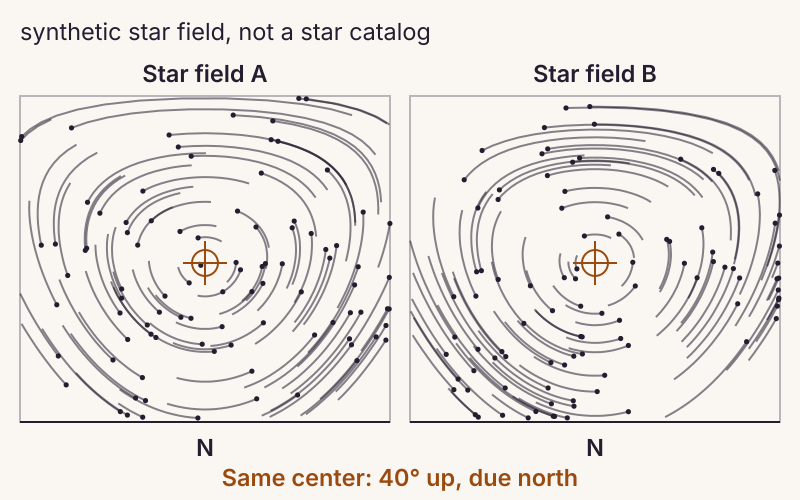
A synthetic star field, not a star catalog, drawn twice: 110 random stars per panel turned for three hours as seen from 40 degrees north, facing north, with the trails in both circling the same pivot.
How the figure was made synthetic star field: 110 stars per panel, uniform within 50 deg of the celestial pole (94 and 97 trails in frame); seeds 11 and 29; lat=40.0; facing north; 3 hours, 15 steps
The figure in words
- Panel A: random star field from seed 11; 94 of its 110 star trails fall inside the frame.
- Panel B: random star field from seed 29; 97 of its 110 star trails fall inside the frame.
- Both panels: drawn for latitude 40 degrees north, looking north, over 3 hours in 15 steps.
- Result: in both panels the trails curve around one point, due north and 40 degrees above the horizon.
- The stars are random and match no real sky; only the geometry of the turning is shown.
"Two random skies turning around one pivot" by Animal Brainwork, https://animalbrainwork.com/navigators/star-compass/. Licensed under CC BY 4.0: https://creativecommons.org/licenses/by/4.0/
Data: site computation
Is it just the North Star?
A single bright star is not the reference the review describes. Where it discusses birds near the equator, the review speaks of “an unobstructed view of the center of the rotating night sky including learned star patterns nearby.” So the reference is a center, read from the patterns around it. Because the pivot does not depend on any particular star, the random skies in the figure turn around the same point a real sky would.
The pivot's height changes with latitude. In the figure, drawn for 40 degrees north, it sits 40 degrees up. The review points out that near the equator the center of rotation lies close to or below the horizon, and that the stars there follow a simpler path, rising in the east, crossing near the zenith and setting in the west. A bird arriving there from the north faces a sky that no longer gives a clear view of the pivot.
How do researchers ask a bird which way to go?
Nobody can interview a migrating bird, so “asking” here is only a figure of speech for an experiment. The bird's answer is the direction it tries to move.
Roswitha and Wolfgang Wiltschko described the basic test in a 2014 review. During the migration season, captive migrants in suitable circular cages hop and flutter in the direction their free-flying relatives are traveling. The spread of that activity is recorded, and a heading is calculated from it. Usually 10 to 15 birds are each tested several times, and the group's mean heading comes from the birds' individual headings.
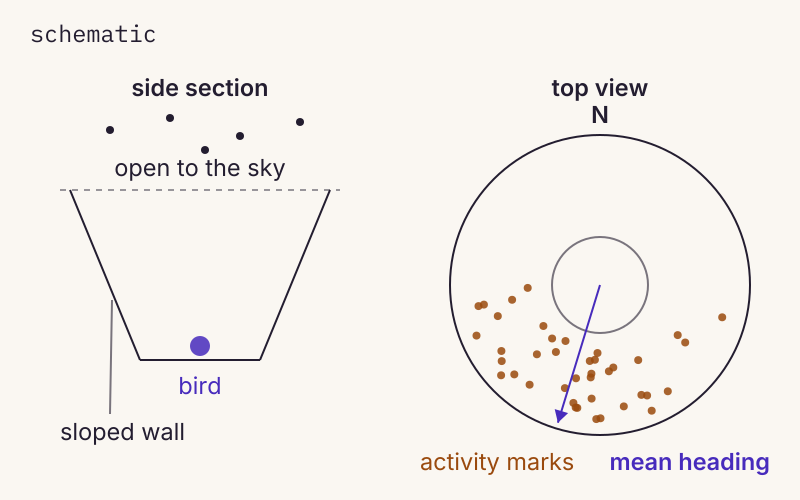
A schematic of a circular orientation cage of general design, not the apparatus of any one study: the bird sits at the bottom, sees the sky through the open top, and its activity on the walls gives a heading.
How the figure was made schematic; general design, no study values; 40 activity marks, normal spread with mean 200 deg and SD 35 deg, seed 16; arrow = mean of the drawn marks, 197 deg
"A circular orientation cage" by Animal Brainwork, https://animalbrainwork.com/navigators/star-compass/. Licensed under CC BY 4.0: https://creativecommons.org/licenses/by/4.0/
Data: site computation
The same cage can be used while one cue is changed. For the magnetic field, the 2014 review describes shifting magnetic north with a coil system and looking for a matching shift in the birds' heading. According to Åkesson and Bianco, the compasses birds use were described from cage experiments: those based on the sun and its polarized skylight, on the stars and on the geomagnetic field.
For the star compass, the review cites two papers by S. T. Emlen, one on the indigo bunting in The Auk in 1967 and one in Science in 1970 bibliographic. Those papers could not be read for this page, so their methods are not described here.
Does a star compass need a clock?
A sun compass does. The sun crosses the sky during the day, so a bird steering by it has to correct for the time of day. The 2017 review describes this time compensation as following a shift of roughly 15 degrees per hour in the sun's bearing at high latitudes. Monarch butterflies on migration also steer by a sun compass, the kind that needs a clock.
The pivot of the night sky does not move, so the review describes the star compass as working without that correction. A bird reading the center of rotation gets the same north at dusk as it does before dawn.
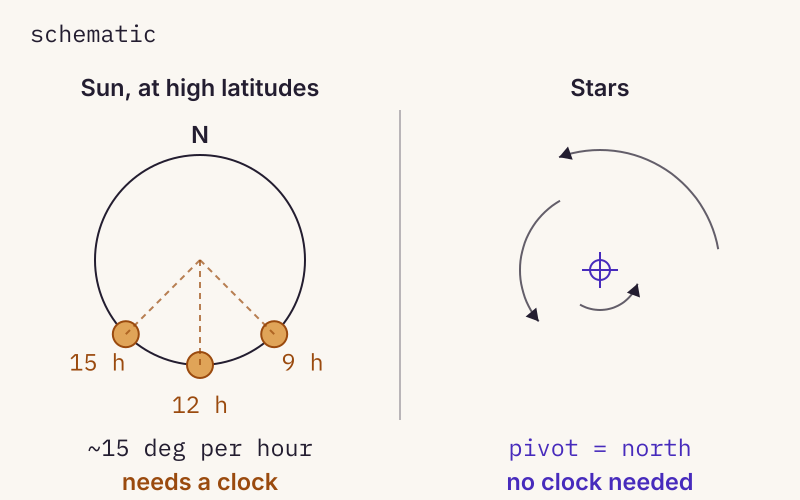
A schematic comparison: the sun's bearing, drawn three hours apart at about 15 degrees per hour, the review's rate for high latitudes, keeps changing, while star arcs turn around a pivot that stays at north.
How the figure was made schematic; sun bearings 135, 180 and 225 deg at 9, 12 and 15 h (about 15 deg per hour, the review's high-latitude rate, 45 deg per 3 h); star arcs of radius 40, 80 and 120 around one fixed pivot
The figure in words
- Sun: bearing at 9 h, 135 degrees; at 12 h, 180 degrees; at 15 h, 225 degrees; about 15 degrees per hour, as at high latitudes, so a clock is needed to correct for it.
- Stars: arcs at three distances all turn around one pivot that stays at north, so no clock is needed.
"Sun compass versus star compass" by Animal Brainwork, https://animalbrainwork.com/navigators/star-compass/. Licensed under CC BY 4.0: https://creativecommons.org/licenses/by/4.0/
Data: Rate of about 15 degrees per hour from Åkesson & Bianco 2017, Journal of Comparative Physiology A, CC BY 4.0
The clock matters in practice. According to the review, a stopover of three days or more can reset a bird's internal clock to local time, and continuous daylight in the far north may let a bird's sense of time drift. Dung beetles rolling dung at night raise a different night-sky question.
How do the star and magnetic compasses work together?
The stars cannot be counted on. The review notes that stars become visible only once the sun is 6 degrees below the horizon, which makes them almost impossible to see during the polar summer. Near the equator, the center of rotation sits close to or below the horizon. Clouds hide the stars too, and the review reports that night migrants tend to set off under clear or partly overcast skies.
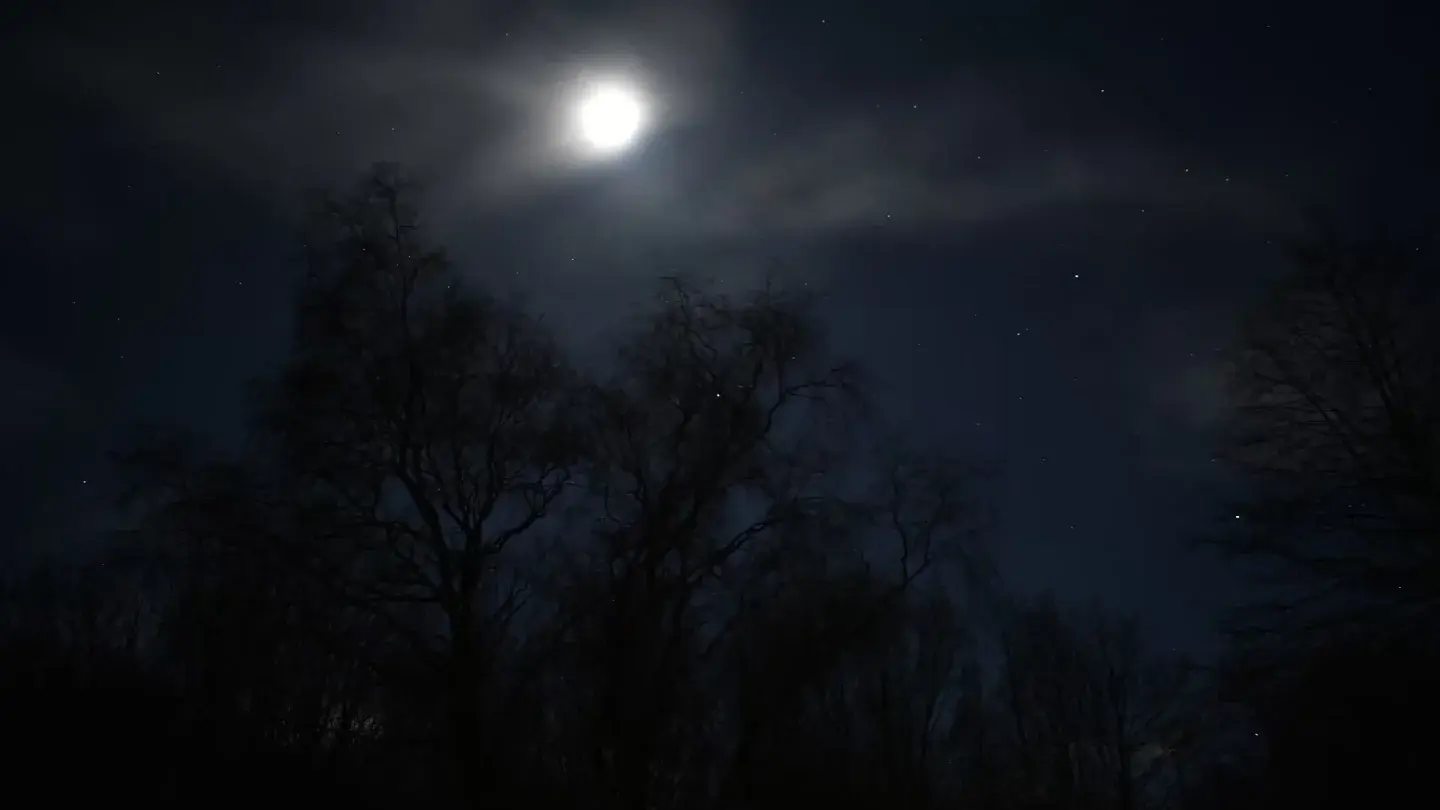
Moonlight, thin cloud and only a scatter of stars above bare trees: a sky like this hides much of the star pattern.
"Star trails" by hannahisabelnic — https://commons.wikimedia.org/wiki/File:Star_trails_(33247004142).jpg — CC0 1.0 (https://creativecommons.org/publicdomain/zero/1.0/); modified: downscaled from 1920 to 1440 px wide WebP
What the magnetic field adds
The geomagnetic field is available across the globe. The review describes the bird's magnetic compass as reading the angle at which the field lines dip into the ground, not their polarity. It also notes that young birds inherit the capacity to use the different compasses but must experience natural compass cues while growing up to use them. Birds hatched in the high Arctic summer have little chance to see the turning stars at all.
The magnetic compass has blind spots of its own, in different places. Close to the poles the field lines are very steep, which the review says may make the dip hard to detect, although in the laboratory songbirds have been shown to detect fields as steep as 85 degrees.
At the magnetic equator the lines run level with the ground. There, a compass based on dip cannot tell north from south. In field tests in East Africa summarized in the review, marsh warblers that had crossed the magnetic equator in the fall seemed to depend heavily on cues from the sky at sunset.
How the compasses share the work is less clear. Åkesson and Bianco pooled 18 route-simulation cases, from earlier studies and their own, and asked which compass would bring a bird near its expected destination. Steering by the dip of the field lines did so in 65 percent of the 17 cases that had data for that route, and a time-compensated sun compass in 44 percent of all 18. A fixed geographic course, which star-based north could supply, did so in 22 percent.
The authors suggest the star compass may work alongside another compass rather than alone. Sea turtle navigation picks up the magnetic side of the story.
Where the finding stops
The star rule on this page rests on cage studies that were read here only through one review's summary of them. Route simulations test which compass fits a flight path; they do not show what a bird used on a given night. The review itself says that what compasses birds use during active migration flights, and how, is not known in detail yet.
Still unsettled
- Which compass sets the reference for the others? The 2017 review notes that compasses may be recalibrated during migration, but the studies behind that statement were not read here, and the review does not settle which cue a bird trusts when the magnetic compass and the stars disagree.
- Can every night migrant read the pivot? The review states as a hypothesis that all bird species can use the stars. The star-compass studies it cites could be read here only by title, so the number of species tested is not shown on this page.
- What happens near the equator, where the pivot sinks to the horizon? The review assumes birds can learn new star patterns there, but it also says data from latitudes near the equator are lacking.
Studies cited
- Åkesson S, Bianco G (2017). Route simulations, compass mechanisms and long-distance migration flights in birds. Journal of Comparative Physiology A 203(6): 475–490. doi:10.1007/s00359-017-1171-y pmc.ncbi.nlm.nih.gov/articles/PMC5522512/Read as: full text; review read in full (PMC version); short quotations with creditText license:CC BY 4.0 (terms)
- Wiltschko R, Wiltschko W (2014). Sensing magnetic directions in birds: radical pair processes involving cryptochrome. Biosensors 4(3): 221–242. doi:10.3390/bios4030221 pmc.ncbi.nlm.nih.gov/articles/PMC4264356/Read as: full text; review read in full (PMC version)Text license:CC BY 3.0 (terms)
Cite this page
“How Do Birds Navigate? A 2017 Review’s No-Clock Star Compass.” Animal Brainwork, published November 24, 2026. https://animalbrainwork.com/navigators/star-compass/. Accessed the day you read it.
How each claim is traced Retrials: every correction, dated Report an error on this page (contact@animalbrainwork.com)
Nearby questions in Navigators
Myth, retested
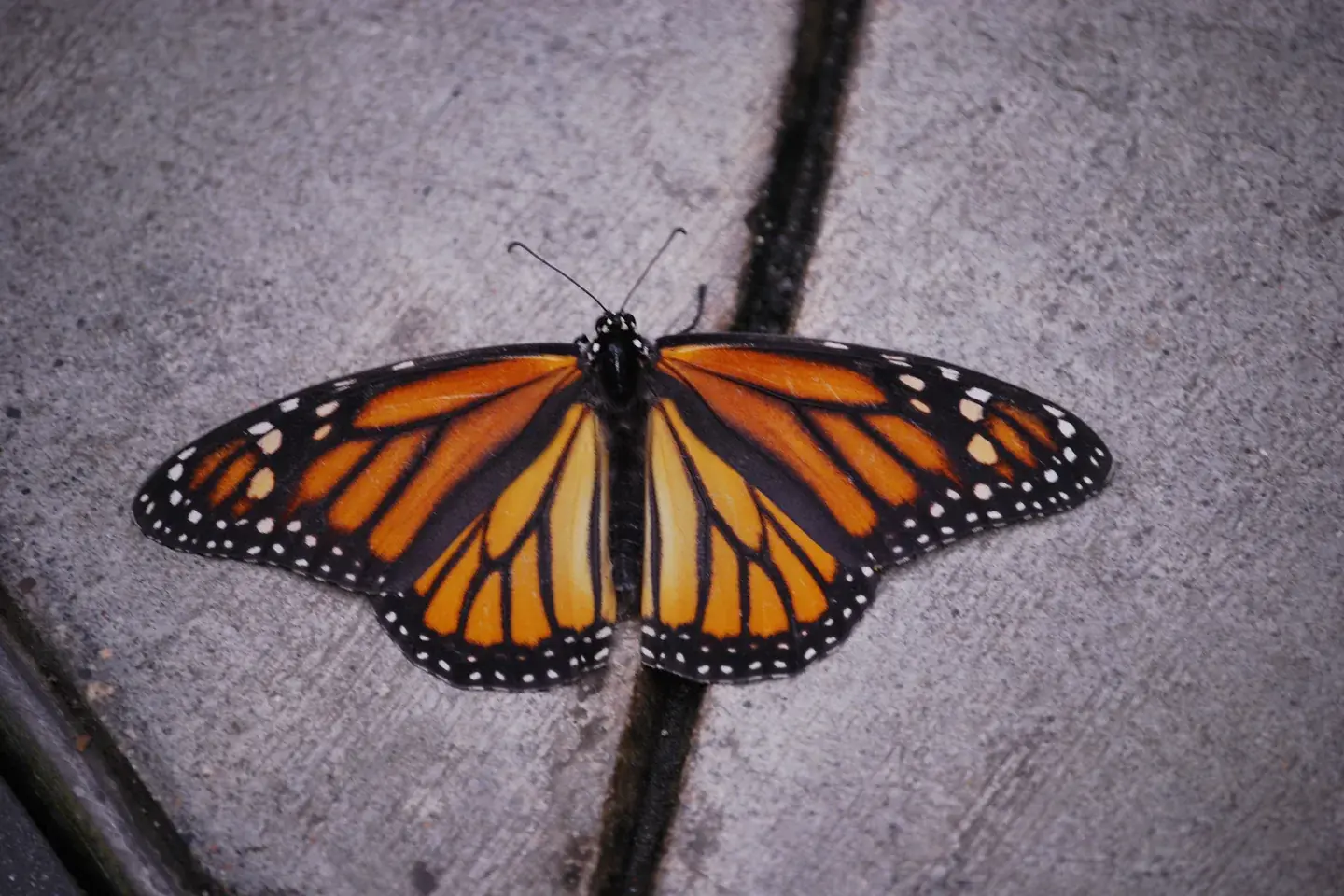
Monarch Butterfly Migration: A Sun Compass on Clock Time
Picture credit
"Monarch butterfly" by Cs california — https://commons.wikimedia.org/wiki/File:Monarch_butterfly.JPG — CC BY 3.0 (https://creativecommons.org/licenses/by/3.0/); modified: cropped to 3:2 (3870 x 2580 px centered in the 3872 x 2592 px original: 1 px off each side, 6 px off top and bottom; butterfly whole), resized to 1440 x 960 px and saved as WebP; no color change
Sense and mechanism
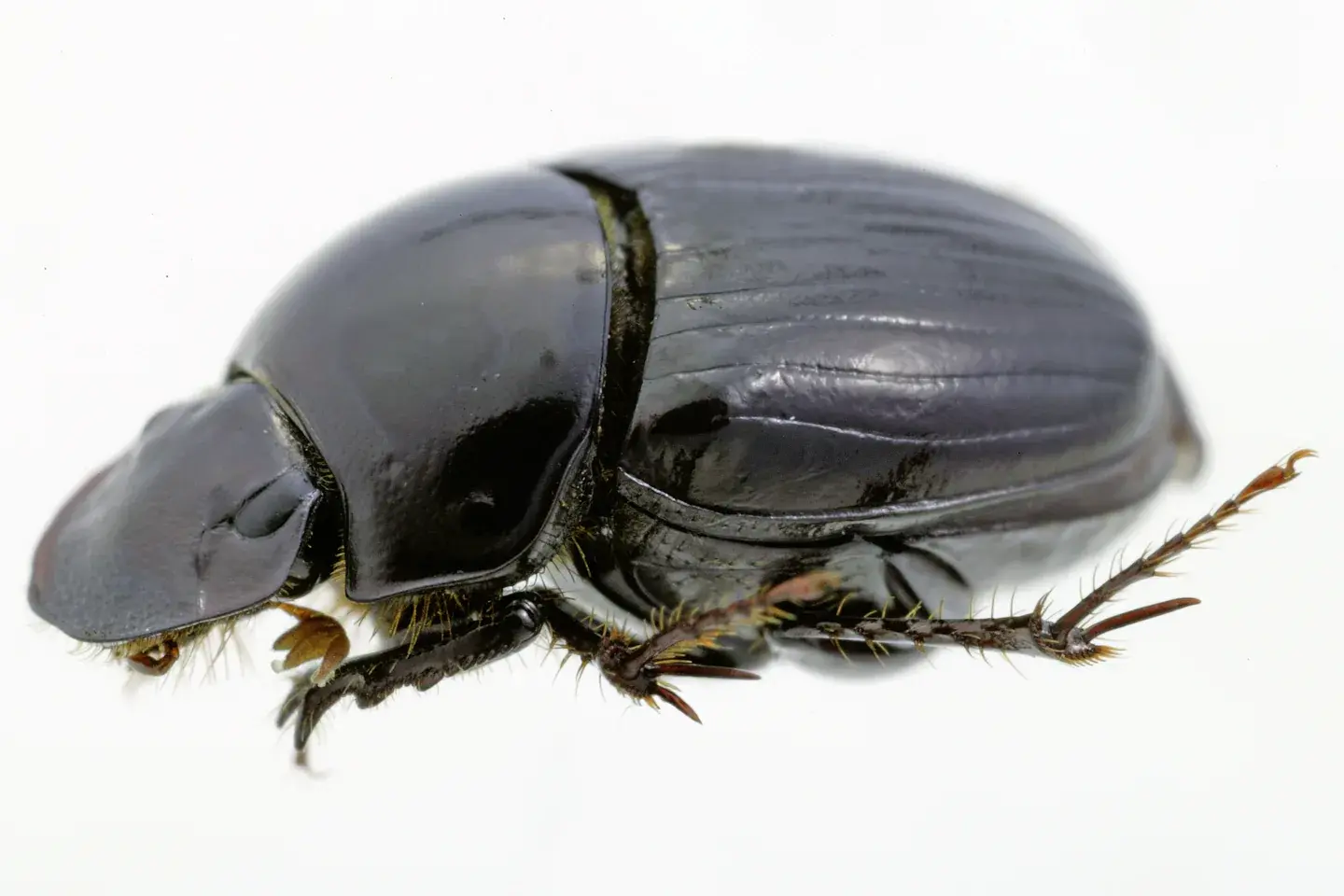
Dung Beetle Milky Way: One Species Shown Using It as of 2017
Picture credit
"Onthophagus chepara - Dung Beetle" by David McClenaghan / CSIRO — https://commons.wikimedia.org/wiki/File:CSIRO_ScienceImage_273_Onthophagus_chepara_Dung_Beetle.jpg — CC BY 3.0 (https://creativecommons.org/licenses/by/3.0/); modified: side margins cropped to 3:2 (2194 x 1463 px from the 2338 x 1463 file; whole beetle kept), downscaled to 1440 x 960 px WebP, cropped by Materialscientist: the current Commons version, uploaded by Materialscientist on 20 September 2014 (comment "crop"), crops the 2,657 x 1,768 px CSIRO upload of 17 September 2014 (File Upload Bot) to 2,338 x 1,463 px, per the file history; that version is the one used
Experiment story
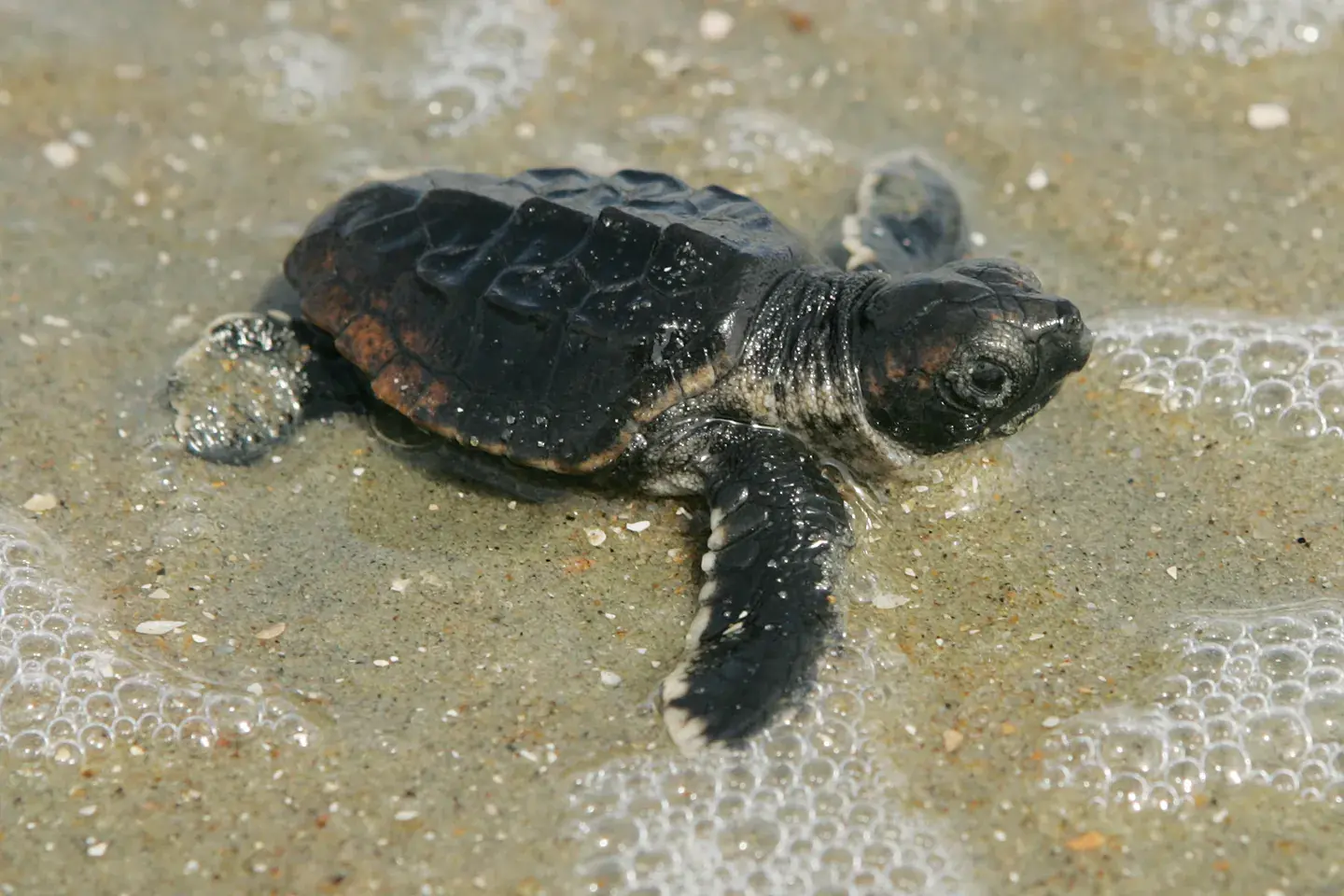
Sea Turtle Navigation: Coil Tests Point to Magnetic Cues
Picture credit
"Loggerhead hatchling at Cape Romain Refuge" by Steve Hillebrand/USFWS — https://www.fws.gov/media/loggerhead-hatchling-cape-romain-refuge-0 — Public domain (work of a US federal employee (U.S. Fish and Wildlife Service) made in the course of official duties, 17 U.S.C. §105; outside the US: the USFWS media page itself lists the license as Public Domain (read 2026-11-23), with the credit Steve Hillebrand/USFWS); modified: cropped to 3:2 (full width, rows 74 to 1426 of 1500), resized to 1440 px wide and saved as WebP