Octopus Intelligence: By One Count, Most Neurons Are in Arms
In one sentence
By J. Z. Young's count, as cited in one study from 2019, the common octopus's eight arms together hold at least 320 million neurons against about 180 million in the central brain, a split that is neither nine brains nor a score for intelligence.
- How it was asked
- Letizia Zullo and colleagues, 2019: does the main nerve cord of an octopus arm carry movement commands to fixed spots, or to many points along the way? The neuron counts are J. Z. Young's, cited in that paper.
- Key study read as
- full text Zullo et al. 2019, Journal of Comparative Physiology A (PMC6478645)
- Sample
- the common octopus (Octopus vulgaris) only; J. Z. Young's older neuron count, cited rather than redone in 2019; the 2019 nerve tests used 19 arm segments, from a number of animals the paper does not give
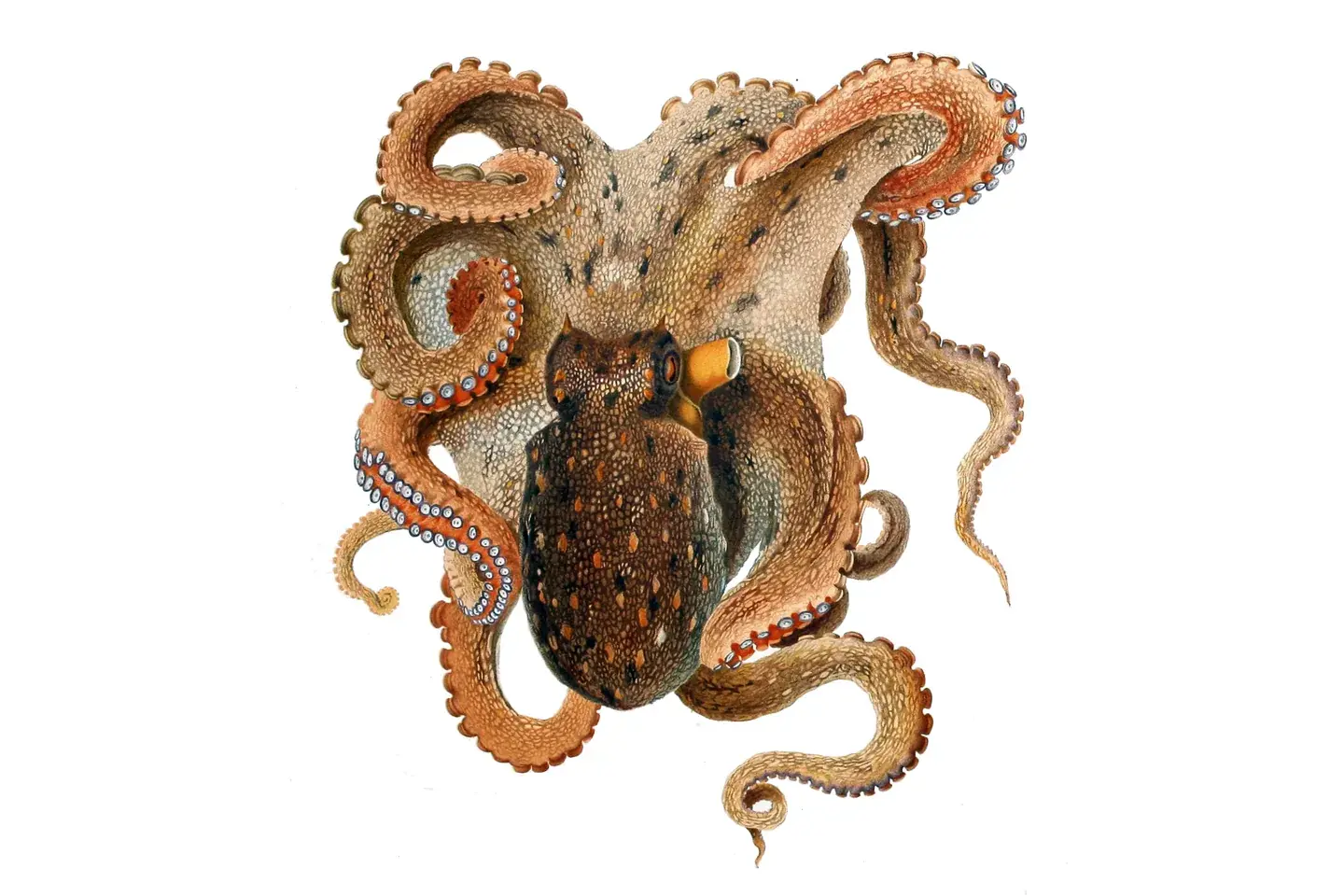
The common octopus, Octopus vulgaris, in a color plate by Comingio Merculiano, dated 1896 on its file page: the species studied in the 2019 arm-nerve paper.
“Octopus vulgaris (Merculiano, in Jatta, I Cefalopodi viventi nel Golfo di Napoli, 1896)”, Comingio Merculiano in Jatta Giuseppe; public domain.
Full credit
"Octopus vulgaris (Merculiano, in Jatta, I Cefalopodi viventi nel Golfo di Napoli, 1896)" by Comingio Merculiano in Jatta Giuseppe — https://commons.wikimedia.org/wiki/File:Octopus_vulgaris_Merculiano.jpg — Public domain (published 1896 in Giuseppe Jatta's I Cefalopodi viventi nel Golfo di Napoli (Italy); public domain in the US (published before 1931); EU: Merculiano's death year not verified from a library or Project Gutenberg catalog record, so this rests on publication in 1896 and the file page's PD-old-100-expired tag; scan tagged PD-scan; upstream not traced); modified: whole plate kept; white margins in the plate's paper color added at left and right to make a 3:2 frame, resized to 1440 px wide and converted to WebP
By one count, each octopus arm holds more than 40 million neurons. The central brain of the same animal, the common octopus, holds about 180 million by the same estimate. Multiply the arm figure by eight and the arms come to at least 320 million.
The count belongs to the anatomist J. Z. Young. A 2019 paper on octopus arm nerves by Letizia Zullo and colleagues cites it in its opening pages: “JZ Young has already pointed out that 180 million neurons in the central brain are connected with more than 40,000,000 neurons in each of the eight arms.” This page read that paper in full full text; Young's own book appears here only as a title in its reference list bibliographic.
The split says where the nerve cells are. It does not say how many brains an octopus has, and it does not convert into a measure of intelligence.
How many brains does an octopus have?
The count names one central brain. Does that add up to nine brains, one in the head and one in each arm? The 2019 paper does not call the arms brains: it describes a main nerve cord running down each arm. Inside that cord, a core of nerve fibers wrapped in nerve cell bodies swells opposite each sucker, and the paper calls each swelling a ganglion, a small cluster of nerve cells.
On this site's reading, the brain-per-arm picture borrows from human anatomy, where one organ in the head holds most of the nerve cells. Reading the octopus through that picture is a borrowed umwelt: the human assumptions that slip in when another animal's world is imagined with human equipment. The numbers are a published count; the “nine brains” framing is the borrowed part.
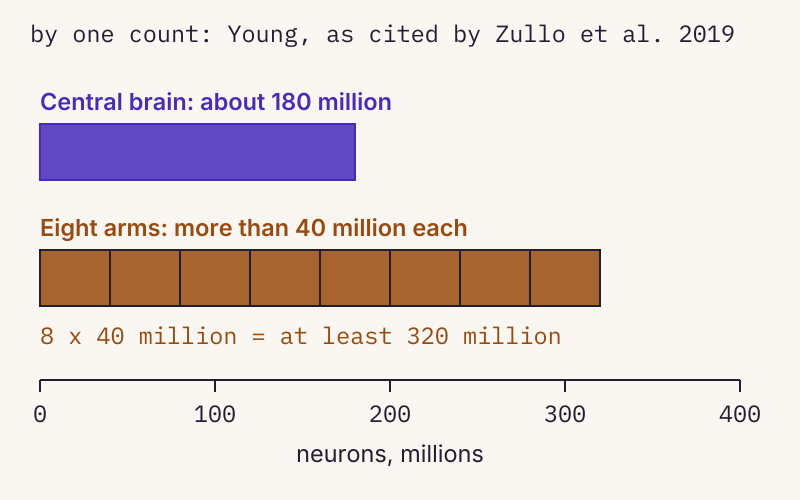
J. Z. Young's neuron count for the common octopus, as cited by Zullo et al. 2019, by one count: about 180 million in the central brain and more than 40 million in each arm, so the eight arms together hold at least 320 million.
How the figure was made bars = neurons in millions on a 0-400 scale; central brain 180; each arm more than 40, drawn as 8 segments of 40; arms together 8 x 40 = 320, a lower bound; counts from Zullo et al. 2019 (CC BY 4.0), citing Young
"Where an octopus's neurons sit, by one count" by Animal Brainwork, https://animalbrainwork.com/thinking/octopus-intelligence/. Licensed under CC BY 4.0: https://creativecommons.org/licenses/by/4.0/
Data: Zullo L, Eichenstein H, Maiole F, Hochner B (2019), Journal of Comparative Physiology A 205(2): 271-279, doi:10.1007/s00359-019-01332-6, CC BY 4.0
| Part (Young's count unless noted, as cited by Zullo et al. 2019) | Neurons or fibers | Bound |
|---|---|---|
| Central brain | 180,000,000 | about |
| Each of the eight arms | 40,000,000 | more than |
| Motor neurons along each arm's nerve cord (Graziadei and Young's count) | 380,000 | about |
| Fibers carrying signals from brain to arms | 32,000 | about |
| Fibers carrying signals from arms to brain | 140,000 | about |
| All eight arms together (computed for this page) | 320,000,000 | at least |
This table as CSV (octopus-neuron-estimates.csv) (source and license notes) Data: Zullo L, Eichenstein H, Maiole F, Hochner B (2019), Journal of Comparative Physiology A 205(2): 271-279, doi:10.1007/s00359-019-01332-6, CC BY 4.0
What can an arm do on its own?
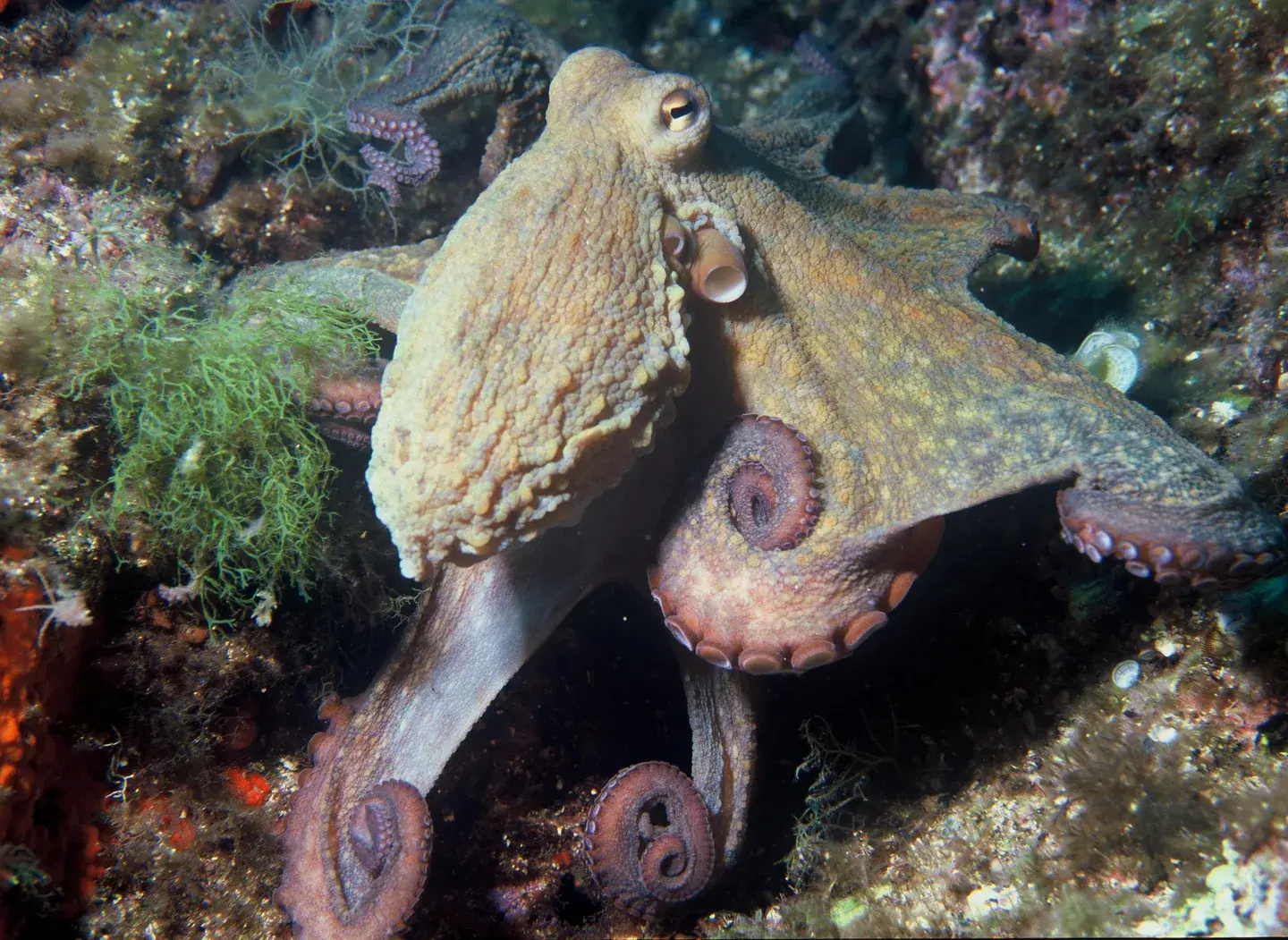
A common octopus on a Mediterranean reef, according to the file page, with several arms curled and their suckers in view.
"Octopus vulgaris" by Albert Kok — https://commons.wikimedia.org/wiki/File:Octopus_vulgaris_2.jpg — Public domain (author's own worldwide public-domain release (PD-user), so it holds in the US and in the EU alike; where such a release is not legally possible, the author grants use for any purpose without conditions); modified: resized to 1440 px wide and converted to WebP
Relatively few nerve fibers connect the two parts. In Young's count, as cited by Zullo and colleagues in 2019, brain and arms are linked by about 32,000 fibers carrying signals out to the arms and about 140,000 carrying signals back. The same 2019 paper cites a count by Graziadei and Young of about 380,000 motor neurons along the nerve cord of each arm.
The authors read that layout as a sign that the arm itself handles much of the sensing and movement control, while the brain sends commands that start particular actions. They also cite earlier work in which stimulating the nerve tract of an arm cut off from the brain still set off a stereotyped arm extension.
What did the 2019 nerve tests show?
Zullo's team worked with 19 isolated lengths of arm nerve cord from common octopuses, each with a small strip of arm muscle left attached in the middle. They stimulated the nerve tract at points up to 30 mm away, both ahead of the muscle and behind it. The muscle contracted from either direction, and the threshold did not depend on the distance.
Signals in the tract traveled at about 250 to 300 cm per second. From these 19 segments, the evidence suggests that many command fibers run long stretches of the arm and contact motor neurons along the way, which the authors call “en passant,” instead of each fiber serving one fixed spot.
How, then, does an octopus pick where a bend starts? The authors propose that a broad command from the brain meets local signals from the arm's own senses. That is a proposal built on tests of isolated nerve cords, not an observation of a free-moving octopus.
Do more neurons mean a smarter animal?
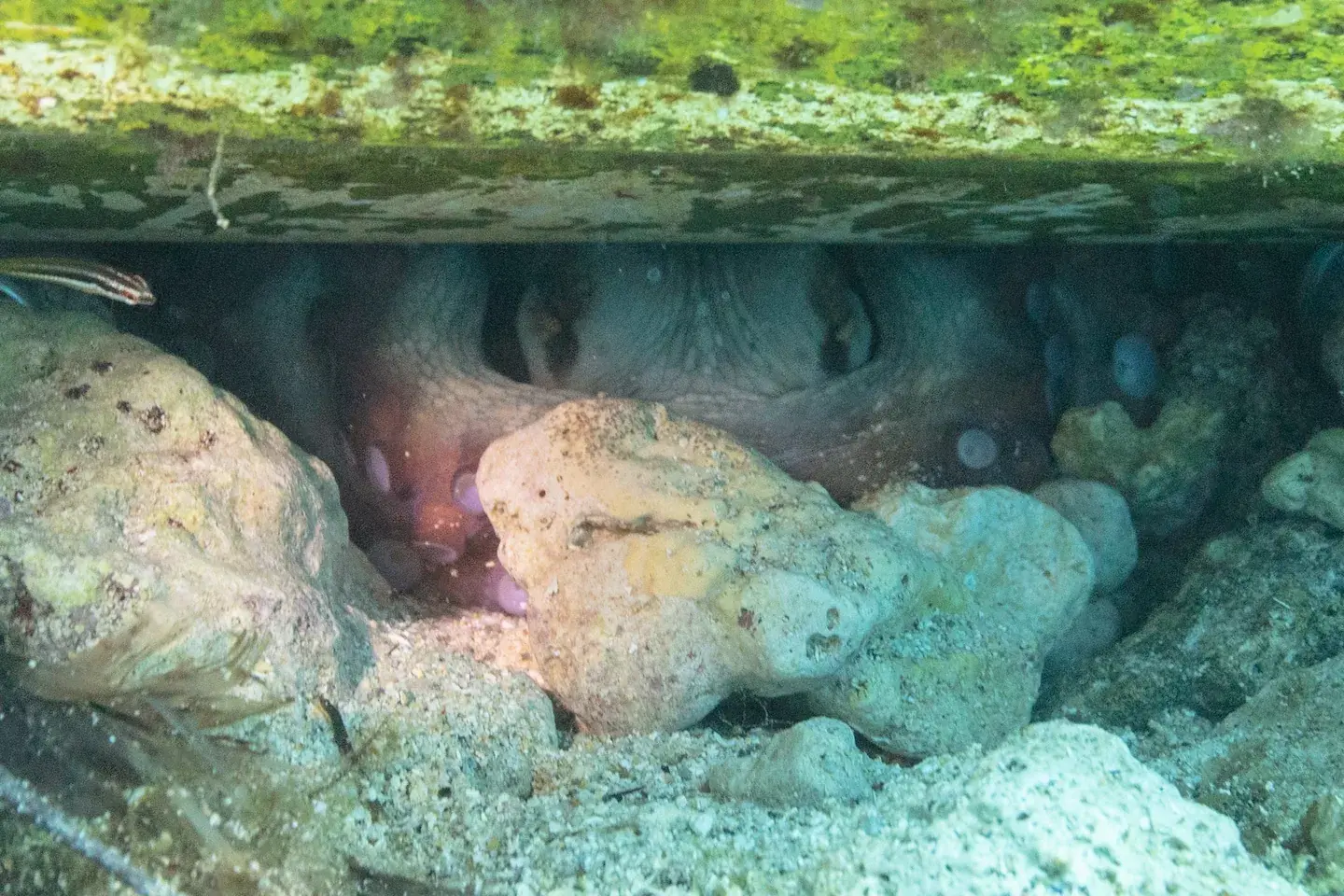
A common octopus tucked under a ledge off Malta, according to the file page, with only its eyes and a few suckers in view.
"Pulpo comun (Octopus vulgaris), Anchor Bay, Malta, 2021-08-24, DD 14" by Diego Delso, delso.photo, License CC BY-SA — https://commons.wikimedia.org/wiki/File:Pulpo_com%C3%BAn_(Octopus_vulgaris),_Anchor_Bay,_Malta,_Malta,_2021-08-24,_DD_14.jpg — CC BY-SA 4.0 (https://creativecommons.org/licenses/by-sa/4.0/); modified: resized to 1440 px wide and converted to WebP
How smart are octopuses? Young's count records how many nerve cells sit in each part of the body, not what the animal does with them, so it cannot answer that alone.
The 2019 paper adds a reason the location matters. It cites earlier work showing that the higher motor centers of the octopus brain are not laid out as a map of the body, and that stimulating them sets off whole actions such as extending several arms. A test designed around one central organ that steers all the limbs may not fit how this animal is built. Colonies of army ants show the other extreme: ants acting on local rules with no one in charge.
Ranking octopuses against crows would compare animals tested on different tasks with different bodies, and this site does not rank them. The same caution applies to any single test. Clever Hans showed how a test can credit the animal for the tester, and the mirror test in one 2019 study of cleaner wrasse is another result that is easy to over-read. Rays, in a 2012 study of ampullae of Lorenzini, are another sea animal with a sense humans lack.
What the count supports is narrow. In one species, by one older count, most of the counted neurons are in the arms, and the 2019 tests on 19 nerve-cord segments suggest that command fibers reach many points along at least 30 mm of arm. It does not show that an arm thinks, and it ranks the octopus against no other animal.
Still unsettled
- Would a modern count give the same numbers? The figures trace to J. Z. Young's anatomy work and were cited in 2019, not recounted; this site has read only that citation, and Young's book only as a title in its reference list.
- How do the arms and the central brain divide the work? Zullo's team found no sign of fibers wired to fixed spots, but they could not rule out a small fraction of such fibers, and they tested only 30 mm of nerve cord.
- What would “smart” mean for an animal built this way? Neither the 2019 paper nor a neuron count supplies a yardstick for comparing an animal with most of its counted neurons in its arms against one with most in its head, so the question stays open rather than ranked.
Studies cited
- Zullo L, Eichenstein H, Maiole F, Hochner B (2019). Motor control pathways in the nervous system of Octopus vulgaris arm. Journal of Comparative Physiology A 205(2): 271-279. doi:10.1007/s00359-019-01332-6 pmc.ncbi.nlm.nih.gov/articles/PMC6478645/Read as: full text; read in full (PMC version), including the Introduction, Methods, Results and DiscussionText license:CC BY 4.0 (terms)
Cite this page
“Octopus Intelligence: By One Count, Most Neurons Are in Arms.” Animal Brainwork, published November 24, 2026. https://animalbrainwork.com/thinking/octopus-intelligence/. Accessed the day you read it.
How each claim is traced Retrials: every correction, dated Report an error on this page (contact@animalbrainwork.com)
Nearby questions in Animal Thinking
Experiment story
Clever Hans: In Pfungst’s Tests, the Horse Read the Asker
Picture credit
"Hans under test (Karl Krall, Denkende Tiere, 1912, plate 1), card crop" by Unknown author; Karl Krall, Denkende Tiere, Leipzig 1912, Tafel 1 — https://commons.wikimedia.org/wiki/File:Hans_Pr%C3%BCfung_1907.jpg — Public domain (published 1912 in Karl Krall's Denkende Tiere (Leipzig), plate 1; photographer unnamed; public domain in the US (published before 1931); EU: anonymous work, more than 70 years after publication; file page tags PD-old-70 and the Public Domain Mark 1.0; upstream not traced); modified: crop of the same original as clever-hans-pruefung-1912 (the page's first image, shown whole): cropped to 3:2, full width, rows 101 to 1900 of the 2699 x 1979 px file, which trims a strip of wall at the top and of courtyard at the bottom and cuts away the printer's monogram in the bottom-right corner, resized to 1440 x 960 px and saved as WebP; no color change
Myth, retested
Mirror Test: In a 2019 Study, 3 of 4 Wrasse Scraped the Mark
Picture credit
"Bluestreak Cleaner Wrasse" by Elias Levy — https://commons.wikimedia.org/wiki/File:Bluestreak_Cleaner_Wrasse_(6997583331).jpg — CC BY 2.0 (https://creativecommons.org/licenses/by/2.0/); modified: cropped to 3:2 (centered, whole fish kept), resized to 1440 px wide and converted to WebP, adjusted by Togabi: the current Commons version, a color adjustment of Elias Levy's photo uploaded by Togabi on 30 November 2017 (comment "Color Adjustment.", same 2,297 x 1,722 px as the 30 May 2015 transfer from Flickr), per the file history, is the one used
Experiment story
Crow Intelligence: Even a Visible Pipe Stumped 5 Test Crows
Picture credit
"Corvus moneduloides, Bourail, New Caledonia" by benkeen — https://commons.wikimedia.org/wiki/File:Corvus_moneduloides,_Bourail,_New_Caledonia_1.jpg — CC0 1.0 (https://creativecommons.org/publicdomain/zero/1.0/); modified: the Commons version used is adjusted by MPF (light levels, color balance and a crop to the bird, 6 April 2026, 1,400 x 1,054 px, from the 1,400 x 1,468 px first upload of benkeen's photo, which MPF also made that day), cropped to 3:2 (1400 x 933; 40 px off the top and 81 px off the bottom, whole bird kept), converted to WebP at the original 1400 px width