Ant Death Spiral: Can Army Ants Circle Until Exhausted?
In one sentence
An ant death spiral, or circular mill, is a closed circle of army ants cut off from their column, and a 2003 essay by Frédéric Delsuc says such ants can keep circling until they die of exhaustion.
- How it was asked
- What traps a column of army ants in a ring? William Beebe described tracing and measuring one ring in British Guiana in a 1921 book; Delsuc (2003) summarized the cause in PLOS Biology.
- Key study read as
- full text Delsuc 2003, PLoS Biology 1(2): e37 (PMC261877)
Species notes
- Common name
- army ant
- Scientific name
- Eciton burchellii (Westwood, 1842)
- Order and family
- Hymenoptera · Formicidae (subfamily Ecitoninae)
- Body length
- not given in the sources read
- Range band
- New World; the ring in Beebe's 1921 book was at Kartabo, British Guiana
- Field marks
- Hunts in dense columns and swarm raids
- Moves between temporary nests
- Queens are wingless
- Most confused with
- Not described in the sources read
- Based on
- Delsuc 2003 full text; Beebe 1921 full text; ITIS record abstract or record
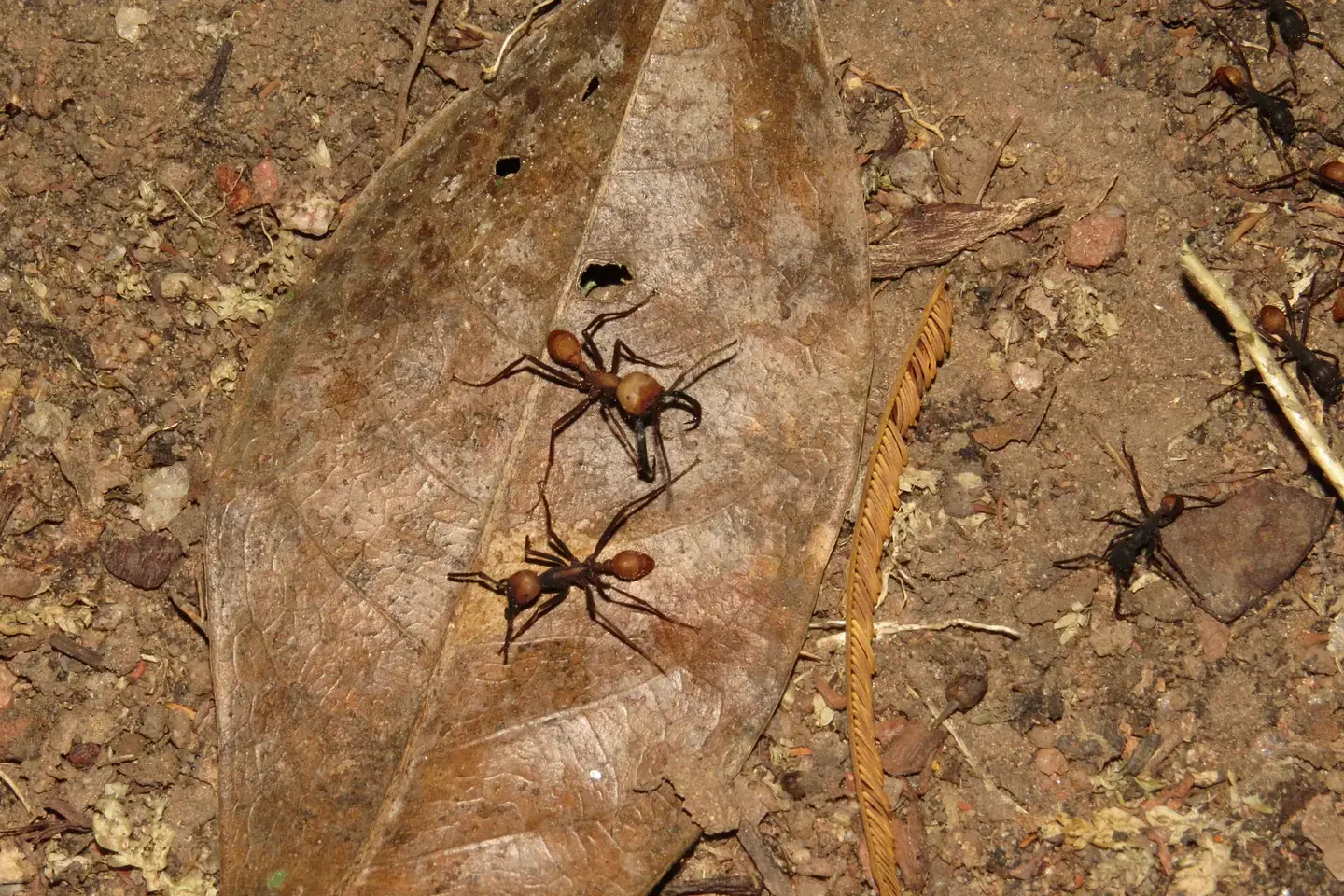
Army ants of the species Eciton burchellii on a fallen leaf in Brazil, July 2015, according to the file page. The ant with the long hooked jaws is a soldier.
"Eciton burchellii, Brazil (20745489570)" by KatzBird — https://commons.wikimedia.org/wiki/File:Eciton_burchellii,_Brazil_(20745489570).jpg — CC BY 2.0 (https://creativecommons.org/licenses/by/2.0/); modified: cropped to 3:2 (full width, rows 160 to 2827 of 3,000 kept), resized to 1440 px wide and converted to WebP
A naturalist once followed a column of army ants through brush and a hollow log, back to where it began. In Edge of the Jungle, William Beebe describes how the two ends of the column had met on a fallen log near the research station at Kartabo, British Guiana. The ring, Beebe wrote, had “a circumference of twelve hundred feet.”
The ants did not stop there. Most were carrying eggs or larvae, as if moving to a new nest, and the column kept turning through the afternoon and was still moving at midnight.
What is an ant mill?
Army ants travel and hunt together in dense columns. A 2003 essay in PLOS Biology by the evolutionary biologist Frédéric Delsuc describes how a mill begins: something disrupts the pheromone communication, the chemical signals that keep the column together, and a party of foragers loses touch with the raid's main column. In the essay's account, those cut-off workers crowd into a tight ring and keep running until the whole group has died of exhaustion.
Delsuc credits those two steps to T. C. Schneirla's 1944 paper on circular milling and his 1971 book on army ants bibliographic. The essay adds that the phenomenon can be reproduced in the laboratory.
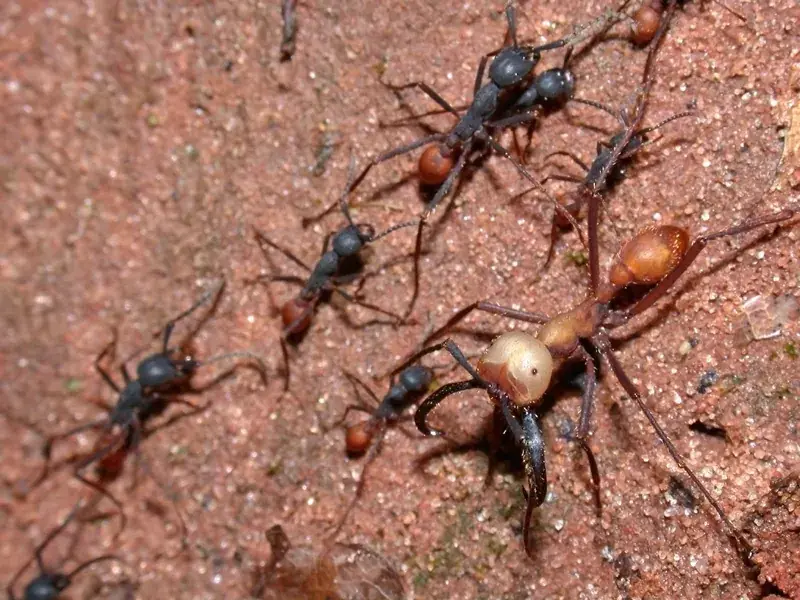
Eciton burchellii army ants on the move over bare red soil, photographed in April 2009 according to the file page.
"Eciton burchellii army ants" by Alex Wild — https://commons.wikimedia.org/wiki/File:Eciton_burchellii_army_ants.jpg — CC0 1.0 (https://creativecommons.org/publicdomain/zero/1.0/); modified: converted to WebP at the original 800 x 600 px
By Beebe's account, his ring was not a cut-off raiding party. It formed the morning after the colony's temporary nest by the station had been broken up, and it carried the colony's young. By the second morning, he wrote, many ants had dropped their loads and the pace had slowed.
Then a half-dead ant straggled off along the beach, others followed its scent, and the rest of the column trailed after it into the forest. Beebe did not learn whether they survived.
Why do army ants walk in circles?
Delsuc's essay answers with the ants' way of life. Army ants are ineffective at foraging alone, so they forage as a group, and they are nomadic, moving between temporary nests. In the essay's reading, the occasional deadly mill is “the evolutionary price that army ants pay to maintain such an ecologically successful and stable strategy of collective foraging.”
Delsuc also cites a 2003 study by Iain Couzin and Nigel Franks bibliographic as showing that a mill is a self-organizing pattern, built from simple rules of motion between neighboring ants.
That is where the no-blueprint rule comes in: before calling on words such as plan or leader, test whether simple rules, local information and repetition can produce what the group did. The swarm scouts on the honey bee swarm page use a local rule, a quorum, to settle on one new home. Here a rule of the same kind leads a group astray.
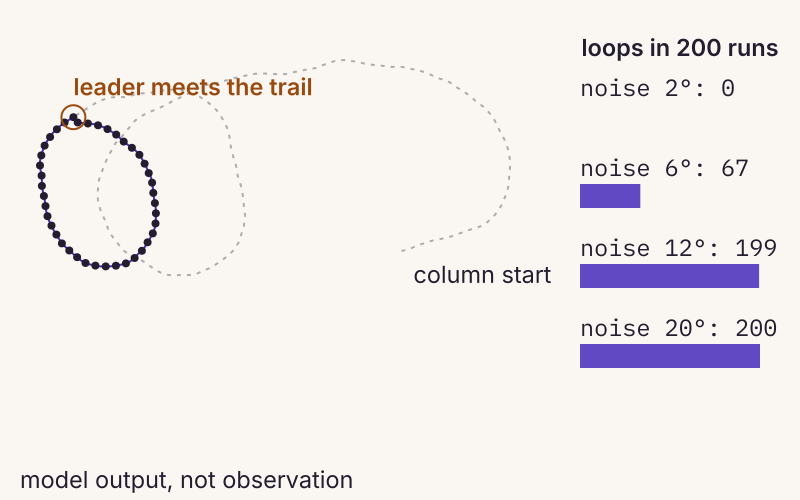
A toy follow-the-trail model in which each ant follows the trail of the ant ahead and only the leader wanders: model output, not observation. In the run shown, the leader met the column's own occupied trail at step 307, closing a loop about 80 body lengths round.
How the figure was made follow-the-trail model; the leader plus 80 followers, spacing 1, speed 1; leader turn bias 2.2 deg, noise 6 deg per step; capture radius 1.6; trail age more than 60 steps; shown run seed=1; noise 2, 6, 12, 20 deg x 200 runs, seeds 5000-5199
"A follow-the-trail rule closes a loop" by Animal Brainwork, https://animalbrainwork.com/hive-and-colony/army-ant-death-spiral/. Licensed under CC BY 4.0: https://creativecommons.org/licenses/by/4.0/
Data: site computation
No ant in this model has a rule for circling. A run counts as a closed loop once the leader comes within 1.6 body lengths of trail the column still covers, and the run stops there. If the leader then took up that trail, each ant would be following another and the loop would have no front, but the model does not simulate that part.
What makes a loop more likely in the model?
The same model was run 200 times at each of four levels of random wandering in the leader's steering. At 2 degrees of noise per step, no run closed a loop, while at 6 degrees 67 runs closed one, and at 12 degrees 199 runs did. At 20 degrees, all 200 runs closed.
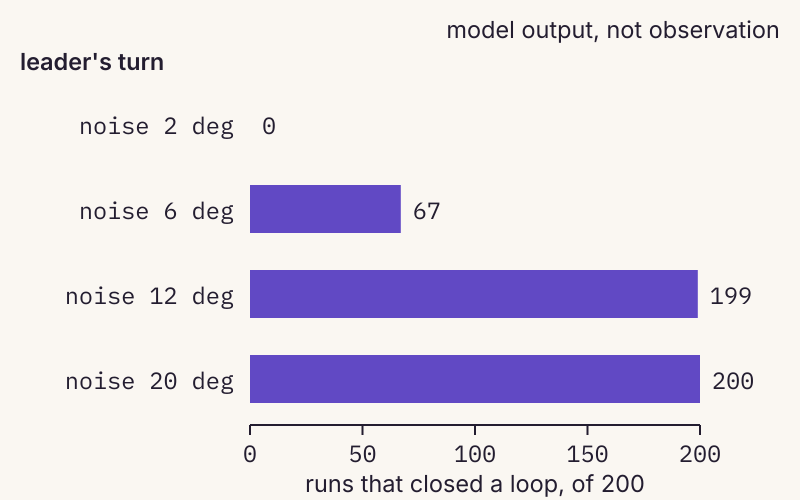
How many of 200 runs of the toy follow-the-trail model closed into a loop at each level of the leader's steering noise: model output, not observation.
How the figure was made follow-the-trail model as above; the leader plus 80 followers; leader turn bias 2.2 deg; noise 2, 6, 12, 20 deg per step; 200 runs per level, seeds 5000-5199; at most 3,000 steps; bar = runs in which the leader met occupied trail laid more than 60 steps earlier
"Loops closed in 200 runs at four noise levels" by Animal Brainwork, https://animalbrainwork.com/hive-and-colony/army-ant-death-spiral/. Licensed under CC BY 4.0: https://creativecommons.org/licenses/by/4.0/
Data: site computation
| Leader's steering noise (model output) | Runs | Runs that closed a loop |
|---|---|---|
| 2 degrees | 200 | 0 |
| 6 degrees | 200 | 67 |
| 12 degrees | 200 | 199 |
| 20 degrees | 200 | 200 |
This table as CSV (antmill-0017-model.csv) (source and license notes) Data: site computation
By this page's arithmetic, the steady 2.2-degree turn alone would carry the leader around a circle about 164 body lengths long, roughly twice the column's 80 body lengths. The column has moved off that trail before the leader comes back to it, so a loop needs extra wandering that cuts back across the ants still on it.
Honeybees pass directions along with a waggle dance instead of a scent trail. Leafcutter ants organize another kind of colony, around a fungus farm. Whether an animal's arms can act on local signals is a separate question, taken up under octopus intelligence. The species named here, Eciton burchellii, is listed by ITIS as a valid species of the subfamily Ecitoninae abstract or record; Beebe and Delsuc both spell it burchelli.
Where the model stops
The model shows that a follow-the-trail rule can close a loop. It does not show that army ants form mills this way.
Its column is the leader plus 80 followers; the ring Beebe measured was 1,200 feet around. Its parameters were set for this page and not fitted to any colony. How models are labeled on this site is set out in Tracing each claim.
Still unsettled
- How often do mills form in the wild, and what breaks them? The sources read here give one ring in detail, Beebe's, which ended when an exhausted ant wandered off and others followed its scent. Schneirla's accounts of mills that ran until the ants died were read here only as titles.
- Does a model that closes a loop show how army ants do it? Not on its own: the toy model here and the laboratory mills Delsuc mentions both produce circles, but the self-organizing account was read here only through Delsuc's summary.
- Why are mills only occasional? Delsuc treats them as an occasional price of group foraging, but neither source read here counts how often colonies lose foragers this way.
Studies cited
- Beebe W (1921). Edge of the Jungle. New York: Henry Holt. Chapter XII, Sequels, pp. 289-294 (circular march of army ants). Public domain in the US (published 1921). www.gutenberg.org/ebooks/25888Read as: full text; chapter XII (Sequels), pp. 289-294, and the appendix of scientific names
- Delsuc F (2003). Army ants trapped by their evolutionary history. PLoS Biology 1(2): e37. doi:10.1371/journal.pbio.0000037 pmc.ncbi.nlm.nih.gov/articles/PMC261877/Read as: full text; read in full (PMC version)
- Couzin ID, Franks NR (2003). Self-organized lane formation and optimized traffic flow in army ants. Proceedings of the Royal Society of London B 270: 139-146. doi:10.1098/rspb.2002.2210 doi.org/10.1098/rspb.2002.2210Read as: bibliographic; known from the reference list of Delsuc 2003
- Integrated Taxonomic Information System (ITIS). Eciton burchellii (Westwood, 1842), Taxonomic Serial No. 575287. itis.gov/servlet/SingleRpt/SingleRptRead as: abstract or record; database record (ITIS single report page), not a full textText license:CC0 1.0 (terms)
Cite this page
“Ant Death Spiral: Can Army Ants Circle Until Exhausted?.” Animal Brainwork, published November 24, 2026. https://animalbrainwork.com/hive-and-colony/army-ant-death-spiral/. Accessed the day you read it.
How each claim is traced Retrials: every correction, dated Report an error on this page (contact@animalbrainwork.com)
Nearby questions in Hive & Colony
Experiment story
Waggle Dance: Distance Code Mostly Tracks Passing Scenery
Picture credit
"Honey bees on honeycomb (Insect Images 1355020)" by Scott Bauer, USDA Agricultural Research Service — https://commons.wikimedia.org/wiki/File:Apis_mellifera_scutellata_1355020.jpg — Public domain (work of a US federal employee (USDA Agricultural Research Service) made in the course of official duties, 17 U.S.C. §105; file page template PD-USGov-USDA-ARS; outside the US: the agency's own public-domain statement for its Image Gallery (ARS Images copyright page); upstream not traced (Bugwood Insect Images re-upload; ARS gallery page not read)); modified: cropped to 3:2 (full width, rows 700 to 2059 of 2948), resized to 1440 px wide and saved as WebP
Sense and mechanism
Bee Vision: Three Receptor Types Peak Near 344, 436, 544 nm
Picture credit
"Pollen covered Bee - Flickr - gailhampshire" by gailhampshire — https://commons.wikimedia.org/wiki/File:Pollen_covered_Bee_-_Flickr_-_gailhampshire.jpg — CC BY 2.0 (https://creativecommons.org/licenses/by/2.0/); modified: cropped to 3:2 (full width, rows 370 to 2508 of 2,728 kept), resized to 1440 px wide and converted to WebP
Experiment story
Honey Bee Swarm: Western Honey Bees Pick a Home by Quorum
Picture credit
"A swarm of Apis mellifera - 20051109" by Bidgee — https://commons.wikimedia.org/wiki/File:A_swarm_of_Apis_mellifera_-_20051109.jpg — CC BY 3.0 (https://creativecommons.org/licenses/by/3.0/); modified: cropped to 3:2 (full width, rows 50 to 1116 of 1,200 kept), resized to 1440 px wide and converted to WebP