Honey Bee Swarm: Western Honey Bees Pick a Home by Quorum
In one sentence
A western honey bee swarm picks its new home by quorum, not by majority: when about 10 to 40 scouts are at one site at once (Schaerf and colleagues, 2013), those scouts fly back and start piping to ready the swarm for flight.
- How it was asked
- How does a swarm settle on one nest site? Schaerf and colleagues (2013) summarized earlier work on that question, then tested whether swarm size changes the choice with computer models and field experiments in Australia; Beekman and Oldroyd (2018) reviewed the field work on quorum, piping and stop signals.
- Key study read as
- full text Schaerf et al. 2013, J R Soc Interface 10(87): 20130533 (PMC3758014)
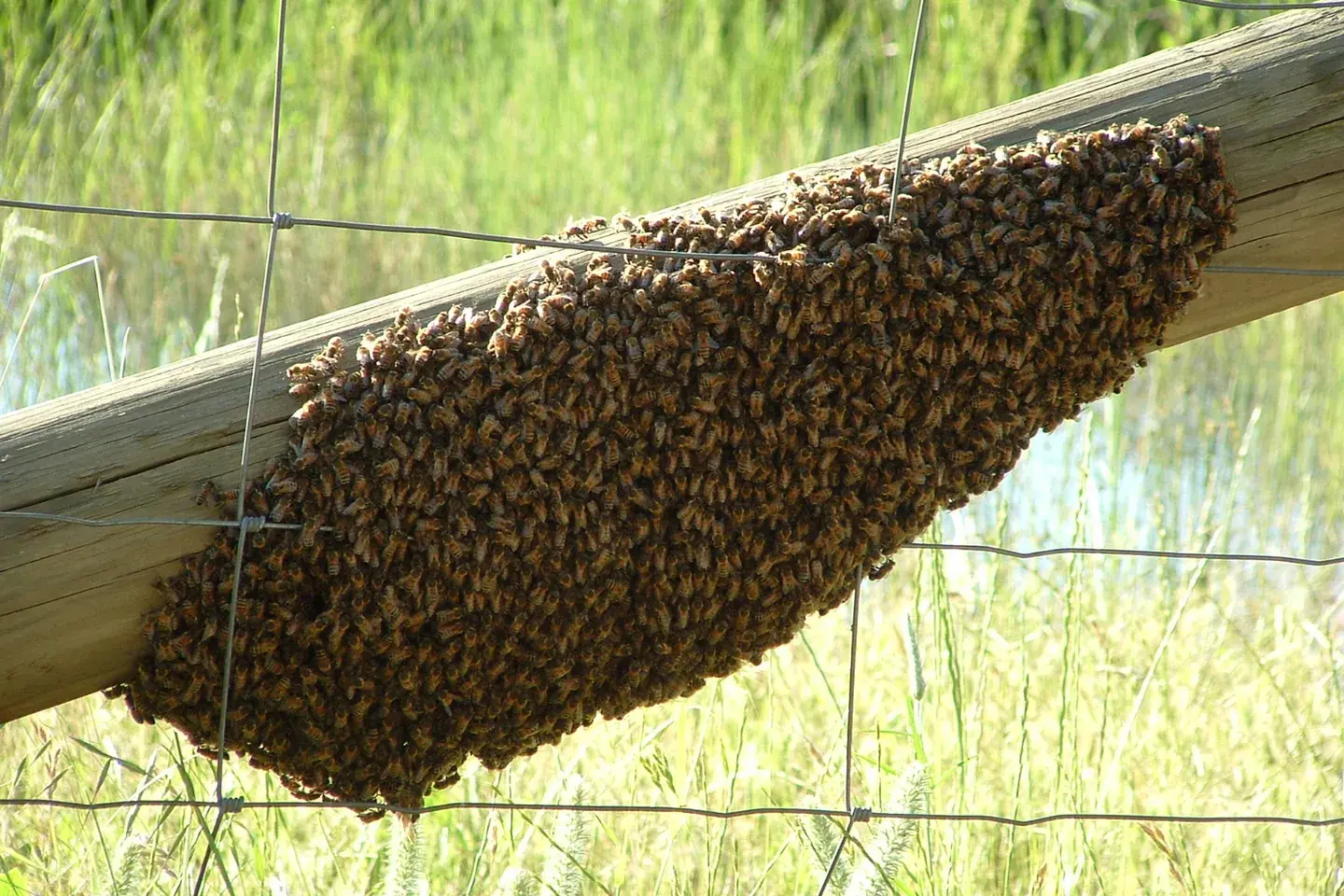
A honeybee swarm on a fence rail at Lake Albert, New South Wales, in November 2005, according to the file page. Scouts from a cluster like this do the house hunting.
"A swarm of Apis mellifera - 20051109" by Bidgee — https://commons.wikimedia.org/wiki/File:A_swarm_of_Apis_mellifera_-_20051109.jpg — CC BY 3.0 (https://creativecommons.org/licenses/by/3.0/); modified: cropped to 3:2 (full width, rows 50 to 1116 of 1,200 kept), resized to 1440 px wide and converted to WebP
A swarm of honeybees clings to a fence rail while its scouts fly off to inspect possible homes. The cluster is a stopover, and the swarm still has to settle where it will live.
This page follows how that choice is made. It does not cover how to handle, collect or relocate a swarm, and it is no guide to approaching one; honeybees sting.
Only a small share of the swarm does the searching: in a 2013 paper, Schaerf and colleagues at the University of Sydney put the scouts at about 5 percent of the bees. A scout that finds a promising cavity flies back and dances for it, and other scouts go out to check. The search ends at a quorum: when 10 to 40 bees are at one site at the same time, that site is in effect chosen, and the bees that met the quorum return and start piping.
That threshold is small compared with the number of scouts available. The same paper gives a mean natural swarm of about 11,800 bees, and by those two figures a swarm of that size has about 590 scouts. Forty of them is under 7 percent, so the choice does not wait for most scouts to agree. Dances for other sites can still be going on when piping begins; stop signals, described below, then quiet them.
Why do honey bees swarm?
Swarming is how a honeybee colony reproduces. The colony splits, and about three-quarters of the workers leave with the colony's queen, according to the 2013 paper. They form a hanging cluster nearby, usually a few tens of meters from the old nest, the 2018 review by Madeleine Beekman and Benjamin Oldroyd notes.
As the review explains, the cluster is only a temporary stop: it has no comb, so it cannot raise young or store honey, and it is exposed to the weather. Natural swarms range from just over 2,400 to 41,000 bees, with a mean of about 11,800, according to figures the 2013 paper cites.
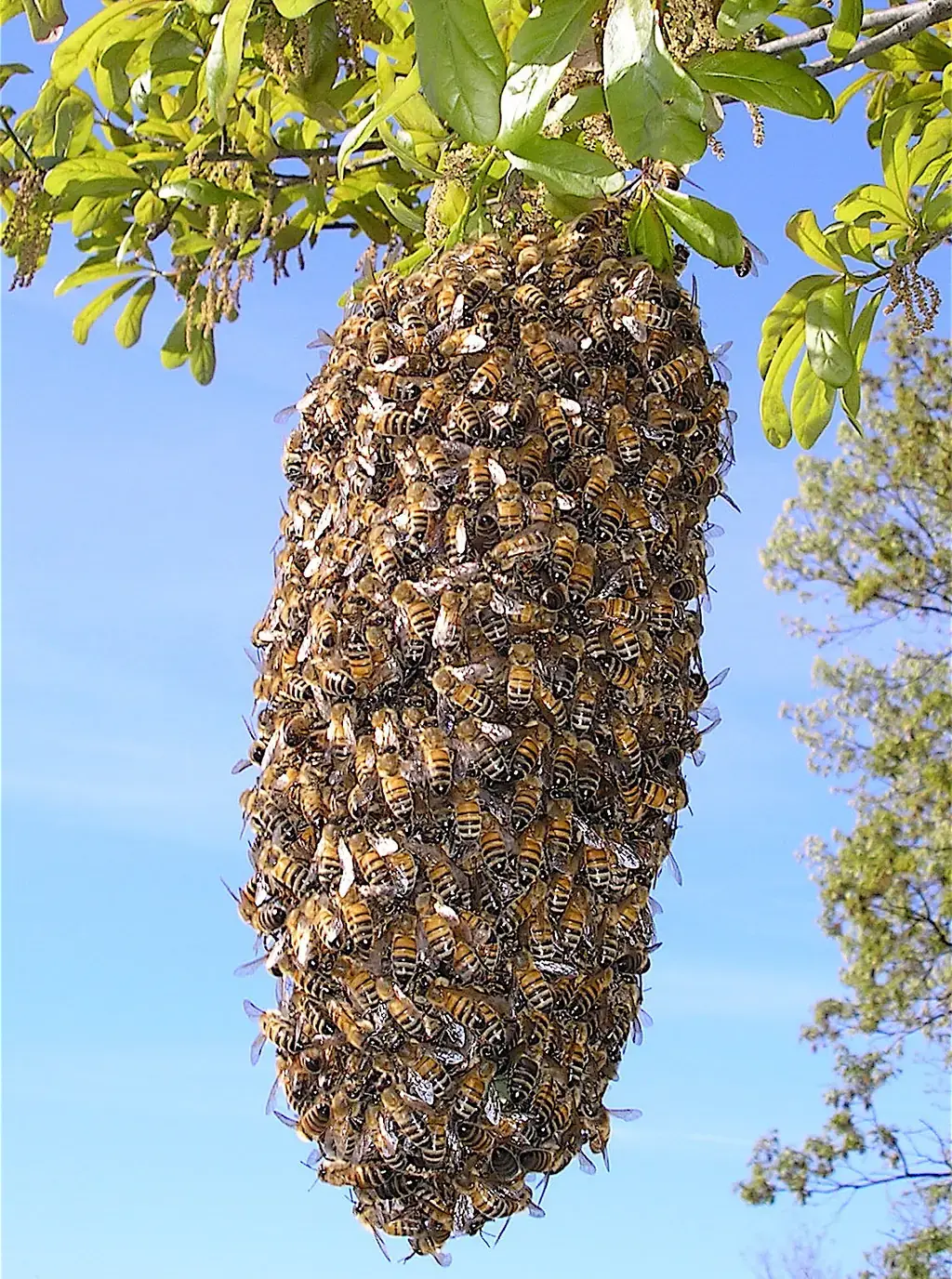
A swarm hanging from a branch, photographed in April 2008 according to the file page. Until the scouts settle on a site, the bees have no comb of their own.
"Bee Swarm" by Mark Osgatharp — https://commons.wikimedia.org/wiki/File:Bee_Swarm.JPG — CC BY-SA 3.0 (https://creativecommons.org/licenses/by-sa/3.0/); modified: resized from 1141 x 1533 to 1024 x 1376 px and saved as WebP
What the swarm needs is a cavity, usually in a tree. The 2018 review lists what the bees prefer: a dry, clean, unoccupied space with an entrance that can be defended, ideally about 40 liters. The choice matters because the cavity's quality is often critical to the colony's survival. The 2013 paper adds a plainer cost: a colony that picks badly will be forced to move again.
How do scouts settle on one site?
To watch the search unfold, researchers build swarms. They gather a large number of bees with a single queen and set the cluster on a vertical board, as the 2018 review describes. Put loosely, as a figure of speech and not a description of the bees, such a board is a question put to the swarm: where will you go, and how will the choice be made?
A scout back from a promising cavity dances on the surface of the cluster. It is the waggle dance, the same signal foragers use for food, here pointing to a home: the angle of the run gives the direction and its duration gives the distance, as the 2013 paper describes it.
How quality enters the count
Quality changes how long a site is advertised. Scouts back from better sites dance more circuits, and each scout dances a little less on each return until she stops. The 2013 paper gives an average drop of 17.2 circuits per return. Because better sites start higher, their dances last longer and draw more recruits.
Recruits inspect a site themselves and, if they rate it well, dance for it too. Over time the dances tend to converge on one site, which can take several days, the 2018 review says. Better sites are more likely to reach the quorum. If no excellent site turns up, a lesser one gets there in the end, which in the review's account keeps the exposed cluster from succumbing to bad weather.
Much of the field work behind this account comes from T. D. Seeley and colleagues. It includes a 2004 paper with P. K. Visscher titled Quorum sensing during nest-site selection by honeybee swarms bibliographic and Seeley's 2010 book Honeybee Democracy bibliographic.
A toy model of the race
The race can be staged in a deliberately simple setting. In this model, 200 scouts choose between a better site, A, and a poorer site, B, and a quorum of 20 scouts ends the search.
The poorer site was set to be twice as easy to find, so site A has to win on recruitment, which grows with site quality, and on keeping its scouts, who were set to quit it a third as often. In the run shown, site A reached the quorum at minute 16, with 24 scouts there against 10 at site B.
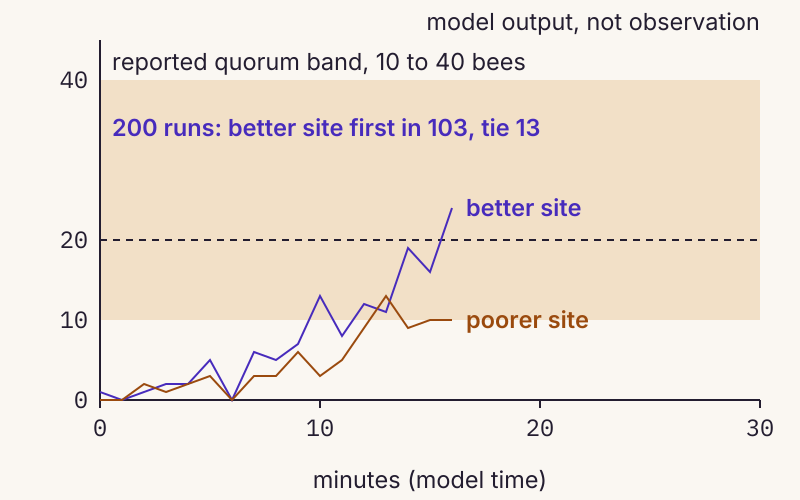
Scouts present at a better site (A) and a poorer site (B), minute by minute, in one run of a toy quorum model until one site held 20 at once: model output, not observation. The shaded band marks the quorum range of 10 to 40 bees reported by Schaerf et al. 2013.
How the figure was made toy quorum model; 200 scouts; site qualities 1.0 and 0.6; find 0.004 and 0.008, recruit 0.001 x committed scouts x quality, quit 0.01 and 0.03 per minute; each committed scout is at the site with probability 0.35 per minute; quorum 20; shown run seed=4; runs=200, seeds 1000-1199
"Scouts at two sites in one run of a toy quorum model" by Animal Brainwork, https://animalbrainwork.com/hive-and-colony/honeybee-swarm-scouts/. Licensed under CC BY 4.0: https://creativecommons.org/licenses/by/4.0/
Data: site computation; shaded quorum band: range reported by Schaerf et al. 2013, Journal of the Royal Society Interface 10(87): 20130533, doi:10.1098/rsif.2013.0533
This table as CSV (swarm-0009-model.csv) (source and license notes) Data: site computation
A model this simple has no plan and no leader, yet it ends with one site. This site's name for the order of explanation that starts there is the no-blueprint rule: before reaching for words such as plan, leader or understand, test whether simple local rules, repeated many times, can account for what a group did. It is a rule for writing about animals, not a claim about how bees work.
So the two kinds of statement stay apart on this page. The model is evidence only that a quorum rule can end a search, while the evidence that swarms behave this way comes from the field studies.
What do stop signals do?
Other scouts can interrupt a dancer. In the 2013 paper's description, another bee head-butts the dancer in the side while producing a buzzing sound, and a dancer that receives enough of these signals may abandon her current bout of dancing.
The signals go mostly to bees dancing for a site other than the signaler's own. Each group of dancers therefore damps the other, a pattern known as cross-inhibition. Schaerf and colleagues, citing earlier work, write that stop signaling slows the choice but makes it more accurate and helps prevent deadlocks. That earlier work is a 2012 paper by Seeley and colleagues titled Stop signals provide cross inhibition in collective decision making by honeybee swarms bibliographic.
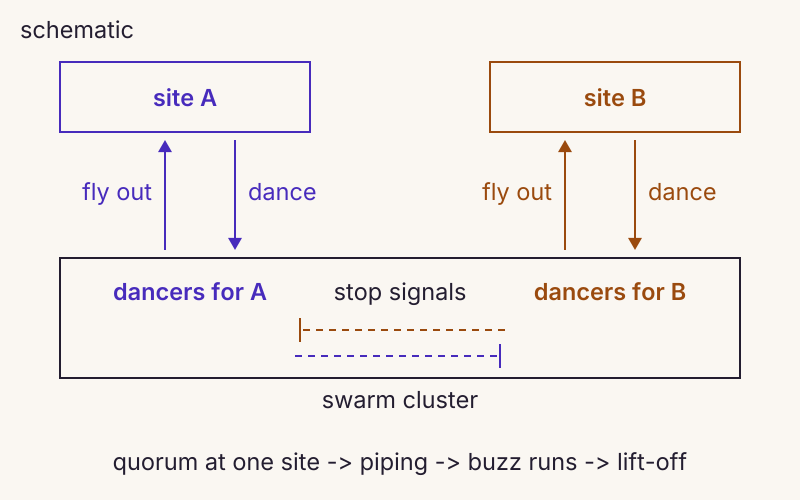
A schematic of the sequence described by Schaerf et al. 2013 and Beekman and Oldroyd 2018: scouts for two sites dance to recruit, stop signals pass between the two groups of dancers, and a quorum at one site leads to piping, buzz runs and lift-off.
How the figure was made schematic; two candidate sites; recruitment by dancing; stop signals aimed mainly at dancers for the other site; sequence quorum -> piping -> buzz runs -> lift-off; arrangement and spacing illustrative
The figure in words
- Scouts fly out to two candidate sites, return and dance on the cluster to recruit more scouts.
- Scouts committed to one site direct stop signals at bees dancing for the other site; dancers who receive them tend to stop.
- A quorum at one site sends its scouts back to pipe.
- Buzz runs follow, and the swarm lifts off.
"Recruitment and stop signals on a swarm" by Animal Brainwork, https://animalbrainwork.com/hive-and-colony/honeybee-swarm-scouts/. Licensed under CC BY 4.0: https://creativecommons.org/licenses/by/4.0/
Data: schematic drawn for this page from the text of Schaerf et al. 2013 (doi:10.1098/rsif.2013.0533) and Beekman & Oldroyd 2018 (doi:10.1098/rstb.2017.0010); no data values
After the quorum
After the quorum, according to the 2018 review, piping tells the quiet bees in the cluster to prepare for flight, and in temperate zones it is essential for warming their flight muscles to 35°C. Once piping begins, stop signals become far more frequent and flight and dancing drop, so scouts stay on the cluster to act as guides.
Lift-off comes with buzz runs, in which scouts that met the quorum run through the cluster and force it into the air, the review says. Bees that know the way then streak through the flying swarm toward the new site, according to both papers.
Agreement among the scouts matters for that flight. The review recounts a swarm described by Lindauer that was split between two sites in opposite directions and could not fly to either, so it clustered again. In experiments by Makinson and Beekman, swarms forced into the air before piping, while dances still pointed several ways, did not fly toward any of the sites.
Does a simple model choose as well as the bees?
Across 200 runs of the same toy model, each with its own random seed, the better site alone reached the quorum first in 103 runs and the poorer site in 84; in 13 runs both sites reached it in the same minute. No run ended without a quorum, so in this model the result comes to about 52 percent for the better site.
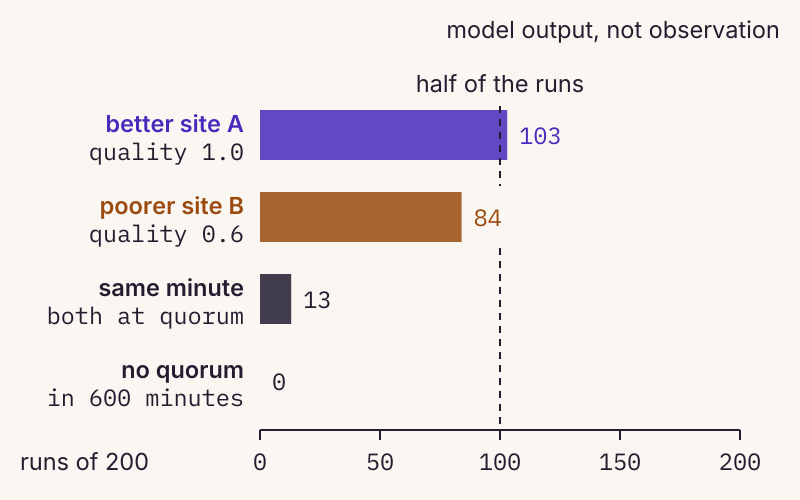
Which site reached the quorum first in 200 runs of the same toy model: model output, not observation. Ending a search in a model is not evidence that swarms follow the same rule.
How the figure was made toy quorum model as above; 200 scouts; site qualities 1.0 and 0.6; quorum 20; at most 600 minutes per run; runs=200, seeds 1000-1199; bars = runs in which that site alone held 20 scouts first, and runs in which both sites held 20 in the same minute
"Which site reached the quorum first in 200 runs" by Animal Brainwork, https://animalbrainwork.com/hive-and-colony/honeybee-swarm-scouts/. Licensed under CC BY 4.0: https://creativecommons.org/licenses/by/4.0/
Data: site computation
| Outcome in 200 runs (model output) | Site quality | Runs |
|---|---|---|
| Better site A alone reached the quorum first | 1.0 | 103 |
| Poorer site B alone reached the quorum first | 0.6 | 84 |
| Both sites reached the quorum in the same minute | none | 13 |
| No quorum within 600 minutes | none | 0 |
This table as CSV (swarm-model-runs.csv) (source and license notes) Data: site computation
Those numbers describe the model, not real swarms. The settings were chosen for this page and not fitted to data, and the poorer site was made easier to find on purpose. What the runs illustrate is narrower: a quorum rule can end a search without any bee comparing the two sites, and the same rule can end it at the worse one. How the models on this site are labeled is set out in Tracing each claim.
Published models and real swarms
Published models with far more detail miss too. Schaerf and colleagues ran an established individual-based model, built without stop signals, on a harder problem with 30 candidate sites. Their simulated small swarms, with 351 scouts, chose the best site 469 times in 1,000 runs, and large swarms, with 873 scouts, chose it 597 times.
Field studies are summed up differently, though not on the same problem. The 2018 review states that a swarm picks the best available site most of the time, citing earlier work. Split decisions, where a swarm divides between two sites, are extremely rare in experiments but have been seen, the 2013 paper notes.
A local rule can also lead a group wrong, as in the ant death spiral. Whether a single animal's choice needs a planner is a different test, taken up in crow intelligence studies, while leafcutter ants show a colony sharing another kind of work, growing its own food.
The quorum account comes from field work on one species, the western honeybee, Apis mellifera, which nests in cavities. The 2018 review describes a smaller relative, the red dwarf honeybee, whose swarms do not seem to use a quorum at any site and lift off once enough dances point roughly the same way. The 10-to-40 figure in the 2013 paper is a range, and this page's model fixes it at 20 only for the sake of the example.
Still unsettled
- How much do stop signals add to the final choice? The 2013 paper credits them with slower but more accurate choices and fewer deadlocks, yet its own model left them out and still reached decisions. The 2012 stop-signal study was read here only as a title, so no figures from it are given.
- Does the quorum threshold move with circumstances? Schaerf and colleagues (2013) report a range of 10 to 40 bees, and their models fix the threshold. The 2018 review notes that Temnothorax ants lower their quorum when their old nest is destroyed, but the two papers read here do not say whether honeybee swarms adjust theirs.
- Does a model that reaches the same choice show how bees reach it? Not on its own: a rule-based model can end at one site, as this page's does, without showing that bees follow those rules. Field tests that change one step at a time, such as the forced lift-off experiments, are one way to tell the two apart.
Studies cited
- Schaerf TM, Makinson JC, Myerscough MR, Beekman M (2013). Do small swarms have an advantage when house hunting? The effect of swarm size on nest-site selection by Apis mellifera. Journal of the Royal Society Interface 10(87): 20130533. doi:10.1098/rsif.2013.0533 pmc.ncbi.nlm.nih.gov/articles/PMC3758014/Read as: full text; read in full (PMC version); paraphrased, numbers given in the article text only
- Beekman M, Oldroyd BP (2018). Different bees, different needs: how nest-site requirements have shaped the decision-making processes in homeless honeybees (Apis spp.). Philosophical Transactions of the Royal Society B 373(1746): 20170010. doi:10.1098/rstb.2017.0010 pmc.ncbi.nlm.nih.gov/articles/PMC5882980/Read as: full text; read in full (PMC version); paraphrased only
- Integrated Taxonomic Information System (ITIS). Apis mellifera Linnaeus, 1758, TSN 154396 (valid; honey bee). www.itis.gov/servlet/SingleRpt/SingleRptRead as: abstract or record; database record (ITIS single report page), not a full textText license:CC0 1.0 (terms)
Cite this page
“Honey Bee Swarm: Western Honey Bees Pick a Home by Quorum.” Animal Brainwork, published November 24, 2026. https://animalbrainwork.com/hive-and-colony/honeybee-swarm-scouts/. Accessed the day you read it.
How each claim is traced Retrials: every correction, dated Report an error on this page (contact@animalbrainwork.com)
Nearby questions in Hive & Colony
Experiment story
Waggle Dance: Distance Code Mostly Tracks Passing Scenery
Picture credit
"Honey bees on honeycomb (Insect Images 1355020)" by Scott Bauer, USDA Agricultural Research Service — https://commons.wikimedia.org/wiki/File:Apis_mellifera_scutellata_1355020.jpg — Public domain (work of a US federal employee (USDA Agricultural Research Service) made in the course of official duties, 17 U.S.C. §105; file page template PD-USGov-USDA-ARS; outside the US: the agency's own public-domain statement for its Image Gallery (ARS Images copyright page); upstream not traced (Bugwood Insect Images re-upload; ARS gallery page not read)); modified: cropped to 3:2 (full width, rows 700 to 2059 of 2948), resized to 1440 px wide and saved as WebP
Sense and mechanism
Bee Vision: Three Receptor Types Peak Near 344, 436, 544 nm
Picture credit
"Pollen covered Bee - Flickr - gailhampshire" by gailhampshire — https://commons.wikimedia.org/wiki/File:Pollen_covered_Bee_-_Flickr_-_gailhampshire.jpg — CC BY 2.0 (https://creativecommons.org/licenses/by/2.0/); modified: cropped to 3:2 (full width, rows 370 to 2508 of 2,728 kept), resized to 1440 px wide and converted to WebP
Experiment story
Are Bees Smart? In One Lab, a String Trick Seemed to Spread
Picture credit
"Bombus terrestris (Buff-tailed bumblebee) - queen" by S. Rae from Scotland, UK — https://commons.wikimedia.org/wiki/File:Bombus_terrestris_(Buff-tailed_bumblebee)_-_queen_-_Flickr_-_S._Rae.jpg — CC BY 2.0 (https://creativecommons.org/licenses/by/2.0/); modified: cropped to 3:2 (full width kept; top and bottom trimmed, so the antenna tips and wing tips fall outside), resized to 1440 px wide and converted to WebP