Leafcutter Ants: They Grow a Fungus Garden on Cut Leaves
In one sentence
Leafcutter ants carry cut leaves into the nest to grow a fungus, and two reviews describe that fungus as the main food of the colony's larvae, while adult workers likely also take in plant sap.
- How it was asked
- Frank Aylward, Cameron Currie and Garret Suen in 2012, and Sean Araújo and colleagues in 2022, both in the journal Insects, reviewed studies of leafcutter ants and the fungus they grow.
- Key study read as
- full text Araújo et al. 2022, Insects (PMC9029082); Aylward et al. 2012, Insects (PMC4553616)
Species notes
- Common name
- leafcutter ant (also leaf-cutting ant, leaf-cutter ant)
- Scientific name
- Atta Fabricius, 1804; Acromyrmex Mayr, 1865
- Order and family
- Hymenoptera · Formicidae (subfamily Myrmicinae, tribe Attini)
- Body length
- not given in the sources read
- Range band
- native to the Neotropics; the two genera occur in North and South America
- Field marks
- Workers carry cut pieces of fresh leaves into the nest
- The underground nest holds fungus gardens grown on that leaf material
- Belongs to Atta or Acromyrmex, the two leaf-cutting genera
- Most confused with
- Not described in the sources read
- Based on
- Araújo et al. 2022 full text; Aylward et al. 2012 full text; ITIS genus records abstract or record
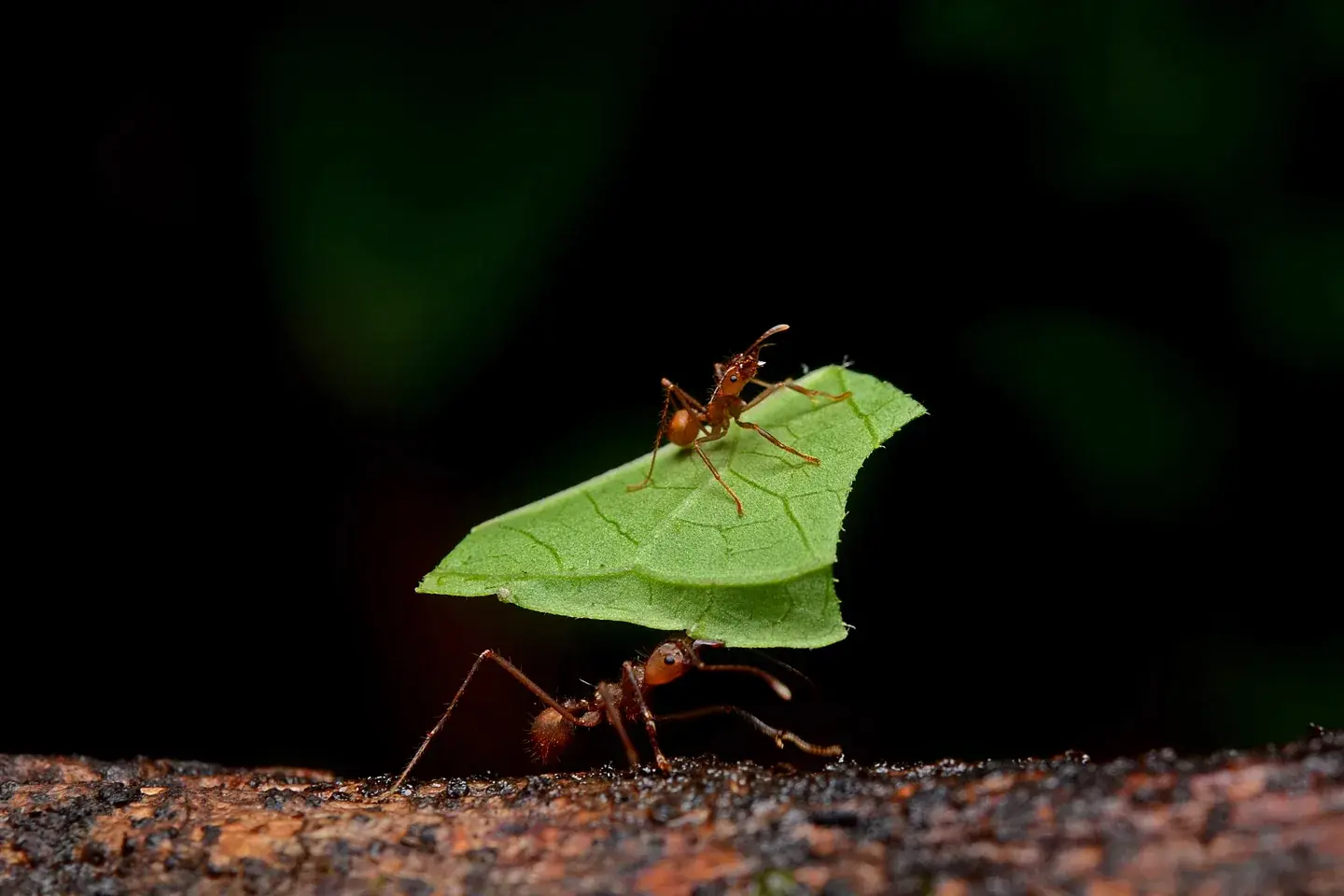
A leafcutter worker carries a cut leaf piece while a smaller worker rides on top, at La Selva Biological Station, Costa Rica, according to the photo's file page, which does not name the genus.
"Leafcutter ants" by Geoff Gallice from Gainesville, FL, USA — https://commons.wikimedia.org/wiki/File:Leafcutter_ants.jpg — CC BY 2.0 (https://creativecommons.org/licenses/by/2.0/); modified: cropped from 4929 x 2465 to the central 3698 x 2465 (3:2, pixels 575 to 4273 across), resized to 1440 px wide and converted to WebP
A leafcutter ant hauls a piece of leaf home, but the leaf is not its dinner. In the nest the piece goes into a garden of fungus, and the fungus feeds the colony.
Leafcutters belong to two genera, Atta and Acromyrmex, which a 2022 review by Sean Araújo and colleagues full text describes as native to the Neotropics. According to the genus records of the Integrated Taxonomic Information System abstract or record, both names are valid: Atta Fabricius, 1804, and Acromyrmex Mayr, 1865. A 2012 review by Frank Aylward, Cameron Currie and Garret Suen full text calls them dominant plant eaters of the American tropics, able to harvest up to 17 percent of the leaf mass in some ecosystems.
What do leafcutter ants do with the leaves?
Workers cut fresh leaves and carry the pieces into their underground nests. There, Aylward's review explains, the leaf material is worked into fungus gardens that the ants grow for food. The fungus, Leucoagaricus gongylophorus, does the digesting. Araújo's review says it makes enzymes that break leaf carbohydrates into nutrients the ants can absorb, and that it also detoxifies some plant compounds.
The ants then eat the fungus. It grows gongylidia, swollen tips of its threads that are rich in lipids and carbohydrates, and Aylward's review calls them “a primary food source for the entire ant colony.” For the larvae, the same review says, they are the only food.
The adult workers are a partial exception. Araújo's review reports one study of Atta cephalotes in which larvae got 100 percent of their food from bundles of gongylidia, called staphylae. Workers got only 4.8 percent of their respiratory energy that way. The rest, the review says, is “presumably supplied by the sap of the plant,” taken in while the workers harvest leaves.
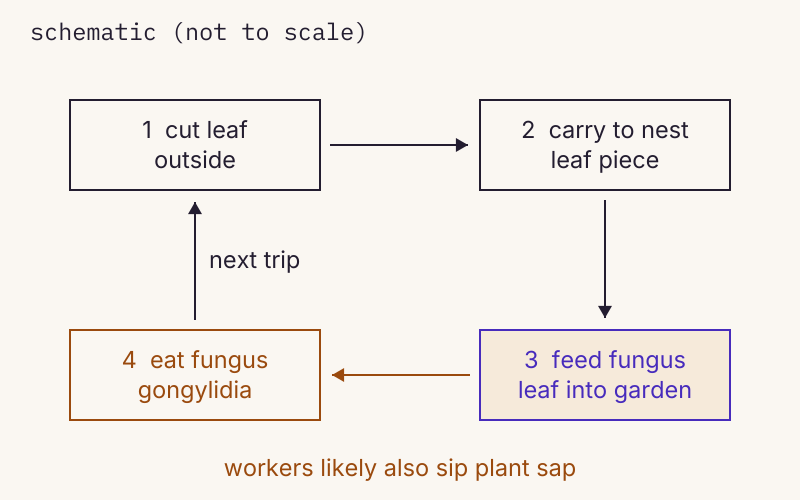
A schematic of the leafcutter farm cycle as the 2012 and 2022 reviews describe it: the leaf pieces feed the fungus, and the colony eats the fungus.
How the figure was made schematic, not to scale; cut -> carry -> feed fungus -> eat fungus; steps from Aylward et al. 2012 and Araujo et al. 2022; side note: workers presumably also take in plant sap (one study cited by Araujo et al. 2022)
The figure in words
- Step 1: workers cut a piece of fresh leaf outside the nest.
- Step 2: they carry the piece home to the underground nest.
- Step 3: the leaf material goes into the fungus garden, where the fungus breaks it down.
- Step 4: the colony eats gongylidia, the fungus's swollen tips, and the cycle starts again.
- Side note: adult workers presumably also take in plant sap while harvesting.
"The leafcutter farm cycle" by Animal Brainwork, https://animalbrainwork.com/hive-and-colony/leafcutter-ants/. Licensed under CC BY 4.0: https://creativecommons.org/licenses/by/4.0/
Data: Araújo S et al. (2022), Insects 13(4): 359, doi:10.3390/insects13040359, CC BY 4.0; Aylward FO, Currie CR, Suen G (2012), Insects 3(1): 41-61, doi:10.3390/insects3010041, CC BY 3.0
The partnership is old. Aylward's review dates the start of ant fungus farming to 45 to 50 million years ago in the Amazon basin, a figure it introduces with “Thought to have originated.”
The leafcutter is not the only insect whose life depends on hauling a load home; the dung beetle does too, and its straight rolls were tested under a planetarium sky.
Who does which job in the colony?
Aylward's review repeats an earlier description of fungus-growing ants as a superorganism, since “the worker castes are not reproductively viable, and survival of the colony hinges completely on the queen.” The workers do everything else.
Besides cutting and carrying, workers add fecal droplets to fresh leaf material in the garden. The droplets carry enzymes from the gongylidia the workers ate; Araújo's review says the workers do not digest many of those enzymes. Workers also feed the young, picking staphylae and placing them in the larvae's mouthparts.
Neither review sorts these jobs by worker size, so this page leaves size classes out.
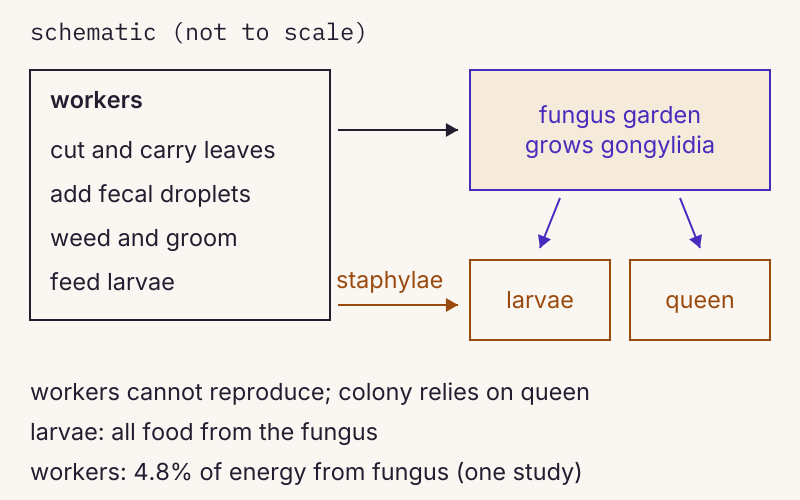
A schematic of who does which job, limited to what Araújo et al. 2022 and Aylward et al. 2012 describe; neither review sorts the jobs by worker size.
How the figure was made schematic, not to scale; worker roles as described in Araujo et al. 2022 and Aylward et al. 2012; 4 worker tasks; larvae 100% of food and workers 4.8% of respiratory energy from fungus bundles, one study of Atta cephalotes; no worker size classes
"Who does which job in a leafcutter colony" by Animal Brainwork, https://animalbrainwork.com/hive-and-colony/leafcutter-ants/. Licensed under CC BY 4.0: https://creativecommons.org/licenses/by/4.0/
Data: Araújo S et al. (2022), Insects 13(4): 359, doi:10.3390/insects13040359, CC BY 4.0; Aylward FO, Currie CR, Suen G (2012), Insects 3(1): 41-61, doi:10.3390/insects3010041, CC BY 3.0
| Role (as the two reviews describe it) | Job | Review |
|---|---|---|
| Workers | cut fresh leaves and carry the pieces into the nest | Aylward et al. 2012 |
| Workers | add fecal droplets with fungal enzymes to new leaf material | Aylward et al. 2012 |
| Workers | weed and groom the garden | Aylward et al. 2012 |
| Workers | place fungus bundles in larval mouthparts | Araújo et al. 2022 |
| Larvae | get all their food from the fungus (one study of Atta cephalotes) | Araújo et al. 2022 |
| Queen | the colony's survival depends on her, since workers cannot reproduce | Aylward et al. 2012 |
| Fungus | breaks leaf material down with enzymes | Araújo et al. 2022 |
This table as CSV (leafcutter-ants-roles.csv) (source and license notes) Data: Araújo S et al. (2022), Insects 13(4): 359, doi:10.3390/insects13040359, CC BY 4.0; Aylward FO, Currie CR, Suen G (2012), Insects 3(1): 41-61, doi:10.3390/insects3010041, CC BY 3.0
Neither review describes any ant handing out these jobs. Elsewhere on this site, honey bee swarm scouts reach a colony decision without a planner, and army ants, a different ant colony, follow a trail rule that can trap them. A honey bee colony also shares the location of food by its waggle dance; the two reviews read here say nothing about how leafcutters share foraging sites. Neither does this page.
How do the ants keep the garden healthy?
A garden of chewed leaves could feed countless microbes, yet Aylward's review reports that fungus gardens hold mostly the one cultivated fungus plus 5 to 6 bacterial groups. A well-described threat is Escovopsis, which the review calls “a specialized parasite of the fungal cultivar.” Araújo's review names Escovopsis and Trichoderma fungi as the main threats.
Aylward's review lists three cleaning behaviors. In weeding, ants remove pieces of garden with dead or infected fungus. In grooming, they lick the garden and filter foreign spores into infrabuccal pockets, small pouches in the mouth. The third is the fecal droplets, which may also help remove unwanted fungi.
Chemistry adds a second layer. Ants rub their legs on their metapleural glands while weeding and grooming, spreading secretions that lab tests found active against fungi and bacteria. Bacteria of the genus Pseudonocardia, the review adds, make compounds that inhibit Escovopsis.
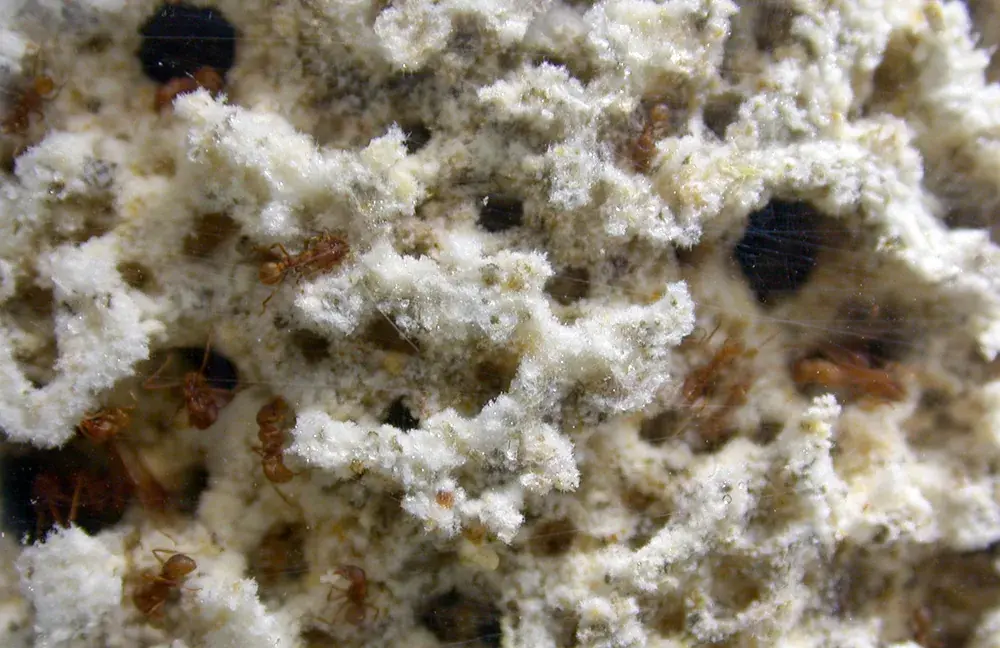
A captive colony of Atta laevigata on its fungus garden at the Museu de Zoologia da USP, according to the photo's file page; the pale, spongy mass is the fungus.
"Atta laevigata fungus garden" by Alex Wild — https://commons.wikimedia.org/wiki/File:Atta_laevigata_fungus_garden.jpg — CC0 1.0 (https://creativecommons.org/publicdomain/zero/1.0/); modified: converted to WebP at the original 1000 px width
These findings come from two reviews of earlier research, and the 2022 review was written for a purpose this page does not cover, so only its sections on the ants' biology are used here. Both reviews agree on the core: the leaves feed the fungus, and the fungus feeds the young. The 100 percent and 4.8 percent figures come from one study of one species, as the review reports it.
Still unsettled
- How much leaf cellulose does the garden actually break down? Aylward's review calls this the most controversial part of the process: one analysis found about 30 percent of leaf cellulose degraded, another found only limited breakdown, and studies the review cites report that the fungus cannot grow on cellulose alone in pure culture, though the review's own Table 1 summarizes one of them as showing that it can.
- Do the garden's bacteria help digest the leaves? Garden bacteria carry genes that could break down plant carbohydrates, but the 2012 review says the consistent presence of many cultured bacteria has yet to be shown, and the 2022 review says little is known about how the garden's organisms interact.
- How much do the workers' fecal droplets matter? Aylward's review says the relative importance of this pretreatment step to overall leaf breakdown is not known.
Studies cited
- Araújo S, Seibert J, Ruani A, Alcántara-de la Cruz R, Cruz A, Pereira A, Zandonai D, Forim M, Silva MF, Bueno O, Fernandes J (2022). The symbiotic fungus Leucoagaricus gongylophorus (Möller) Singer (Agaricales, Agaricaceae) as a target organism to control leaf-cutting ants. Insects 13(4): 359. doi:10.3390/insects13040359 pmc.ncbi.nlm.nih.gov/articles/PMC9029082/Read as: full text; read in full (PMC version); only the sections on the ants' biology are usedText license:CC BY 4.0 (terms)
- Aylward FO, Currie CR, Suen G (2012). The evolutionary innovation of nutritional symbioses in leaf-cutter ants. Insects 3(1): 41-61. doi:10.3390/insects3010041 pmc.ncbi.nlm.nih.gov/articles/PMC4553616/Read as: full text; read in full (PMC version)Text license:CC BY 3.0 (terms)
- Integrated Taxonomic Information System (ITIS). Atta Fabricius, 1804, TSN 154201 (genus; valid; Formicidae, Myrmicinae, Attini). www.itis.gov/servlet/SingleRpt/SingleRptRead as: abstract or record; database record (ITIS single report page), not a full textText license:CC0 1.0 (terms)
- Integrated Taxonomic Information System (ITIS). Acromyrmex Mayr, 1865, TSN 574019 (genus; valid; Formicidae, Myrmicinae, Attini). itis.gov/servlet/SingleRpt/SingleRptRead as: abstract or record; database record (ITIS single report page), not a full textText license:CC0 1.0 (terms)
Cite this page
“Leafcutter Ants: They Grow a Fungus Garden on Cut Leaves.” Animal Brainwork, published November 24, 2026. https://animalbrainwork.com/hive-and-colony/leafcutter-ants/. Accessed the day you read it.
How each claim is traced Retrials: every correction, dated Report an error on this page (contact@animalbrainwork.com)
Nearby questions in Hive & Colony
Experiment story
Waggle Dance: Distance Code Mostly Tracks Passing Scenery
Picture credit
"Honey bees on honeycomb (Insect Images 1355020)" by Scott Bauer, USDA Agricultural Research Service — https://commons.wikimedia.org/wiki/File:Apis_mellifera_scutellata_1355020.jpg — Public domain (work of a US federal employee (USDA Agricultural Research Service) made in the course of official duties, 17 U.S.C. §105; file page template PD-USGov-USDA-ARS; outside the US: the agency's own public-domain statement for its Image Gallery (ARS Images copyright page); upstream not traced (Bugwood Insect Images re-upload; ARS gallery page not read)); modified: cropped to 3:2 (full width, rows 700 to 2059 of 2948), resized to 1440 px wide and saved as WebP
Sense and mechanism
Bee Vision: Three Receptor Types Peak Near 344, 436, 544 nm
Picture credit
"Pollen covered Bee - Flickr - gailhampshire" by gailhampshire — https://commons.wikimedia.org/wiki/File:Pollen_covered_Bee_-_Flickr_-_gailhampshire.jpg — CC BY 2.0 (https://creativecommons.org/licenses/by/2.0/); modified: cropped to 3:2 (full width, rows 370 to 2508 of 2,728 kept), resized to 1440 px wide and converted to WebP
Experiment story
Honey Bee Swarm: Western Honey Bees Pick a Home by Quorum
Picture credit
"A swarm of Apis mellifera - 20051109" by Bidgee — https://commons.wikimedia.org/wiki/File:A_swarm_of_Apis_mellifera_-_20051109.jpg — CC BY 3.0 (https://creativecommons.org/licenses/by/3.0/); modified: cropped to 3:2 (full width, rows 50 to 1116 of 1,200 kept), resized to 1440 px wide and converted to WebP