Are Bees Smart? In One Lab, a String Trick Seemed to Spread
In one sentence
In one lab study from 2016, almost no untrained bumblebees solved a string-pulling puzzle, but 15 of 25 learned it by watching a trained bee and the trick spread through three colonies, which the authors traced to simple learning rather than insight.
- How it was asked
- Sylvain Alem, Clint Perry, Lars Chittka and colleagues, 2016: could bumblebees learn to pull a string to reach a flower hidden under clear plastic, and could they pick the skill up from another bee?
- Key study read as
- full text Alem et al. 2016, PLOS Biology (PMC5049772), with its 2016 correction notice
- Sample
- Buff-tailed bumblebee workers from 11 lab colonies: 291 bees tested untrained, 40 trained step by step, 52 caged observers of a trained bee (25 tested on a straight string, 27 on a coiled one), 15 ghost-control observers, 104 foragers in three colonies seeded with a trained bee; the spread result rests on three seeded colonies against three controls, in one laboratory small sample
Small sample: 20 or fewer animals and not yet repeated, so this reads as a lead, not a conclusion.
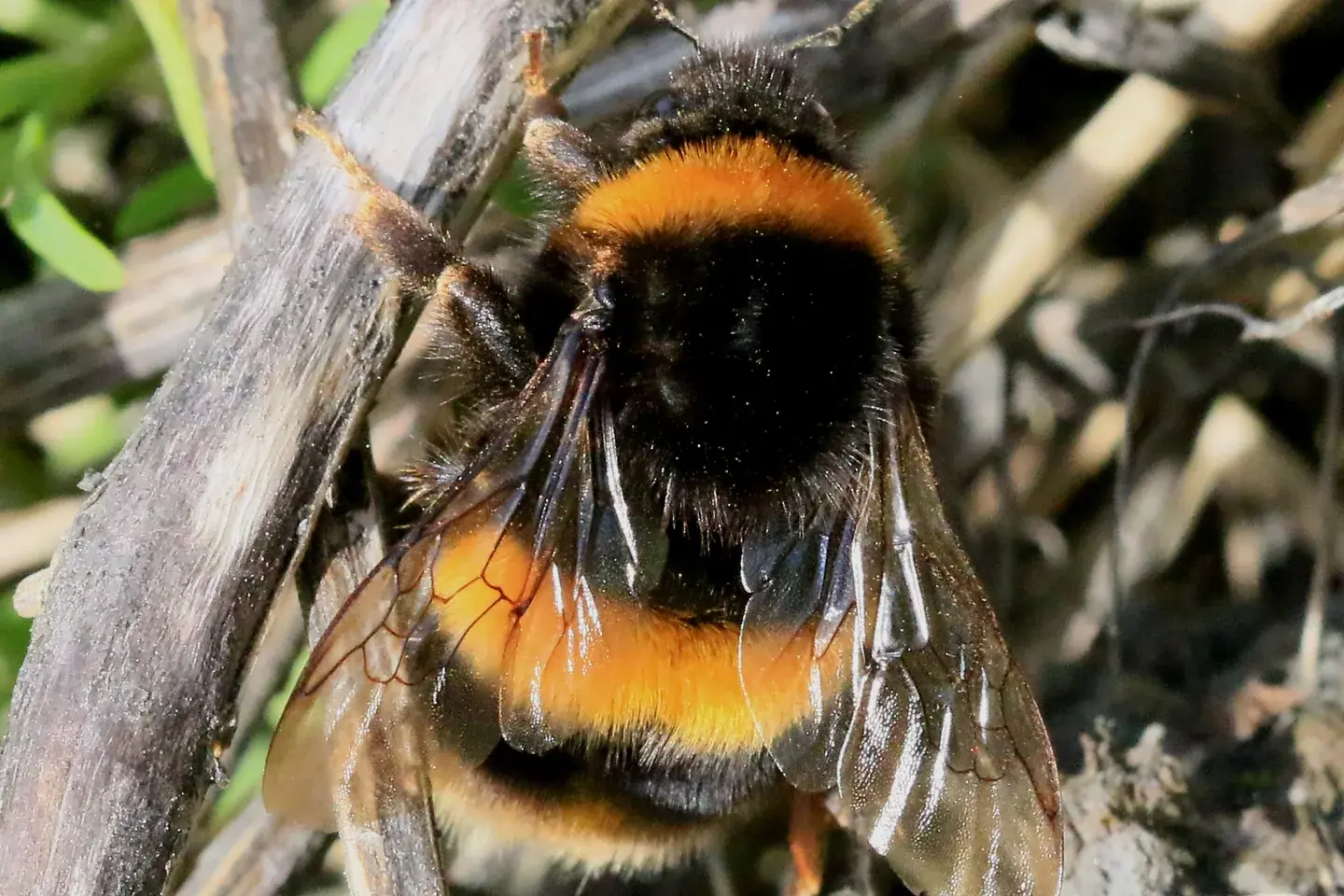
A buff-tailed bumblebee queen, Bombus terrestris as named on the photo's file page; the 2016 string-pulling study used workers of this species from lab colonies.
"Bombus terrestris (Buff-tailed bumblebee) - queen" by S. Rae from Scotland, UK — https://commons.wikimedia.org/wiki/File:Bombus_terrestris_(Buff-tailed_bumblebee)_-_queen_-_Flickr_-_S._Rae.jpg — CC BY 2.0 (https://creativecommons.org/licenses/by/2.0/); modified: cropped to 3:2 (full width kept; top and bottom trimmed, so the antenna tips and wing tips fall outside), resized to 1440 px wide and converted to WebP
Under a clear plastic table sat a blue artificial flower, and only a string reached past the edge. The bumblebees had already learned that blue flowers like this one held sugar water. Faced with the table, they landed on top and tried to reach the flower through the plastic.
None of 291 untrained bees solved the puzzle in a first five-minute try. Yet in the same 2016 study, 15 of 25 bees that had watched a trained bee pull the string solved it on their first try after watching, and the trick later spread through three colonies.
The study's answer to whether bees are smart is narrower than yes or no. Bumblebees picked up an unnatural skill from each other, and the authors found that simple learning, not insight, was enough to explain it.
How did bumblebees learn to pull a string?
Sylvain Alem, Clint Perry, Lars Chittka and colleagues at Queen Mary University of London ran the tests with buff-tailed bumblebees (Bombus terrestris) from 11 colonies supplied by a rearing program. Each artificial flower was a blue disc 3 cm across with sugar water at its center. A cotton string 4.5 cm long was glued to it, and the flower sat under a clear table raised 0.6 cm, too low for a bee to squeeze under.
The setup works as a question put to the bees, though the question is only a figure of speech: is there a way to reach a reward that is in sight but out of reach?
Only two bees answered it alone. After failing a first try, 2 of 25 untrained bees in one colony succeeded on a second five-minute try. The paper describes both as unusually exploratory: they moved the string by accident while trying to reach the flower, and took about 245 seconds, more than ten times longer than practiced pullers. Across the experiments, no other untrained bee found the solution.
Most bees needed lessons. In stepwise training, the flower was pushed farther under the table in four steps, until at the last step it sat 2 cm under and a 2.5 cm tail of string was the only way to it. Of 40 bees, 23 completed the training, at about 309 minutes each on average, while 17 stopped foraging or failed along the way.
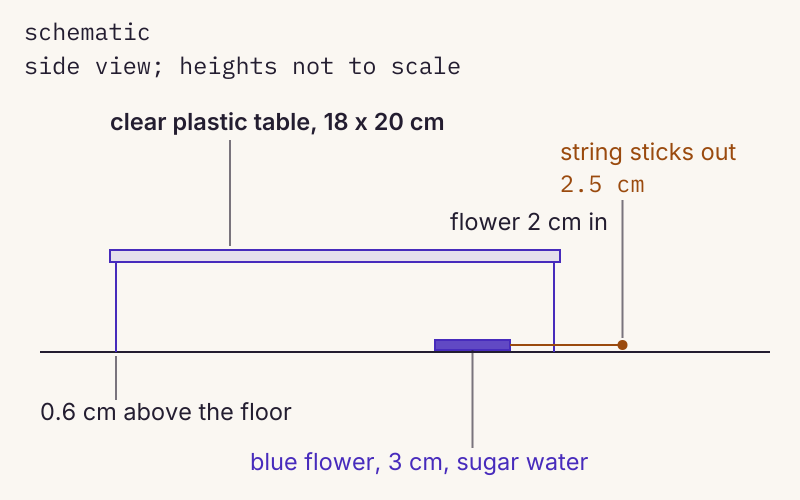
A schematic of the setup in the 2016 study by Alem and colleagues at the final training step: a blue flower under a clear table, reachable only by its string.
How the figure was made schematic; side view; table 18 x 20 cm, 0.6 cm above the floor; flower 3 cm across, 2 cm under the edge; string 4.5 cm, 2.5 cm past the edge; widths at 25 units per cm, heights not to scale
"The string-pulling setup" by Animal Brainwork, https://animalbrainwork.com/hive-and-colony/bumblebee-string-pulling/. Licensed under CC BY 4.0: https://creativecommons.org/licenses/by/4.0/
Data: Alem S, Perry CJ, Zhu X, Loukola OJ, Ingraham T, Søvik E, Chittka L (2016), PLOS Biology 14(10): e1002564, doi:10.1371/journal.pbio.1002564, CC BY 4.0
Could untrained bees learn by watching?
The team then placed untrained bees in a small plastic chamber between two tables, where each watched a trained bee pull strings ten times. Released alone into the arena afterward, 15 of 25 observers pulled a string and drank on their first try. That is 60 percent, against 2 of 25 untrained bees on a second try. The observers were slow at first, at about 181 seconds, close to the two lone solvers.
A claim that one animal learned from another owes the Clever Hans tax: the discount a cognition claim carries until the chance that the animal was reading cues from people is ruled out. The name comes from Clever Hans, the horse whose case shows why cues from the people around an animal have to be ruled out. In this study's “ghost control,” an experimenter moved the flowers with thin nylon threads pulled from outside the arena, so the paper notes the bees could not have seen fingers. An untrained bee then drank from the exposed flower.
None of the 15 bees that watched this learned the task. Before each test, strings were replaced and tables washed to remove scent cues, and each observer was tested alone. The methods section does not describe blind scoring of the videos.
The authors read the ghost result as showing that the bees needed to see another bee pulling. They also note that the observers may simply not have attended to the moving flower. With 15 bees, the evidence suggests rather than settles that point.
Video analysis pointed to two simple effects of watching. Observers went to the spot where they had seen the demonstrator, which the paper calls local enhancement, and less strongly toward the string itself, called stimulus enhancement. The blue disc mattered as well, and what a bee can see of the flower it is pulling is a separate question about color.
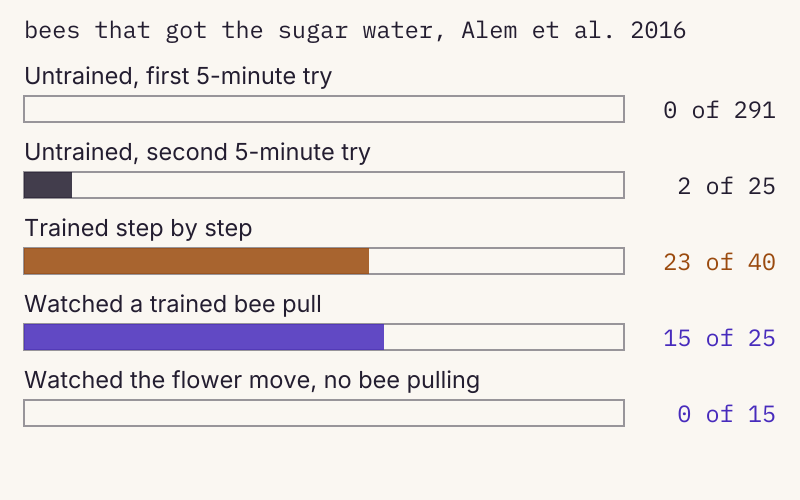
Counts from the 2016 study by Alem and colleagues: how many bees reached the sugar water in each group, from untrained bees to bees that watched a trained demonstrator.
How the figure was made bars = bees that got the reward / bees tested; counts from Alem et al. 2016 (CC BY 4.0): 0/291, 2/25, 23/40, 15/25, 0/15; training drop-outs 8 + 3 + 1 + 5 = 17
"Which bumblebees solved the string task" by Animal Brainwork, https://animalbrainwork.com/hive-and-colony/bumblebee-string-pulling/. Licensed under CC BY 4.0: https://creativecommons.org/licenses/by/4.0/
Data: Alem S, Perry CJ, Zhu X, Loukola OJ, Ingraham T, Søvik E, Chittka L (2016), PLOS Biology 14(10): e1002564, doi:10.1371/journal.pbio.1002564, CC BY 4.0
| Group (one lab study, Alem et al. 2016) | Bees tested | Got the sugar water |
|---|---|---|
| Untrained, first five-minute try | 291 | 0 |
| Untrained, second five-minute try | 25 | 2 |
| Trained step by step | 40 | 23 |
| Watched a trained bee pull | 25 | 15 |
| Watched the flower move, no bee pulling (ghost control) | 15 | 0 |
This table as CSV (bumblebee-string-pulling.csv) (source and license notes) Data: Alem S, Perry CJ, Zhu X, Loukola OJ, Ingraham T, Søvik E, Chittka L (2016), PLOS Biology 14(10): e1002564, doi:10.1371/journal.pbio.1002564, CC BY 4.0; Alem S, Perry CJ, Zhu X, Loukola OJ, Ingraham T, Søvik E, Chittka L (2016), Correction, PLOS Biology 14(12): e1002589, doi:10.1371/journal.pbio.1002589, CC BY 4.0
Did the trick spread through a colony?
The last experiment looked more like a colony's daily traffic. In three colonies, one bee trained to pull strings was added; three more colonies got none. Foragers then entered the arena two at a time, in the order they left the nest, with five minutes per bout and 150 paired bouts per colony.
After those 150 bouts, 25 of 47 foragers in colony 6, 17 of 29 in colony 7 and 12 of 28 in colony 8 had learned to pull the string. No forager learned in the three colonies without a trained bee. Where testing went on, the count kept rising, to 34 of 47 in colony 6 and 18 of 28 in colony 8.
A network analysis favored social transmission over independent discovery in all three seeded colonies. Those counts come from three seeded colonies and three controls in one laboratory, so the evidence suggests social spread without settling it.
How did a newcomer pick it up?
The videos showed learning in stages. A newcomer first drank beside a bee that had pulled a flower out, then followed it around the table, then pulled alongside it, and finally pulled alone. On average a learner was shown about five demonstrations before pulling on its own.
Some learners became demonstrators for others. The paper counts up to four “generations” of learners in two colonies, while stressing that these were not biological generations. In colony 6, the seeded demonstrator died after 58 paired bouts, and the skill kept spreading.
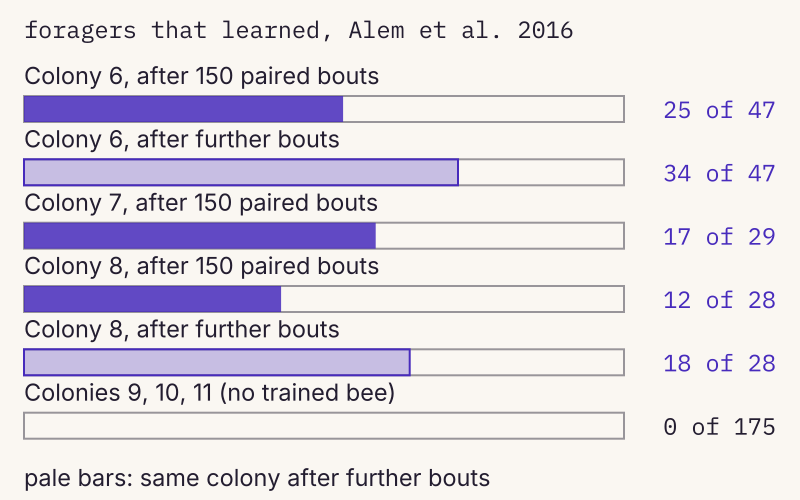
Foragers that learned to pull the string in the 2016 study by Alem and colleagues: the three colonies with one trained bee added shown one by one, the three without one pooled.
How the figure was made bars = foragers that learned / foragers in the colony; counts from Alem et al. 2016 (CC BY 4.0): 25/47, 34/47, 17/29, 12/28, 18/28; controls 0/51, 0/58, 0/66, total 175; 150 paired bouts per colony, then further bouts in colonies 6 and 8 for 34/47 and 18/28
The figure in words
- Colony 6, one trained bee added: 25 of 47 foragers learned after 150 paired bouts, 34 of 47 after further bouts.
- Colony 7, one trained bee added: 17 of 29 after 150 paired bouts.
- Colony 8, one trained bee added: 12 of 28 after 150 paired bouts, 18 of 28 after further bouts.
- Colonies 9, 10 and 11, no trained bee: 0 of 51, 0 of 58 and 0 of 66.
"How far string pulling spread in each colony" by Animal Brainwork, https://animalbrainwork.com/hive-and-colony/bumblebee-string-pulling/. Licensed under CC BY 4.0: https://creativecommons.org/licenses/by/4.0/
Data: Alem S, Perry CJ, Zhu X, Loukola OJ, Ingraham T, Søvik E, Chittka L (2016), PLOS Biology 14(10): e1002564, doi:10.1371/journal.pbio.1002564, CC BY 4.0; Alem S, Perry CJ, Zhu X, Loukola OJ, Ingraham T, Søvik E, Chittka L (2016), Correction, PLOS Biology 14(12): e1002589, doi:10.1371/journal.pbio.1002589, CC BY 4.0
The colony 11 count comes from a correction notice published in December 2016. It replaced an earlier 57 with 66 and stated that the results and conclusions did not change.
Is this insight or learning?
Insight, in this kind of test, means solving the task by grasping how the string connects to the reward, without trial and error. The study probed it with a coiled string: a 14 cm string zigzagged under the table, so the first tugs moved nothing in view. None of 27 bees that had watched a demonstrator solved it. Three of eight experienced pullers did, a small group.
A second test removed the blue disc, leaving a colorless flower. Right after training, only 2 of 15 bees reached the sugar water; after 48 hours and 20 more pulls, 11 of the 15 did. The authors concluded that learning the behavior “relied on a combination of simple associative mechanisms and trial-and-error learning” and did not require insight.
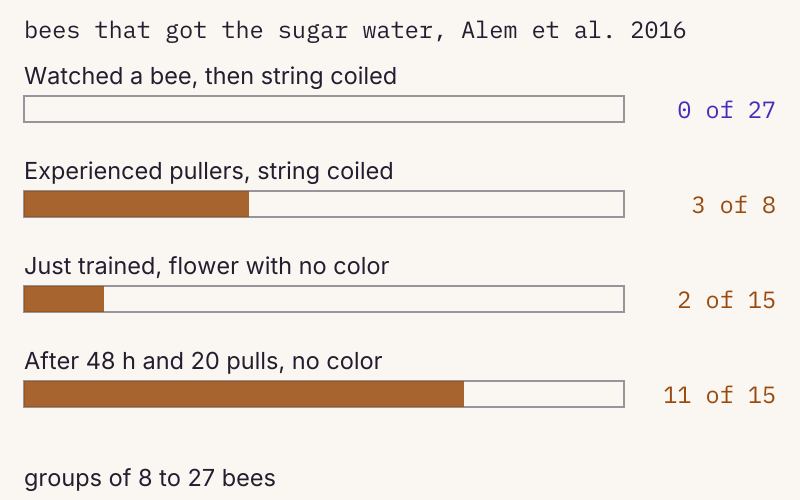
Counts from the 2016 study by Alem and colleagues for two tests that removed the usual visual feedback, a coiled string and a flower with no color; the groups are small.
How the figure was made bars = bees that got the reward / bees tested; counts from Alem et al. 2016 (CC BY 4.0): 0/27, 3/8, 2/15, 11/15; coiled string 14 cm; 20 pulls over 48 h
The figure in words
- Observers that had watched a demonstrator, string coiled: 0 of 27.
- Experienced pullers, string coiled: 3 of 8.
- Freshly trained bees, flower with no color: 2 of 15.
- The same bees after 48 hours and 20 pulls, flower with no color: 11 of 15.
"String pulling without the usual feedback" by Animal Brainwork, https://animalbrainwork.com/hive-and-colony/bumblebee-string-pulling/. Licensed under CC BY 4.0: https://creativecommons.org/licenses/by/4.0/
Data: Alem S, Perry CJ, Zhu X, Loukola OJ, Ingraham T, Søvik E, Chittka L (2016), PLOS Biology 14(10): e1002564, doi:10.1371/journal.pbio.1002564, CC BY 4.0
“Simple” here does not mean trivial. The paper's point runs the other way: a skill traveled through colonies without sophisticated reasoning behind it, which the authors take as a sign that the basic toolkit for spreading skills may be common. Reading the bees as reasoning planners, or as bare reflexes, would both miss what the study measured. The same question of insight versus learning follows crows given a puzzle about water instead of string.
What the study supports is narrow. Bumblebee workers from one laboratory, in a test arena, learned an unnatural task from each other and passed it along inside colonies. The authors judge a wild version of this exact spread unlikely, and frame that as a matter of opportunity rather than ability. The study does not compare bumblebees with honeybees, whose shared knowledge travels by dance, and it ranks no species.
Still unsettled
- Did observers learn the pull, or only where to stand? The coiled-string failures suggest the pulling itself came from trial and error, and the 15-bee ghost control could not separate a missing demonstrator from missing attention, as the paper itself notes.
- Does anything like this happen outside a lab? The authors think a natural version of this spread may be unlikely and call it a question of opportunity, and as of November 2026 this site has not read a field test of it.
- How much can one lab result claim about culture? The learner “generations” were not biological ones, the task was a single unnatural puzzle, and this site has not read an independent repeat by another laboratory.
Studies cited
- Alem S, Perry CJ, Zhu X, Loukola OJ, Ingraham T, Søvik E, Chittka L (2016). Associative mechanisms allow for social learning and cultural transmission of string pulling in an insect. PLOS Biology 14(10): e1002564. doi:10.1371/journal.pbio.1002564 pmc.ncbi.nlm.nih.gov/articles/PMC5049772/Read as: full text; read in full (PMC version), including the methods and Table 4Text license:CC BY 4.0 (terms)
- Alem S, Perry CJ, Zhu X, Loukola OJ, Ingraham T, Søvik E, Chittka L (2016). Correction: Associative mechanisms allow for social learning and cultural transmission of string pulling in an insect. PLOS Biology 14(12): e1002589. doi:10.1371/journal.pbio.1002589 pmc.ncbi.nlm.nih.gov/articles/PMC5198970/Read as: full text; correction notice read in full (PMC version)Text license:CC BY 4.0 (terms)
Cite this page
“Are Bees Smart? In One Lab, a String Trick Seemed to Spread.” Animal Brainwork, published November 24, 2026. https://animalbrainwork.com/hive-and-colony/bumblebee-string-pulling/. Accessed the day you read it.
How each claim is traced Retrials: every correction, dated Report an error on this page (contact@animalbrainwork.com)
Nearby questions in Hive & Colony
Experiment story
Waggle Dance: Distance Code Mostly Tracks Passing Scenery
Picture credit
"Honey bees on honeycomb (Insect Images 1355020)" by Scott Bauer, USDA Agricultural Research Service — https://commons.wikimedia.org/wiki/File:Apis_mellifera_scutellata_1355020.jpg — Public domain (work of a US federal employee (USDA Agricultural Research Service) made in the course of official duties, 17 U.S.C. §105; file page template PD-USGov-USDA-ARS; outside the US: the agency's own public-domain statement for its Image Gallery (ARS Images copyright page); upstream not traced (Bugwood Insect Images re-upload; ARS gallery page not read)); modified: cropped to 3:2 (full width, rows 700 to 2059 of 2948), resized to 1440 px wide and saved as WebP
Sense and mechanism
Bee Vision: Three Receptor Types Peak Near 344, 436, 544 nm
Picture credit
"Pollen covered Bee - Flickr - gailhampshire" by gailhampshire — https://commons.wikimedia.org/wiki/File:Pollen_covered_Bee_-_Flickr_-_gailhampshire.jpg — CC BY 2.0 (https://creativecommons.org/licenses/by/2.0/); modified: cropped to 3:2 (full width, rows 370 to 2508 of 2,728 kept), resized to 1440 px wide and converted to WebP
Experiment story
Honey Bee Swarm: Western Honey Bees Pick a Home by Quorum
Picture credit
"A swarm of Apis mellifera - 20051109" by Bidgee — https://commons.wikimedia.org/wiki/File:A_swarm_of_Apis_mellifera_-_20051109.jpg — CC BY 3.0 (https://creativecommons.org/licenses/by/3.0/); modified: cropped to 3:2 (full width, rows 50 to 1116 of 1,200 kept), resized to 1440 px wide and converted to WebP