Clever Hans: In Pfungst’s Tests, the Horse Read the Asker
In one sentence
In one study of a single horse, Oskar Pfungst found Clever Hans right 98 percent of the time when the questioner knew the answer and 8 percent when nobody present did, a gap he traced to the questioner's unintended head movements.
- How it was asked
- Oskar Pfungst, Berlin, fall 1904: numerals shown to the horse alone or to the questioner too, then blinders that hid the questioner.
- Key study read as
- full text Pfungst 1911, English translation by Carl L. Rahn.
- Sample
- One horse and one set of questioners; 42 and 49 tests in the card series small sample
Small sample: 20 or fewer animals and not yet repeated, so this reads as a lead, not a conclusion.
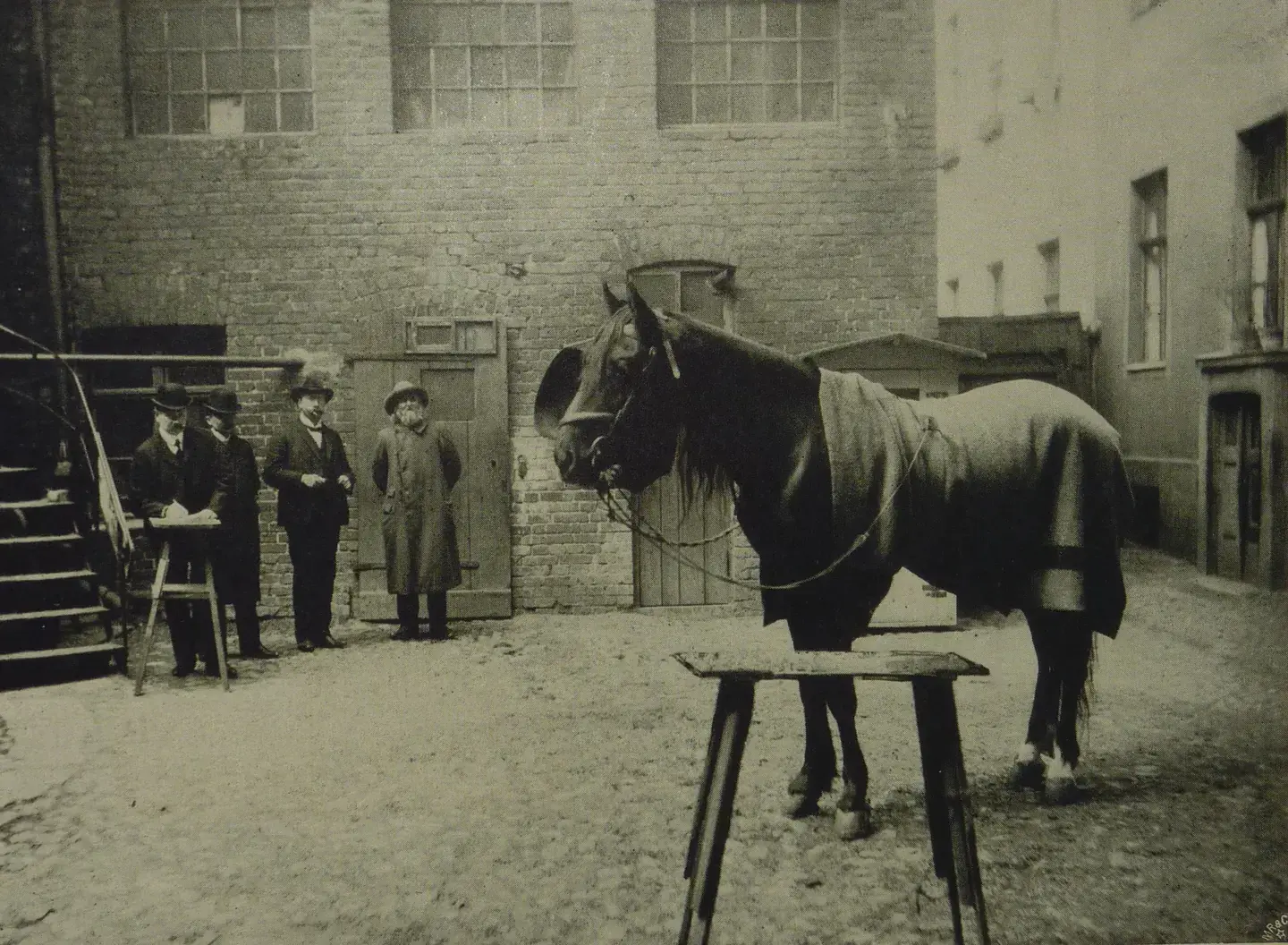
Clever Hans in a Berlin courtyard, with four men in hats standing back by the wall. According to the file page, the plate comes from Karl Krall's 1912 book Denkende Tiere, shows the horse being tested, and names the men as Busse, Gehrke, Karl Krall and Wilhelm von Osten.
“Hans under test (Karl Krall, Denkende Tiere, 1912, plate 1)”, Unknown author; Karl Krall, Denkende Tiere, Leipzig 1912, Tafel 1; public domain.
Full credit
"Hans under test (Karl Krall, Denkende Tiere, 1912, plate 1)" by Unknown author; Karl Krall, Denkende Tiere, Leipzig 1912, Tafel 1 — https://commons.wikimedia.org/wiki/File:Hans_Pr%C3%BCfung_1907.jpg — Public domain (published 1912 in Karl Krall's Denkende Tiere (Leipzig), plate 1; photographer unnamed; public domain in the US (published before 1931); EU: anonymous work, more than 70 years after publication; file page tags PD-old-70 and the Public Domain Mark 1.0; upstream not traced); modified: resized to 1440 px wide and saved as WebP
Card and share picture, cropped from this picture: "Hans under test (Karl Krall, Denkende Tiere, 1912, plate 1), card crop" by Unknown author; Karl Krall, Denkende Tiere, Leipzig 1912, Tafel 1 — https://commons.wikimedia.org/wiki/File:Hans_Pr%C3%BCfung_1907.jpg — Public domain (published 1912 in Karl Krall's Denkende Tiere (Leipzig), plate 1; photographer unnamed; public domain in the US (published before 1931); EU: anonymous work, more than 70 years after publication; file page tags PD-old-70 and the Public Domain Mark 1.0; upstream not traced); modified: crop of the same original as clever-hans-pruefung-1912 (the page's first image, shown whole): cropped to 3:2, full width, rows 101 to 1900 of the 2699 x 1979 px file, which trims a strip of wall at the top and of courtyard at the bottom and cuts away the printer's monogram in the bottom-right corner, resized to 1440 x 960 px and saved as WebP; no color change
In a paved courtyard in northern Berlin, a horse answered questions by tapping his right forefoot. Visitors paid nothing and could walk right up to the Russian trotting horse and his owner, Mr. von Osten, a former mathematics teacher. Put a sum to Hans and he tapped out a number; ask him a yes-or-no question and he nodded or shook his head.
Oskar Pfungst, a co-worker at Carl Stumpf's Psychological Institute in Berlin, took over the questioning in the fall of 1904 and changed one thing at a time. In his numeral-card series, Hans was right in 98 percent of 42 tests when the questioner knew the number, and in 8 percent of 49 tests when nobody present knew it. The difference, he found, lay in the questioner rather than the horse.
His book appeared in English in 1911, translated by Carl L. Rahn, and that edition full text is the source for this page's account of the case.
What could Clever Hans supposedly do?
Pfungst's first chapter lists what the horse was credited with, and counting was the least of it. Hans was said to add, subtract, multiply and divide, to turn common fractions into decimals, to pick out German words written on placards, and to give the date of any day named to him. Letters, musical tones and playing cards had all been turned into numbers so that he could tap them.
The case divided Germany. Pfungst records that the horse appeared on picture postcards and liquor labels, and that respected naturalists declared themselves convinced. Others were sure the horse was being given signs and pointed to the owner's slouch hat, the questioner's long coat or a hand thrust into a pocket of carrots.
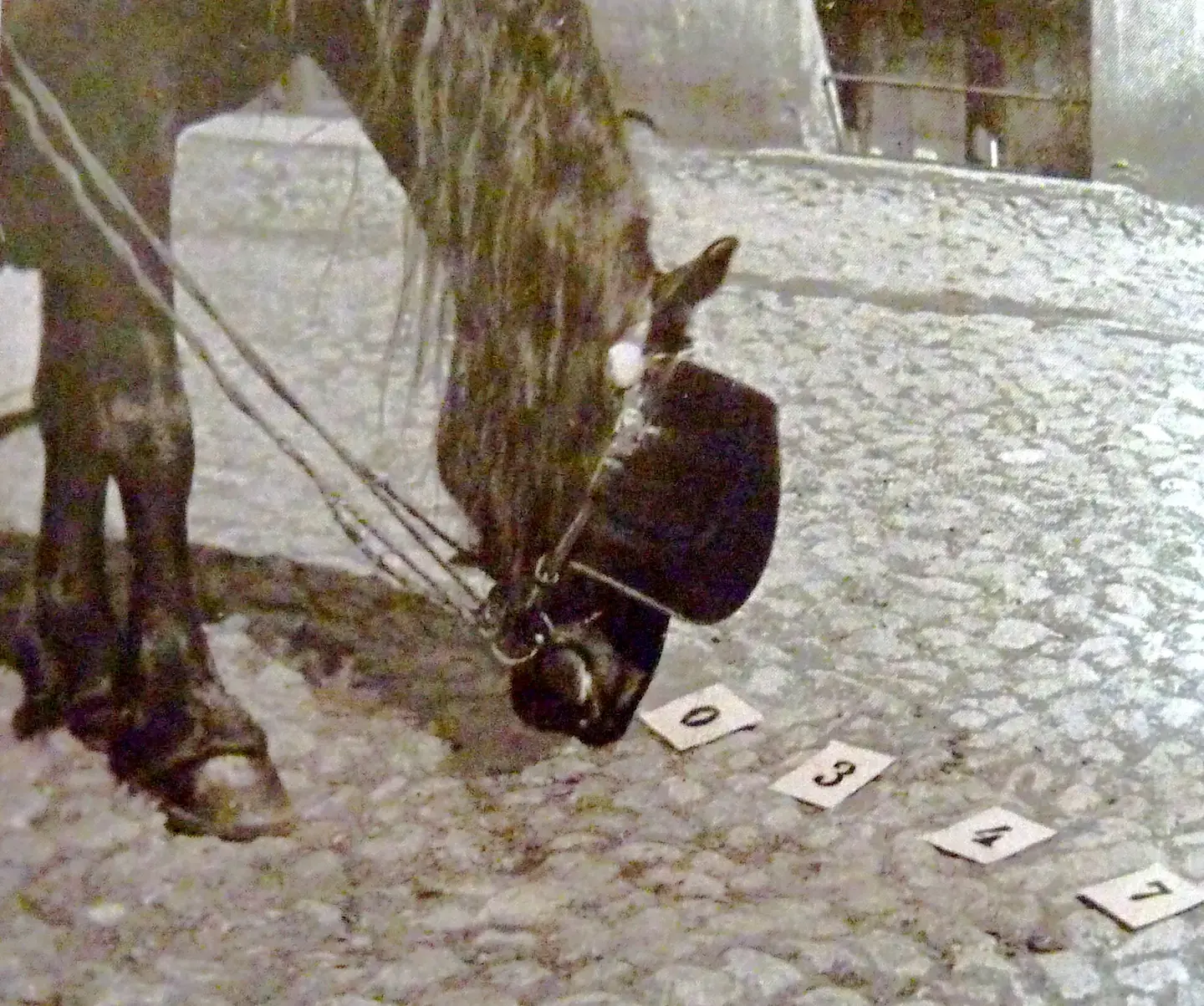
Hans, with a large flap fixed beside his eye, lowers his nose to numeral cards laid on the cobbles. According to the file page, the photograph comes from Karl Krall's 1912 book Denkende Tiere and was probably taken before 1909.
“Hans pointing to numerals (Karl Krall, Denkende Tiere, 1912, p. 364)”, Karl Krall, Denkende Tiere, 1912, p. 364; public domain.
Full credit
"Hans pointing to numerals (Karl Krall, Denkende Tiere, 1912, p. 364)" by Karl Krall, Denkende Tiere, 1912, p. 364 — https://commons.wikimedia.org/wiki/File:Hans_zeigt_Zahlen_an.jpg — Public domain (published 1912 in Karl Krall's Denkende Tiere (Leipzig), p. 364; public domain in the US (published before 1931); EU: Krall's death year not verified from a library or Project Gutenberg catalog record, so this rests on publication in 1912 and the file page's PD-old-70 tag and Public Domain Mark 1.0; upstream not traced); modified: adjusted by Frank C. Müller: the current Commons version, brightened by him on 16 August 2011 per the file history, is the one used, resized to 1440 px wide and saved as WebP
A group of thirteen men, among them a circus manager, a zoo director and Stumpf himself, watched von Osten and the horse in September 1904. Their report of September 12, printed in the English edition, found no deliberate tricks and judged that unintentional signs “of the kind which are at present familiar” were also excluded. Stumpf later stressed that the group had not declared that the horse could think. It had set out only to rule out tricks.
How did Pfungst test the horse?
Every test that followed can be read, as a figure of speech only, as a question put to the horse: is the answer in you, or in the person beside you? The questioner stood at the horse's right, where von Osten had been used to standing, and paid each correct answer with a bit of bread or carrot. A large canvas tent put up inside the courtyard gave the tests some isolation.
For the card series, numerals were shown to Hans in a way that kept them hidden from everyone present, the questioner included. Pfungst called this the procedure without knowledge. In the matching tests the questioner saw the card as well. He alternated the two kinds of trial so that nobody could blame a strange routine for the horse's misses, and each result was recorded at once.
Sight came next. Blinders 15 by 15 centimeters hid the questioner, who stood at the horse's right where Hans could hear him but not see him; then the questioner stepped forward into view and asked the same thing again. Von Osten had first offered his own screens, a slate held over a face, a bolster tied to the horse's head and a pair of small blinders, and none of them gave clear results.
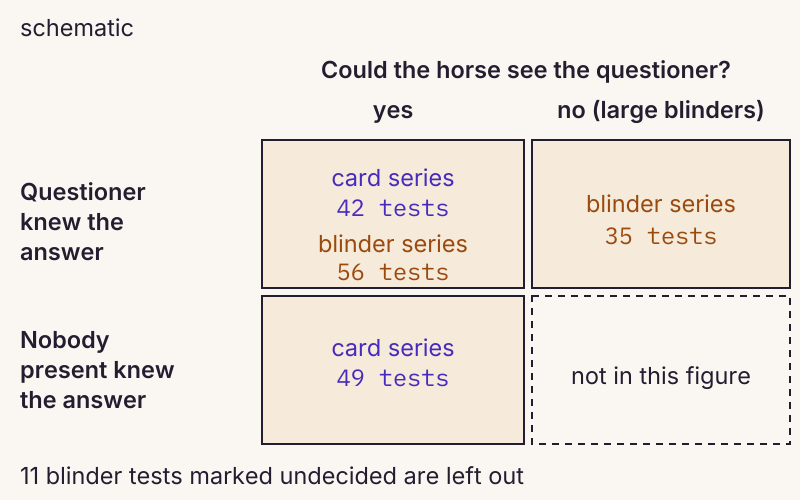
A schematic of the conditions Pfungst varied: whether the questioner knew the answer, and whether the horse could see the questioner. Drawn from the text of the 1911 English translation.
How the figure was made schematic; questioner knew / nobody present knew x horse could / could not see the questioner; card series 42 and 49 tests; large-blinder series 56 seen, 35 not seen, 11 undecided omitted; 1911 English translation, ch. II
The figure in words
- Questioner knew the answer, horse could see him: card series, 42 tests; large-blinder series, 56 tests.
- Nobody present knew the answer, horse could see the questioner: card series, 49 tests.
- Questioner knew the answer, horse could not see him: large-blinder series, 35 tests.
- Nobody knew and the horse could not see: not part of either series shown here.
- Eleven blinder tests in which it was unclear whether the horse saw the questioner are left out.
"Which conditions Pfungst varied" by Animal Brainwork, https://animalbrainwork.com/thinking/clever-hans/. Licensed under CC BY 4.0: https://creativecommons.org/licenses/by/4.0/
Data: Pfungst 1911, transl. C. L. Rahn (public domain in the US), ch. II, pp. 35 and 43
What happened when the asker didn't know the answer?
The card series split cleanly. With the questioner knowing the number, Hans was right in 98 percent of 42 tests. With nobody present knowing it, he was right in 8 percent of 49. In one run with von Osten himself as questioner, a card showing 10 that he had not seen drew 17 taps; once he had seen it, Hans tapped 10.
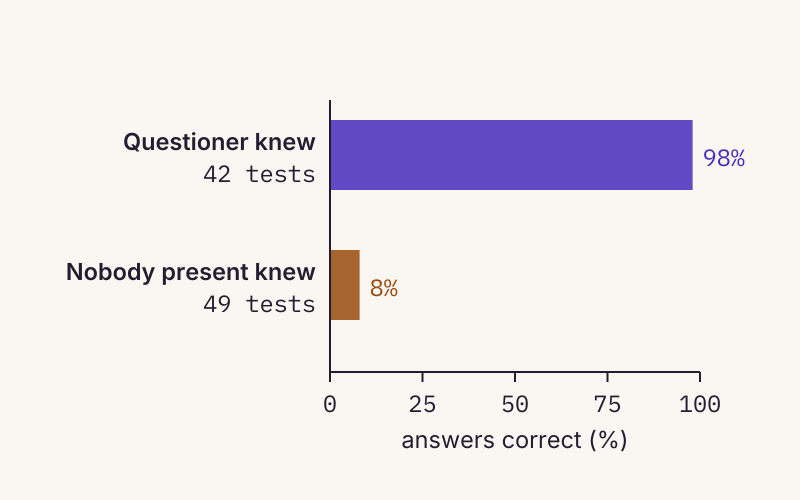
Pfungst's numeral-card series with one horse: Hans was right in 98 percent of 42 tests when the questioner knew the number and in 8 percent of 49 tests when nobody present knew it.
How the figure was made bars: percent correct as printed in Pfungst 1911, ch. II, p. 35; 42 tests with knowledge, 98 percent; 49 tests without knowledge, 8 percent; one horse
"Card-series results in Pfungst's tests" by Animal Brainwork, https://animalbrainwork.com/thinking/clever-hans/. Licensed under CC BY 4.0: https://creativecommons.org/licenses/by/4.0/
Data: Pfungst 1911, transl. C. L. Rahn (public domain in the US), ch. II, p. 35
Pfungst's tests, card series (source: Pfungst 1911, ch. II, p. 35, read in full):
| Condition | Tests | Answers correct |
|---|---|---|
| Questioner knew the number | 42 | 98% |
| Nobody present knew the number | 49 | 8% |
This table as CSV (clever-hans-pfungst-tests.csv) (source and license notes) Data: Pfungst 1911, transl. C. L. Rahn (public domain in the US), ch. II, p. 35
Pfungst treated the few correct answers without knowledge as chance and concluded that the horse could not read numerals without help. The book prints only the percentages, so the counts behind them are not given.
The large blinders gave the same answer from the other side. In 102 tests, the questioner was certainly not seen in 35, and Hans was right in 6 percent of them, only two answers. When the questioner was in view, in 56 tests, the horse was right in 89 percent. The 11 tests marked undecided came out at 18 percent.
With von Osten's small blinders, by contrast, a third of 108 tests could not be classed as seen or not seen. Pfungst noted that counting those as unseen, as von Osten had, would have made the horse look independent of sight.
What cue was Hans reading?
Pfungst found the signal by watching von Osten, and he described it as “minimal movements of the head on the part of the experimenter.” Once a problem had been set, the questioner bent his head and trunk slightly forward without meaning to, and the horse began to tap. When the count reached the answer, the questioner's head gave a slight upward jerk, and Hans swung his foot back to its starting place. Raising the head and trunk fully came a moment later and was not the stop signal.
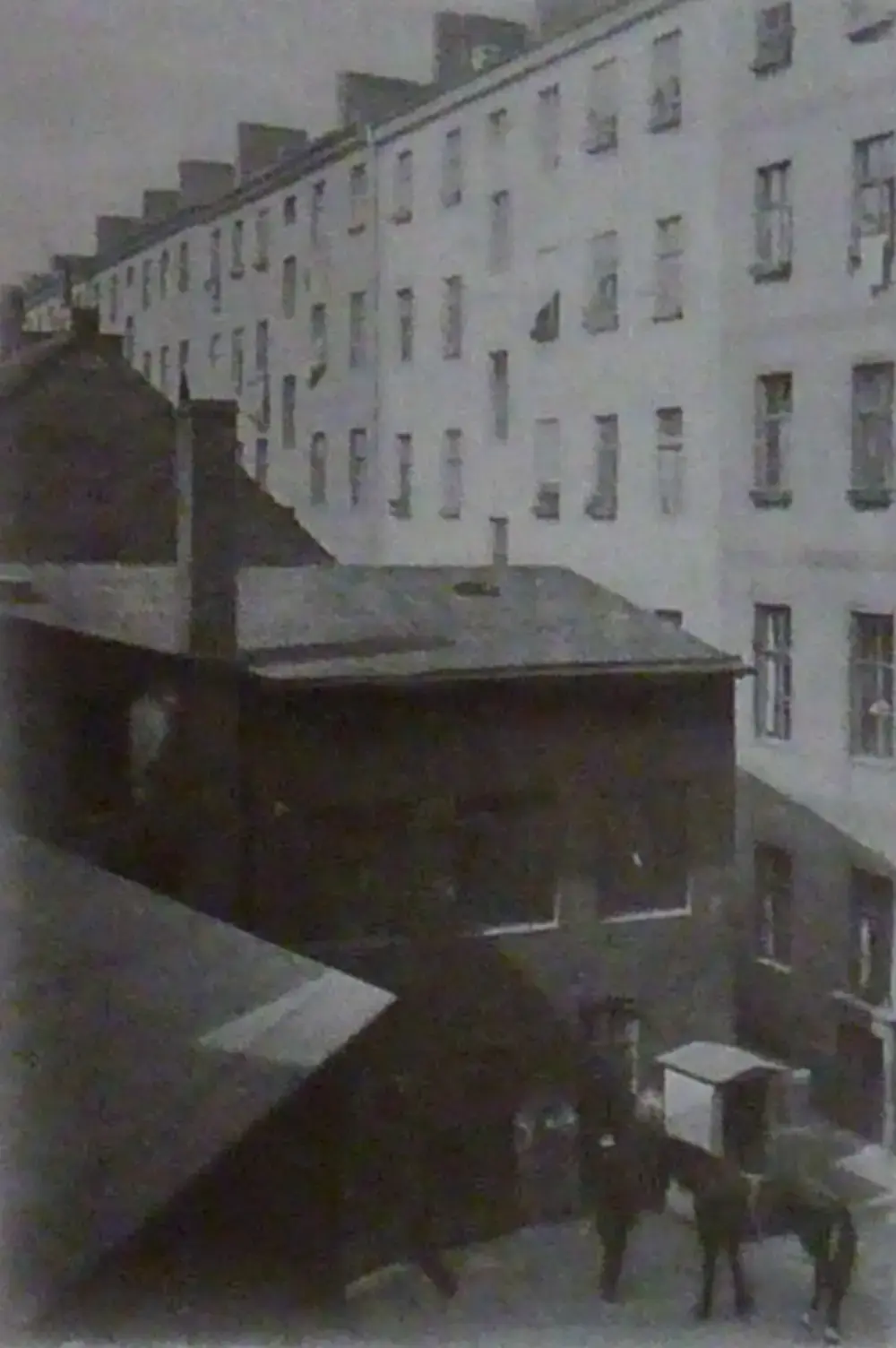
Hans in the courtyard outside his stall in Berlin, below tall apartment blocks, with one small figure beside him. According to the file page, the photograph appeared in Karl Krall's 1912 book Denkende Tiere and dates from 1909 or earlier.
“Hans in front of his stall in Berlin (Karl Krall, Denkende Tiere, 1912, p. 73)”, Karl Krall, Denkende Tiere, 1912, p. 73; public domain.
Full credit
"Hans in front of his stall in Berlin (Karl Krall, Denkende Tiere, 1912, p. 73)" by Karl Krall, Denkende Tiere, 1912, p. 73 — https://commons.wikimedia.org/wiki/File:Hans_vor_seinem_Stall_in_Berlin.jpg — Public domain (published 1912 in Karl Krall's Denkende Tiere (Leipzig), p. 73; public domain in the US (published before 1931); EU: Krall's death year not verified from a library or Project Gutenberg catalog record, so this rests on publication in 1912 and the file page's PD-old-70 tag and Public Domain Mark 1.0; upstream not traced); modified: resized to 1000 px wide and saved as WebP
The other people who got answers, such as the zoologist Schillings and Count zu Castell, made the same movements, while von Osten's were the smallest of all. Pfungst also noted that, as far as he could tell, Hans did not look at the objects he was counting or the words he was reading, yet strained hard to keep the questioner in view.
Pfungst then learned to make the movements on purpose. Stumpf's report of December 9, 1904, printed in the same book, says he could set off each of the horse's responses by moving in the right way, without putting the question at all. It also says he got the same result by simply concentrating on the number he wanted, because the movement then came whether he willed it or not.
The same movements in people
To see whether the movements were peculiar to a few men, Pfungst played the horse himself at the Psychological Institute. Each of 25 people stood at his right and concentrated on a number while he tapped with his hand. All but two made the same involuntary movements described for the courtyard, above all a slight upward jerk of the head at the final number. The movements seldom amounted to a millimeter.
What is the Clever Hans tax?
Animal Brainwork uses the name the Clever Hans tax for the discount every claim about animal cognition carries until one possibility has been ruled out: that the animal was reading cues from the people around it rather than doing the mental work the claim credits it with. Pfungst's card series is the example. The same horse that was right in 98 percent of 42 tests with a knowing questioner was right in 8 percent of 49 tests once nobody present knew the answer.
This page uses Clever Hans effect for the pattern Pfungst exposed, in which an animal's answers track signals that a questioner gives without meaning to. Read as this site reads them, the tests involved one horse and one set of questioners, so they show a risk, not a law about animals. A fair test of an animal's skill keeps the answer from anyone the animal can see.
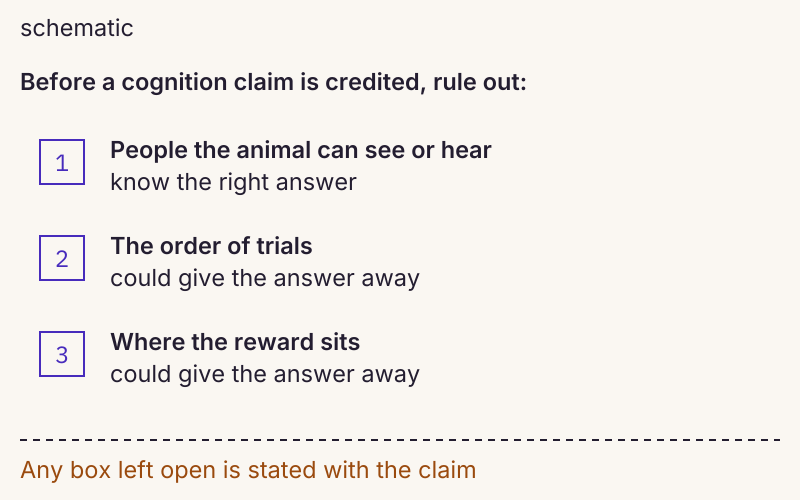
A schematic checklist for paying the Clever Hans tax: three ways people's cues can reach an animal in a test, each to be ruled out before a claim about animal intelligence is credited.
How the figure was made schematic; three cue sources from this site's definition of the Clever Hans tax; checklist layout; no data
The figure in words
- People the animal can see or hear know the right answer.
- The order of trials could give the answer away.
- Where the reward sits could give the answer away.
- Any source left open is stated alongside the claim.
"The Clever Hans tax as a checklist" by Animal Brainwork, https://animalbrainwork.com/thinking/clever-hans/. Licensed under CC BY 4.0: https://creativecommons.org/licenses/by/4.0/
Data: site computation
The same question is asked of the mirror test given to cleaner wrasse in one 2019 study, of New Caledonian crows given puzzles, of archerfish that told a learned face from new ones in a 2016 study and of a bumblebee string-pulling experiment with a demonstrator. Each of those pages says how the experiment kept people's cues out, or says that it did not.
The 1904 tests also have limits of their own. The evidence suggests that one horse, schooled for four years by one owner, answered to its questioners' movements, and that a crowd of confident observers missed those movements. It does not show that horses learn nothing, and Pfungst wrote that his negative conclusion had to be generalized “with care,” because Hans was a domesticated animal kept in unusual conditions.
Still unsettled
- How much can a cue leak when people stay in the room? Pfungst measured the leak for one horse under two kinds of control. Any later experiment with a person in view has to show its own controls, and no single number carries over from a horse in a Berlin courtyard.
- Do the 1904 numbers say anything about other animals? The tests used one horse and one set of questioners. Pfungst himself argued that Hans, a confined domestic horse, could not be taken as normal without further qualification, so the percentages describe a risk in testing rather than a measure of horses.
- Is reading people a skill worth studying for its own sake? Pfungst concluded that the horse's ability to perceive movements “greatly exceeds that of the average man” and guessed at a difference in the retina. His book does not test that guess.
Studies cited
- Pfungst O (1911). Clever Hans (the horse of Mr. von Osten): a contribution to experimental animal and human psychology, transl. C. L. Rahn, with an introduction by C. Stumpf. New York: Henry Holt. Rahn English translation 1911; public domain in the US (published 1911). gutenberg.pglaf.org/cache/epub/33936/pg33936-images.htmlRead as: full text; Project Gutenberg 33936; ch. I-II, IV and Conclusion, with Stumpf's introduction and supplements II-IV (reports of September 12 and December 9, 1904)
Cite this page
“Clever Hans: In Pfungst’s Tests, the Horse Read the Asker.” Animal Brainwork, published November 24, 2026. https://animalbrainwork.com/thinking/clever-hans/. Accessed the day you read it.
How each claim is traced Retrials: every correction, dated Report an error on this page (contact@animalbrainwork.com)
Nearby questions in Animal Thinking
Myth, retested
Mirror Test: In a 2019 Study, 3 of 4 Wrasse Scraped the Mark
Picture credit
"Bluestreak Cleaner Wrasse" by Elias Levy — https://commons.wikimedia.org/wiki/File:Bluestreak_Cleaner_Wrasse_(6997583331).jpg — CC BY 2.0 (https://creativecommons.org/licenses/by/2.0/); modified: cropped to 3:2 (centered, whole fish kept), resized to 1440 px wide and converted to WebP, adjusted by Togabi: the current Commons version, a color adjustment of Elias Levy's photo uploaded by Togabi on 30 November 2017 (comment "Color Adjustment.", same 2,297 x 1,722 px as the 30 May 2015 transfer from Flickr), per the file history, is the one used
Experiment story
Crow Intelligence: Even a Visible Pipe Stumped 5 Test Crows
Picture credit
"Corvus moneduloides, Bourail, New Caledonia" by benkeen — https://commons.wikimedia.org/wiki/File:Corvus_moneduloides,_Bourail,_New_Caledonia_1.jpg — CC0 1.0 (https://creativecommons.org/publicdomain/zero/1.0/); modified: the Commons version used is adjusted by MPF (light levels, color balance and a crop to the bird, 6 April 2026, 1,400 x 1,054 px, from the 1,400 x 1,468 px first upload of benkeen's photo, which MPF also made that day), cropped to 3:2 (1400 x 933; 40 px off the top and 81 px off the bottom, whole bird kept), converted to WebP at the original 1400 px width
Myth, retested
Octopus Intelligence: By One Count, Most Neurons Are in Arms
Picture credit
"Octopus vulgaris (Merculiano, in Jatta, I Cefalopodi viventi nel Golfo di Napoli, 1896)" by Comingio Merculiano in Jatta Giuseppe — https://commons.wikimedia.org/wiki/File:Octopus_vulgaris_Merculiano.jpg — Public domain (published 1896 in Giuseppe Jatta's I Cefalopodi viventi nel Golfo di Napoli (Italy); public domain in the US (published before 1931); EU: Merculiano's death year not verified from a library or Project Gutenberg catalog record, so this rests on publication in 1896 and the file page's PD-old-100-expired tag; scan tagged PD-scan; upstream not traced); modified: whole plate kept; white margins in the plate's paper color added at left and right to make a 3:2 frame, resized to 1440 px wide and converted to WebP