Crow Intelligence: Even a Visible Pipe Stumped 5 Test Crows
In one sentence
In one 2014 study, New Caledonian crows dropped stones to raise water and mostly chose objects that sink, but only one of five crows solved a U-tube with a hidden pipe, and none of five reliably chose the connected tube with the pipe in view.
- How it was asked
- Corina Logan and colleagues, 2014: would wild-caught New Caledonian crows drop stones into the tube that actually raised their food, across seven versions of the Aesop's fable task?
- Key study read as
- full text Logan et al. 2014, PLOS ONE (PMC4108369)
- Sample
- 8 wild-caught crows, 4 to 6 per task small sample; a separate 2014 study by Sarah Jelbert and colleagues tested 6 crows
Small sample: 20 or fewer animals and not yet repeated, so this reads as a lead, not a conclusion.
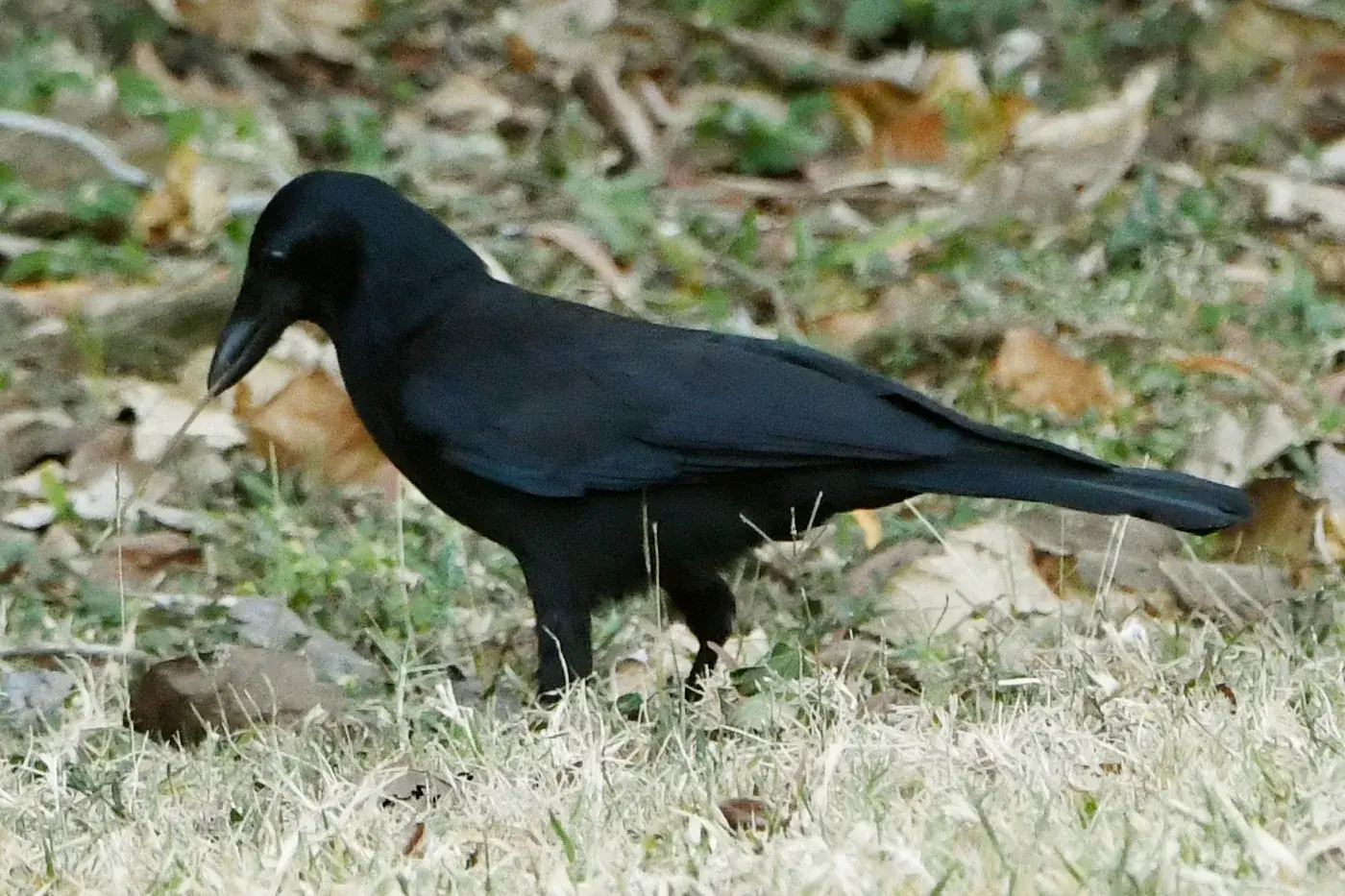
A New Caledonian crow, Corvus moneduloides, on open ground at Bourail, New Caledonia, according to the photo's file page: the species tested in both 2014 Aesop's fable studies.
“Corvus moneduloides, Bourail, New Caledonia”, benkeen; CC0.
Full credit
"Corvus moneduloides, Bourail, New Caledonia" by benkeen — https://commons.wikimedia.org/wiki/File:Corvus_moneduloides,_Bourail,_New_Caledonia_1.jpg — CC0 1.0 (https://creativecommons.org/publicdomain/zero/1.0/); modified: the Commons version used is adjusted by MPF (light levels, color balance and a crop to the bird, 6 April 2026, 1,400 x 1,054 px, from the 1,400 x 1,468 px first upload of benkeen's photo, which MPF also made that day), cropped to 3:2 (1400 x 933; 40 px off the top and 81 px off the bottom, whole bird kept), converted to WebP at the original 1400 px width
In Aesop's fable, a thirsty crow drops pebbles into a pitcher until the water rises high enough to drink. Laboratories have turned the story into a test: a crow gets a tube of water with a scrap of meat floating on a cork, just out of reach, and a few stones on the table.
New Caledonian crows handle the basic version. In two 2014 studies they dropped stones into water rather than sand and picked objects that sink. In one of those studies, though, a version with a hidden pipe between two tubes stopped nearly all the birds. When the pipe was put on view, none of the five crows reliably chose the tube it connected.
What is the Aesop's fable test?
Corina Logan and colleagues, writing in PLOS ONE in 2014 full text, define it in one line: the test “requires an animal to drop stones into a water-filled tube to bring a floating food reward within reach.” Sarah Jelbert's team, in a second 2014 paper in the same journal full text, traces it to experiments on rooks by Bird and Emery in 2009 bibliographic.
Logan's team adds that dropping stones into water is a kind of tool use “not seen in the wild,” which, the paper argues, makes it a fair task for comparing species.
Each version of the tube works, as a figure of speech only, like a question put to the bird: which choice brings the food up? Water or sand, a sinking object or a floating one, a narrow tube or a wide one.
Before testing, the crows in Logan's study learned to drop stones onto a platform that collapsed and released meat. In the water tests, the water sat 12 millimeters below the point where each bird could reach the food with its bill. Each stone raised it 4 to 5 millimeters, and the gap was set so that two to four stones were needed.
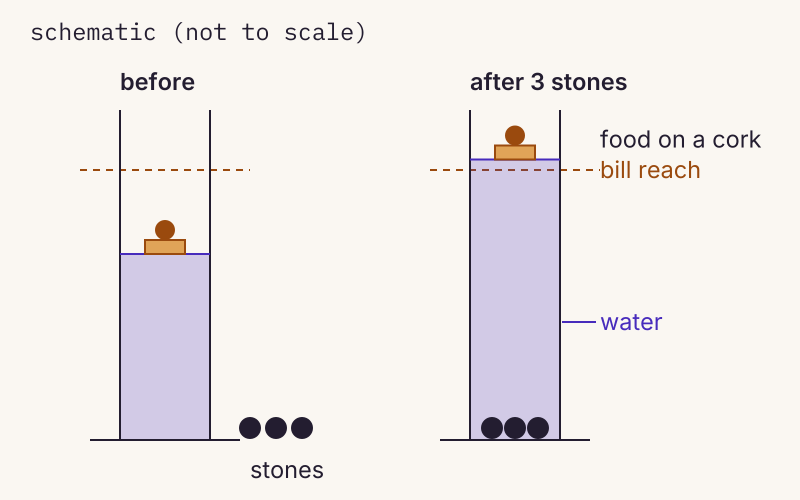
A schematic of the Aesop's fable task as Logan's team set it up: the food starts just below the crow's reach, and dropped stones raise the water until the bird can take it.
How the figure was made schematic, not to scale; after the methods of Logan et al. 2014: tube inner diameter 40 mm; water 12 mm below the bird's reach; stones 14-17 g, each raising the water 4-5 mm; drawn with 3 stones
"The Aesop's fable task" by Animal Brainwork, https://animalbrainwork.com/thinking/crow-intelligence/. Licensed under CC BY 4.0: https://creativecommons.org/licenses/by/4.0/
Data: Logan CJ, Jelbert SA, Breen AJ, Gray RD, Taylor AH (2014), PLOS ONE 9(7): e103049, doi:10.1371/journal.pone.0103049, CC BY 4.0
Who could the crows see?
Any claim about animal problem solving owes the Clever Hans tax: the discount it carries until the chance that the animal was reading cues from people has been ruled out. The name comes from Clever Hans, the horse whose questioners gave away the answers without meaning to.
In Logan's study, each crow was tested alone, out of sight of the other birds, and the useful tube switched sides in a planned, irregular order. Jelbert's team also filmed all of its trials. Neither paper says where the experimenter stood or whether the crows could see that person, so this page cannot count that part of the tax as paid. On the U-tube most crows chose at chance, which shows no sign of a helpful cue, though the one crow that passed the covered version leaves the gap open.
What did the crows get right?
Choosing what to drop went well in both studies. In Logan's study, 6 of 6 crows passed when offered sinking erasers and floating foam blocks, and 6 of 6 passed with closed metal cubes against open cube frames of the same weight. On water against sand, 3 of 5 crows passed, and 74 percent of all stones dropped went into the water. Jelbert's study found the same pattern, with 6 of 6 crows passing sinking against floating and 5 of 5 passing solid against hollow.
Tube width was harder. In Logan's version, each crow got only four objects, enough to win in the narrow tube but not the wide one, and 4 of 6 crows chose the narrow tube. Three of those four then switched to the wide tube when the narrow tube's water was set too low to ever reach. Jelbert's crows had 12 objects, enough to win in either tube, and none of the 5 showed a preference for the narrow one.
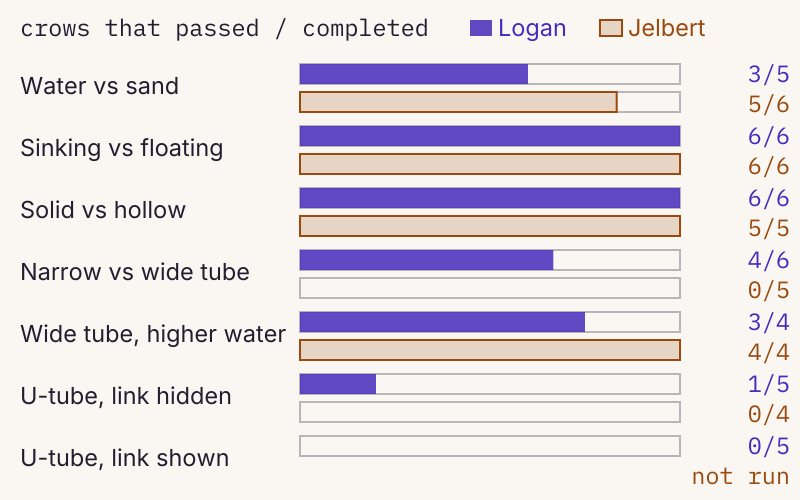
Crows that passed each Aesop's fable task out of those that completed it, as each 2014 study reports it; Jelbert's team ran no uncovered U-tube.
How the figure was made bars = crows that passed / crows that completed each task; pass = individual binomial test over 20 trials, as each study reports it; Logan et al. 2014 (CC BY 4.0): 3/5, 6/6, 6/6, 4/6, 3/4, 1/5, 0/5; Jelbert et al. 2014 (CC BY 4.0): 5/6, 6/6, 5/5, 0/5, 4/4, 0/4
"Aesop's fable tasks: crows that passed, two 2014 studies" by Animal Brainwork, https://animalbrainwork.com/thinking/crow-intelligence/. Licensed under CC BY 4.0: https://creativecommons.org/licenses/by/4.0/
Data: Logan CJ, Jelbert SA, Breen AJ, Gray RD, Taylor AH (2014), PLOS ONE 9(7): e103049, doi:10.1371/journal.pone.0103049, CC BY 4.0; Jelbert SA, Taylor AH, Cheke LG, Clayton NS, Gray RD (2014), PLOS ONE 9(3): e92895, doi:10.1371/journal.pone.0092895, CC BY 4.0
| Task (two 2014 studies, as each reports it) | Logan et al. | Jelbert et al. |
|---|---|---|
| Water vs sand | 3 of 5 | 5 of 6 |
| Sinking vs floating | 6 of 6 | 6 of 6 |
| Solid vs hollow | 6 of 6 | 5 of 5 |
| Narrow vs wide tube, equal water | 4 of 6 | 0 of 5 |
| Wide tube with higher water | 3 of 4 | 4 of 4 |
| U-tube, link hidden | 1 of 5 | 0 of 4 |
| U-tube, link shown | 0 of 5 | not run |
This table as CSV (crow-aesop-tasks.csv) (source and license notes) Data: Logan CJ, Jelbert SA, Breen AJ, Gray RD, Taylor AH (2014), PLOS ONE 9(7): e103049, doi:10.1371/journal.pone.0103049, CC BY 4.0; Jelbert SA, Taylor AH, Cheke LG, Clayton NS, Gray RD (2014), PLOS ONE 9(3): e92895, doi:10.1371/journal.pone.0092895, CC BY 4.0
Logan's team then found a catch in the object results. On a dry platform where a solid and an open object of the same weight worked equally well, the crows still dropped the solid one, 95 percent of the time. The authors write that this “calls into question” earlier object choices, since a crow may simply prefer to handle solid things.
With four to six birds per task, the evidence suggests these preferences rather than settles them.
Where did the crows get stuck?
The U-tube asks for something a crow cannot see. Logan's version used two setups, each a standard tube beside a narrow tube holding the food, and the stones were too big to fit into the narrow tubes. Under a paper-covered lid, a pipe joined only one pair, so stones raised the food on that side alone, and a red or blue mark told the two apart.
One crow, Kitty, passed. Four failed, and one stopped taking part. Across all birds, the connected tube got 47 percent of the stones, close to the 50 percent that random dropping would give.
Then the team took away the cover and the color marks, so the pipe was in plain view. All five crows failed, choosing the connected side 44 percent of the time. The paper notes that the birds “rarely bent over” to look at the newly exposed part, which included the pipe. Kitty chose correctly on the first trial but not consistently afterward, and the authors suggest her earlier success came from linking the color mark with food.
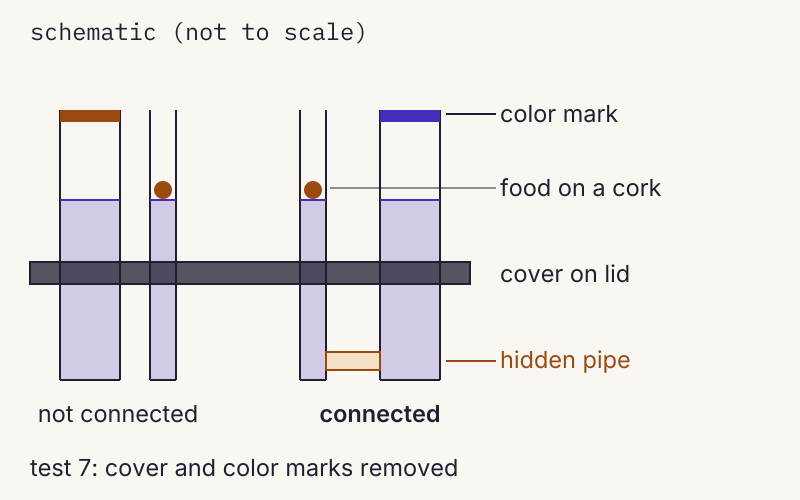
A schematic of the U-tube as Logan's team describes it: a pipe under the lid joins one stone tube to its food tube, and in the second version the cover and color marks are removed.
How the figure was made schematic, not to scale; after the methods of Logan et al. 2014: two apparatuses, each a standard tube and a food tube 25 mm apart; a pipe under the lid joins one pair; food tubes 300 mm apart; test 6 with cover and color marks, test 7 without
"The U-tube task" by Animal Brainwork, https://animalbrainwork.com/thinking/crow-intelligence/. Licensed under CC BY 4.0: https://creativecommons.org/licenses/by/4.0/
Data: Logan CJ, Jelbert SA, Breen AJ, Gray RD, Taylor AH (2014), PLOS ONE 9(7): e103049, doi:10.1371/journal.pone.0103049, CC BY 4.0
The two studies differ on what the successes mean. Jelbert's team, whose four crows all chose at chance on their U-tube, concluded that the birds have “a sophisticated, but incomplete, understanding of the causal properties of displacement.”
Logan's follow-up changed the setup and got mixed answers: more crows passed the width test with fewer objects, while the object bias and the uncovered U-tube undercut a reasoning account. Its abstract says the results “do not provide support for the hypothesis that these crows can infer the presence of a hidden causal mechanism.”
Read together, the two papers show crows choosing well among objects and water levels, mostly after practice. In Logan's data, most of the learning came in the first 10 of 20 trials. Neither study shows a crow working out a hidden pipe.
Do New Caledonian crows make tools too?
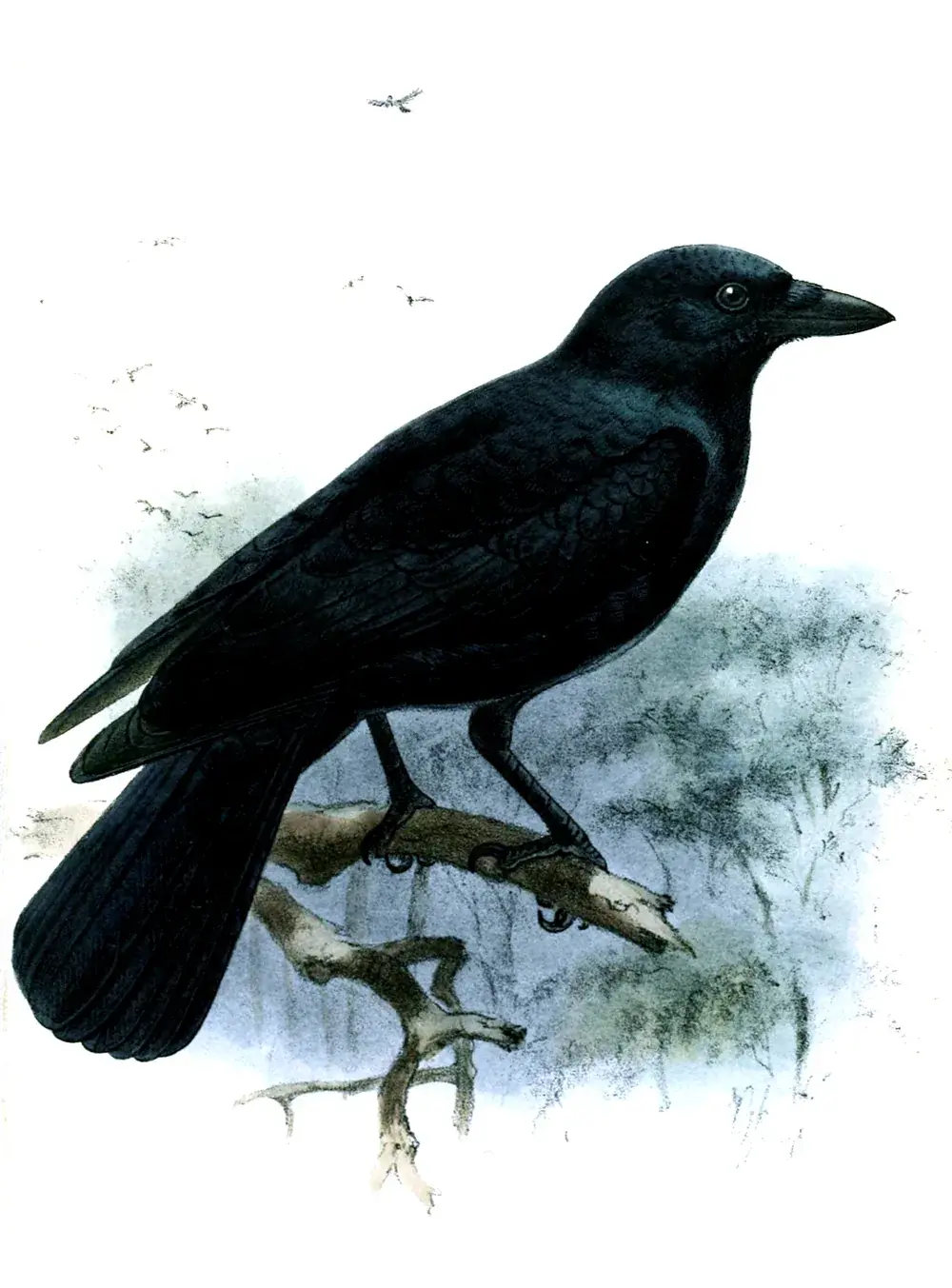
A New Caledonian crow painted by J. G. Keulemans for volume 3 of “Catalogue of the Birds in the British Museum,” 1877, according to the plate's file page.
“Corvus moneduloides (Catalogue of the Birds in the British Museum, vol. 3, 1877)”, John Gerrard Keulemans; public domain.
Full credit
"Corvus moneduloides (Catalogue of the Birds in the British Museum, vol. 3, 1877)" by John Gerrard Keulemans — https://commons.wikimedia.org/wiki/File:CorvusMoneduloidesKeulemans.jpg — Public domain (published 1877 in the Catalogue of the Birds in the British Museum, vol. 3 (London); public domain in the US (published before 1931); EU: Keulemans's death year not verified from a library or Project Gutenberg catalog record, so this rests on publication in 1877 and the file page's PD-old-100 tag and Public Domain Mark 1.0; upstream not traced); modified: the Commons version used is adjusted by MPF (red cast removed, 16 March 2014; that version is 2,367 px high against 2,590 px for the 2010 upload), resized to 1000 px wide and converted to WebP
The species' scientific name is Corvus moneduloides R. P. Lesson, 1831. Jelbert's paper describes these crows as routinely making and using tools in the wild as well as in captivity. The reports it cites for those two claims include a 1996 paper in Nature by Hunt on hook tools and a 2002 paper in Science by Weir, Chappell and Kacelnik on shaping hooks bibliographic.
Stone dropping is another matter. The same paper notes that the crows drop candlenuts onto hard surfaces to crack them but are not known to drop stones into water.
That novelty is part of the appeal for comparison across species. Logan's paper reports that Eurasian jays also failed an earlier U-tube, and rooks have faced the water and object versions. A shared task allows researchers to compare how species handle one problem, not to rank them.
A bird working with its bill faces a different job from an animal with hands, so one task cannot stand in for a whole mind. The same goes for bumblebees solving a string puzzle instead of a water tube, for octopus intelligence and how its neurons are counted, and for honey bee swarm scouts reaching a decision with no single planner.
What the two 2014 studies support is narrow. Of eight crows in one study and six in the other, held in aviaries on Grande Terre, most of those that completed each task chose water, sinking objects and higher water levels, and none was shown to solve a U-tube by working out the pipe. The papers do not show what wild crows do with water on their own, and both call for further tests.
Still unsettled
- Did the successful crows reason about cause or learn fast from what they saw? Logan's team notes that the width result fits either picture, a crow imagining how far the water would rise or a crow watching how far the food moved, and says a tube that hides that feedback is needed to tell them apart.
- Would crows pass a U-tube whose pipe was in view from the very first trial? In Logan's study the uncovered U-tube came after the covered one, so the crows met it with that history, and Jelbert's team listed a revealed connection among the untested changes.
- Do the object choices show a grasp of what objects do, or a liking for solid things? Logan's platform test found solid objects preferred even where only weight mattered, and the paper says that kind of handling bias has not been well controlled in earlier studies.
Studies cited
- Logan CJ, Jelbert SA, Breen AJ, Gray RD, Taylor AH (2014). Modifications to the Aesop's Fable paradigm change New Caledonian crow performances. PLOS ONE 9(7): e103049. doi:10.1371/journal.pone.0103049 pmc.ncbi.nlm.nih.gov/articles/PMC4108369/Read as: full text; read in full (PMC version), including Table 1 and the methodsText license:CC BY 4.0 (terms)
- Jelbert SA, Taylor AH, Cheke LG, Clayton NS, Gray RD (2014). Using the Aesop's Fable paradigm to investigate causal understanding of water displacement by New Caledonian crows. PLOS ONE 9(3): e92895. doi:10.1371/journal.pone.0092895 journals.plos.org/plosone/articleRead as: full text; read in full on the journal siteText license:CC BY 4.0 (terms)
- Integrated Taxonomic Information System (ITIS). Corvus moneduloides R. P. Lesson, 1831, TSN 559506 (valid; New Caledonian Crow). www.itis.gov/servlet/SingleRpt/SingleRptRead as: abstract or record; database record (ITIS single report page), not a full textText license:CC0 1.0 (terms)
Cite this page
“Crow Intelligence: Even a Visible Pipe Stumped 5 Test Crows.” Animal Brainwork, published November 24, 2026. https://animalbrainwork.com/thinking/crow-intelligence/. Accessed the day you read it.
How each claim is traced Retrials: every correction, dated Report an error on this page (contact@animalbrainwork.com)
Nearby questions in Animal Thinking
Experiment story
Clever Hans: In Pfungst’s Tests, the Horse Read the Asker
Picture credit
"Hans under test (Karl Krall, Denkende Tiere, 1912, plate 1), card crop" by Unknown author; Karl Krall, Denkende Tiere, Leipzig 1912, Tafel 1 — https://commons.wikimedia.org/wiki/File:Hans_Pr%C3%BCfung_1907.jpg — Public domain (published 1912 in Karl Krall's Denkende Tiere (Leipzig), plate 1; photographer unnamed; public domain in the US (published before 1931); EU: anonymous work, more than 70 years after publication; file page tags PD-old-70 and the Public Domain Mark 1.0; upstream not traced); modified: crop of the same original as clever-hans-pruefung-1912 (the page's first image, shown whole): cropped to 3:2, full width, rows 101 to 1900 of the 2699 x 1979 px file, which trims a strip of wall at the top and of courtyard at the bottom and cuts away the printer's monogram in the bottom-right corner, resized to 1440 x 960 px and saved as WebP; no color change
Myth, retested
Mirror Test: In a 2019 Study, 3 of 4 Wrasse Scraped the Mark
Picture credit
"Bluestreak Cleaner Wrasse" by Elias Levy — https://commons.wikimedia.org/wiki/File:Bluestreak_Cleaner_Wrasse_(6997583331).jpg — CC BY 2.0 (https://creativecommons.org/licenses/by/2.0/); modified: cropped to 3:2 (centered, whole fish kept), resized to 1440 px wide and converted to WebP, adjusted by Togabi: the current Commons version, a color adjustment of Elias Levy's photo uploaded by Togabi on 30 November 2017 (comment "Color Adjustment.", same 2,297 x 1,722 px as the 30 May 2015 transfer from Flickr), per the file history, is the one used
Myth, retested
Octopus Intelligence: By One Count, Most Neurons Are in Arms
Picture credit
"Octopus vulgaris (Merculiano, in Jatta, I Cefalopodi viventi nel Golfo di Napoli, 1896)" by Comingio Merculiano in Jatta Giuseppe — https://commons.wikimedia.org/wiki/File:Octopus_vulgaris_Merculiano.jpg — Public domain (published 1896 in Giuseppe Jatta's I Cefalopodi viventi nel Golfo di Napoli (Italy); public domain in the US (published before 1931); EU: Merculiano's death year not verified from a library or Project Gutenberg catalog record, so this rests on publication in 1896 and the file page's PD-old-100-expired tag; scan tagged PD-scan; upstream not traced); modified: whole plate kept; white margins in the plate's paper color added at left and right to make a 3:2 frame, resized to 1440 px wide and converted to WebP