Archerfish: In a 2016 Study, Four Fish Told Faces Apart
In one sentence
In a 2016 study, archerfish trained to spit at a screen kept telling one learned human face apart from 44 new ones; with four fish per experiment, the evidence suggests rather than settles that a fish can learn this.
- How it was asked
- Cait Newport and colleagues, 2016: once an archerfish had learned to avoid one face, would it keep avoiding that face when each scored test trial paired it with a new one?
- Key study read as
- full text Newport et al. 2016, Scientific Reports (PMC4895153)
- Sample
- 4 fish per experiment, 8 fish in all; only 2 fish finished the last two test blocks of the first experiment small sample
Small sample: 20 or fewer animals and not yet repeated, so this reads as a lead, not a conclusion.
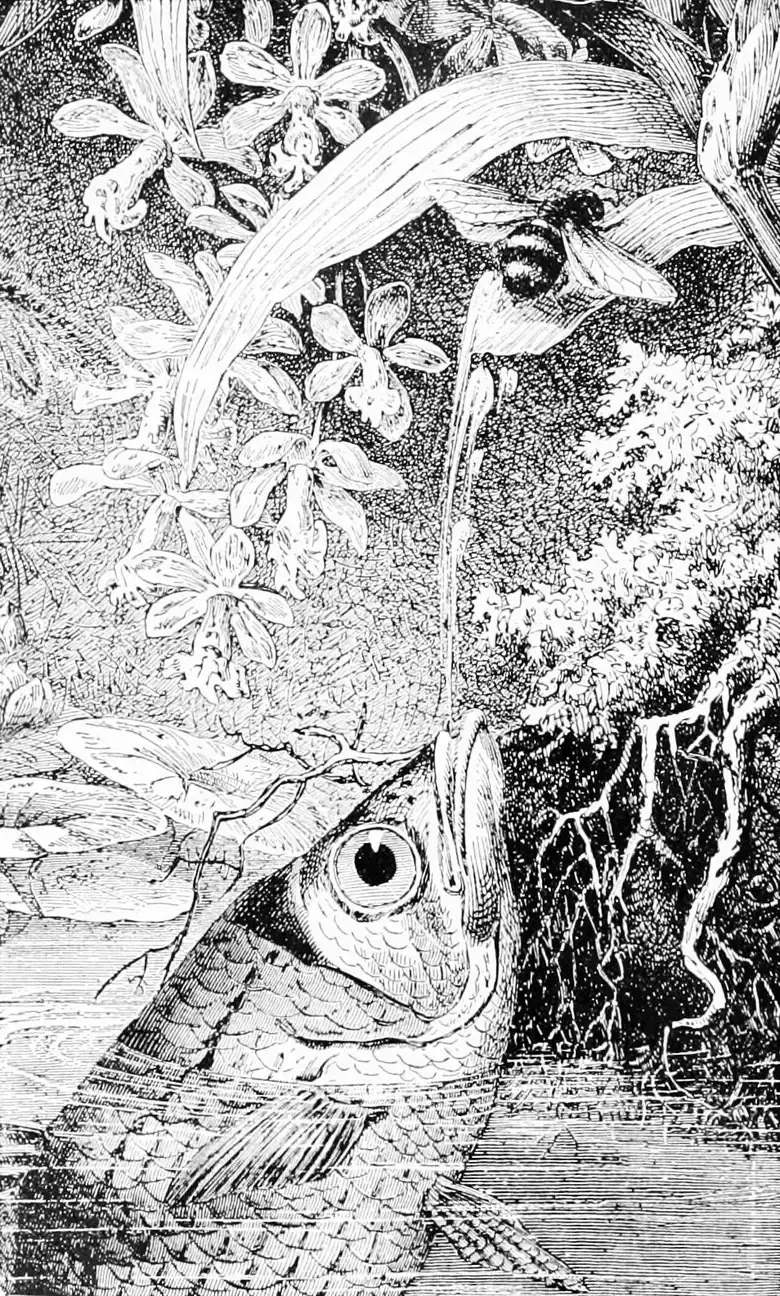
An archerfish aiming a jet of water at an insect on a leaf, in an unsigned engraving from Popular Science Monthly, 1893–94.
“The toxotes throwing water at insects (Popular Science Monthly, vol. 44)”, Unknown author, Popular Science Monthly Volume 44; public domain.
Full credit
"The toxotes throwing water at insects (Popular Science Monthly, vol. 44)" by Unknown author, Popular Science Monthly Volume 44 — https://commons.wikimedia.org/wiki/File:PSM_V44_D612_The_toxotes_throwing_water_at_insects.jpg — Public domain (published 1893–94 in Popular Science Monthly vol. 44 (New York); artist unnamed; public domain in the US (published before 1931); EU: anonymous work, more than 70 years after publication; file page tags PD-old-70 and the Public Domain Mark 1.0; upstream not traced); modified: resized from 954 to 780 px wide and converted to WebP; whole engraving, no crop
Card and share picture, cropped from this picture: "The toxotes throwing water at insects (Popular Science Monthly, vol. 44)" by Unknown author, Popular Science Monthly Volume 44 — https://commons.wikimedia.org/wiki/File:PSM_V44_D612_The_toxotes_throwing_water_at_insects.jpg — Public domain (published 1893–94 in Popular Science Monthly vol. 44 (New York); artist unnamed; public domain in the US (published before 1931); EU: anonymous work, more than 70 years after publication; file page tags PD-old-70 and the Public Domain Mark 1.0; upstream not traced); modified: cropped to 3:2 (954 x 636 px, crop box 0,680,954,1316 of the 954 x 1585 original; moved 120 px down from the earlier box 0,560,954,1196 on 2026-11-24) to show the lower part of the jet, the fish's head and the front of its body; the upper jet and the insect at the top of the engraving are outside the crop, converted to WebP (quality 84, as before)
An archerfish knocks insects off leaves with a jet of water, its mouth barely breaking the surface. That kind of aim depends on eyesight, and a 2016 study used it to put a question to a fish, loosely speaking: is this the face you learned?
A team led by Cait Newport at the University of Queensland showed human faces on a screen above a tank. Four archerfish learned to avoid one face. Each scored test trial then paired that face with a new one from a pool of 44. In the last test block, which only two of them finished, the fish chose correctly 81.5 percent of the time, where guessing gives 50; a second experiment, with 18 faces stripped of color, brightness and head-shape cues, reached 86.25 percent.
Each experiment used four fish. The evidence suggests that a fish can learn to tell human faces apart in this setup. It does not show how the fish did it.
How does an archerfish hunt?
The 2016 paper describes the archerfish as a hunter that depends heavily on vision to spot small prey against a busy background, which is why the team chose it for a test of fine visual detail.
The shot itself was filmed in a 2012 study. Alberto Vailati and colleagues recorded two banded archerfish, Toxotes jaculatrix, at 1,000 frames per second as they fired at prey 97 to 153 millimeters away. Water left the mouth at about 2 meters per second. The front of the jet then sped up to about 4 meters per second, because water from behind kept catching up and swelling it into one large drop.
That drop matters. The authors estimated that at impact the jet delivered about 3,000 watts per kilogram of the muscles that drive it, against roughly 500 watts per kilogram for vertebrate muscle. They concluded that the boost happens outside the fish, in the jet itself. Their impact force, about 200 millinewtons on average, was an upper bound for ideal conditions, at least five times the grip of most insect prey.
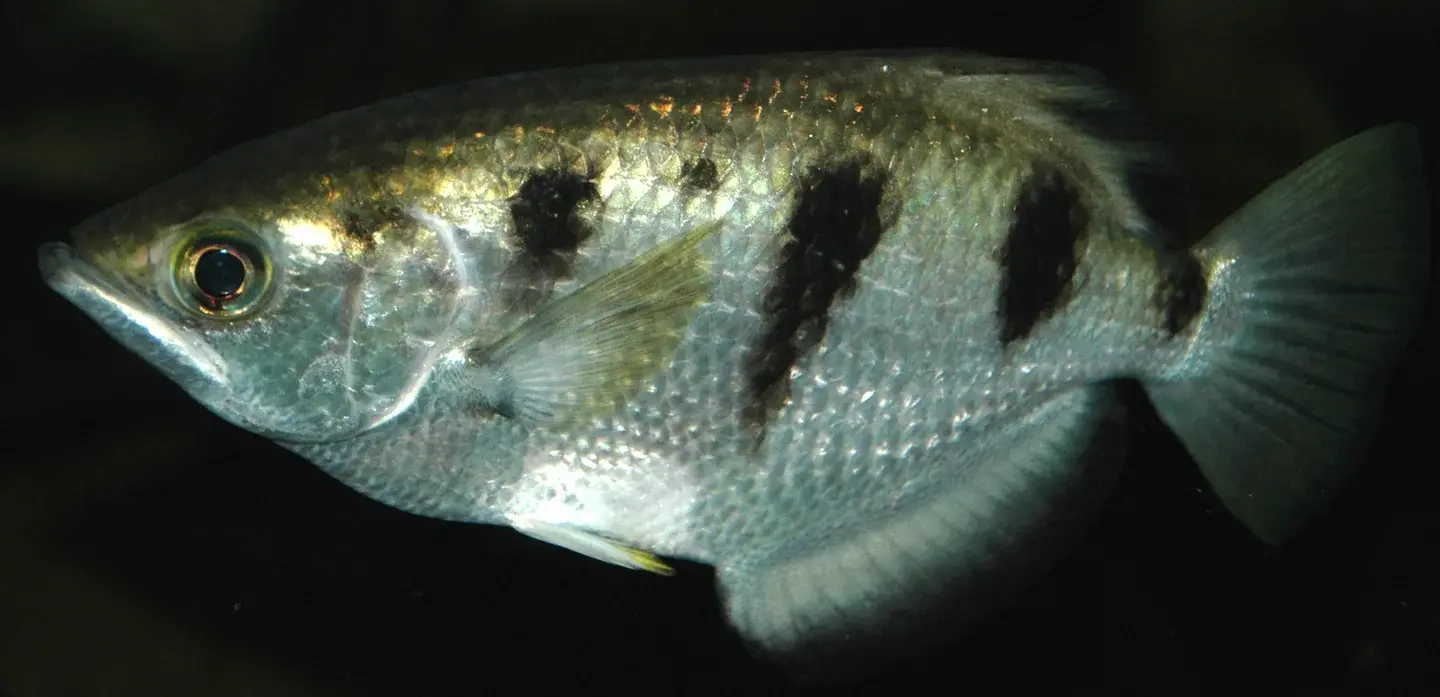
A banded archerfish, Toxotes jaculatrix as named on the photo's file page, at an aquarium; this is the species in the 2012 jet study, not the one in the face study.
"Toxotes jaculatrix (banded archerfish) 3" by James St. John — https://commons.wikimedia.org/wiki/File:Toxotes_jaculatrix_(banded_archerfish)_3_(15099317284).jpg — CC BY 2.0 (https://creativecommons.org/licenses/by/2.0/); modified: resized to 1440 px wide and converted to WebP
Two fish in one tank is a small sample too. The 2012 authors called for more systematic studies on more individuals. The face study used a related species, Toxotes chatareus, which also goes by the common name archerfish.
How do you ask a fish about human faces?
The 2016 paper started from a question about people. Human face processing leans on the fusiform gyrus, part of the neocortex, the outer brain layer of mammals. Fish do not appear to have neocortex-like cells, the paper notes, and with little contact with people they are unlikely to have evolved a special skill for human faces.
The test was a two-way choice. A computer monitor hung above the tank, facing down and parallel to the water, and showed one image on each half.
A fish that hit the correct image with a jet of water got one food pellet. A hit on the wrong image ended the trial. All the fish had already been trained to spit at images on a monitor.
The images were 62 front views of women's faces, drawn from a database of three-dimensional head models at the Max Planck Institute in Tübingen. Hair and clothing had been removed. Each fish first learned one rewarded face and one unrewarded face, until it was at least 71 percent correct in two sessions in a row. The second experiment set the bar at 75 percent.
In the tests, the fish had to keep avoiding the unrewarded face and hit whichever new face appeared beside it. The team chose avoidance because earlier work by Newport had found that archerfish form a stronger link with unrewarded images than with rewarded ones.
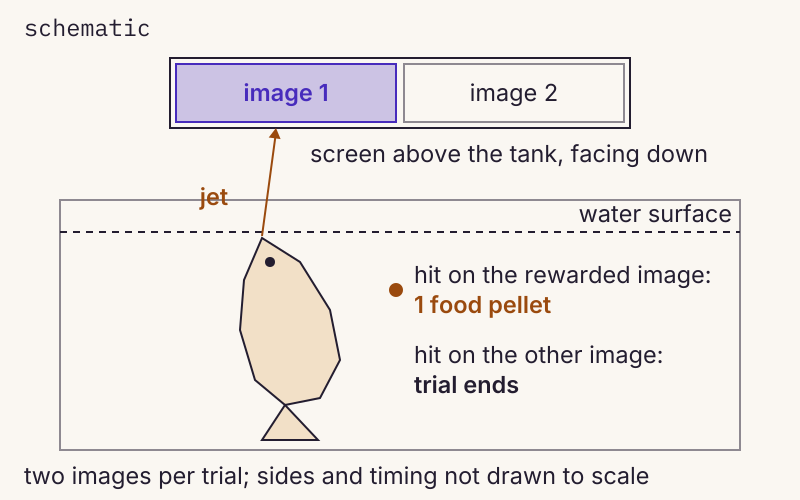
A schematic of the 2016 face test: two images on a screen above the water, one food pellet for a hit on the rewarded image; no faces are drawn.
How the figure was made schematic; methods of Newport et al. 2016; screen above the tank, parallel to the water; two images per trial; hit on the rewarded image = 1 food pellet; hit on the other = trial ends; no faces drawn
"How the archerfish face test was set up" by Animal Brainwork, https://animalbrainwork.com/thinking/archerfish/. Licensed under CC BY 4.0: https://creativecommons.org/licenses/by/4.0/
Data: Newport C, Wallis G, Reshitnyk Y, Siebeck UE (2016), Scientific Reports 6: 27523, doi:10.1038/srep27523, CC BY 4.0
Was a person giving the answer away?
Any result like this owes the Clever Hans tax: the discount a claim about animal cognition carries until the chance that the animal read cues from people has been ruled out. The name comes from Clever Hans, the horse that showed why a fair test keeps the answer from anyone the animal can see.
A screen pays part of that tax, since the images came from a monitor rather than a person's hands. The paper does not say where the experimenter stood during trials or how the pellet reached the water. On paper, that part of the tax has not been paid.
How often did the fish pick the right face?
In the first experiment, the four fish learned their first pair of faces in 2 to 14 sessions. Testing then paired the learned face with the 44 new ones, in blocks of trials. Fish 1 and 4 finished four blocks, while Fish 2 and 3 finished two, so the last two block averages rest on two fish.
Block averages went from 64.75 percent in the first block to 81.5 percent in the fourth, with a dip to 66.5 in the third. In the second experiment, four new fish faced 18 new faces in grayscale, with brightness matched and an oval mask hiding the outline of the head. All four finished four blocks. Their averages went from 73.50 to 86.25 percent, again with a dip, this time in the second block.
The team's statistical model found the fish told the learned face apart from the new ones in both experiments (P < 0.001). Individual fish peaked between 77 and 89 percent correct. The authors wrote it plainly: “Our sample size was small (N = 4 fish for each experiment).”
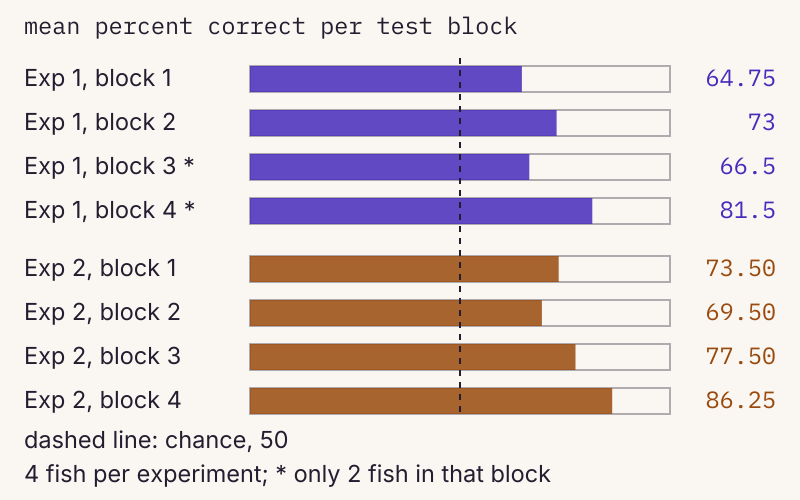
Mean percent correct in each test block of the 2016 archerfish face study, four fish per experiment; the starred blocks rest on two fish, and the dashed line marks chance.
How the figure was made bars = mean percent correct per block as printed in Newport et al. 2016 (CC BY 4.0); 4 fish per experiment; Exp 1 blocks 3-4 = Fish 1 and 4 only; chance line at 50
"Archerfish face test: percent correct by block" by Animal Brainwork, https://animalbrainwork.com/thinking/archerfish/. Licensed under CC BY 4.0: https://creativecommons.org/licenses/by/4.0/
Data: Newport C, Wallis G, Reshitnyk Y, Siebeck UE (2016), Scientific Reports 6: 27523, doi:10.1038/srep27523, CC BY 4.0
| Experiment (4 fish each) | Block | Fish in block | New faces | Mean percent correct | SD |
|---|---|---|---|---|---|
| 1 | 1 | 4 | 44 | 64.75 | 8.342 |
| 1 | 2 | 4 | 44 | 73 | 11.40 |
| 1 | 3 | 2 | 44 | 66.5 | 2.121 |
| 1 | 4 | 2 | 44 | 81.5 | 6.364 |
| 2 | 1 | 4 | 18 | 73.50 | 12.77 |
| 2 | 2 | 4 | 18 | 69.50 | 14.62 |
| 2 | 3 | 4 | 18 | 77.50 | 6.351 |
| 2 | 4 | 4 | 18 | 86.25 | 5.50 |
This table as CSV (archerfish-face-accuracy.csv) (source and license notes) Data: Newport C, Wallis G, Reshitnyk Y, Siebeck UE (2016), Scientific Reports 6: 27523, doi:10.1038/srep27523, CC BY 4.0
What else could the fish be reading?
A face carries plenty of simpler cues. The second experiment removed three of them: color, by turning the images gray; brightness, by setting all images to the same average; and head outline, by laying one oval mask over all the faces. The learned face also differed between fish, which makes a quirk of one particular face a weak explanation: in the first experiment each pair of fish learned a different face, and in the second each fish had its own.
The authors argued that the fish were unlikely to be using trivial features, because one face stood out from 44 others that varied in how alike they looked. The same paper points out that an earlier bee study used only four faces, few enough to be told apart by simple features. The reward-and-choice logic is the same one used when bees were trained to tell colors apart.
What did the study leave untested?
All the images were front views, so changes in viewing angle, lighting or expression were not part of the test; the authors call front views “a very restricted version” of what human face recognition involves. Fish also differed in how fast they learned, which the authors read as a sign that different fish may have used different features.
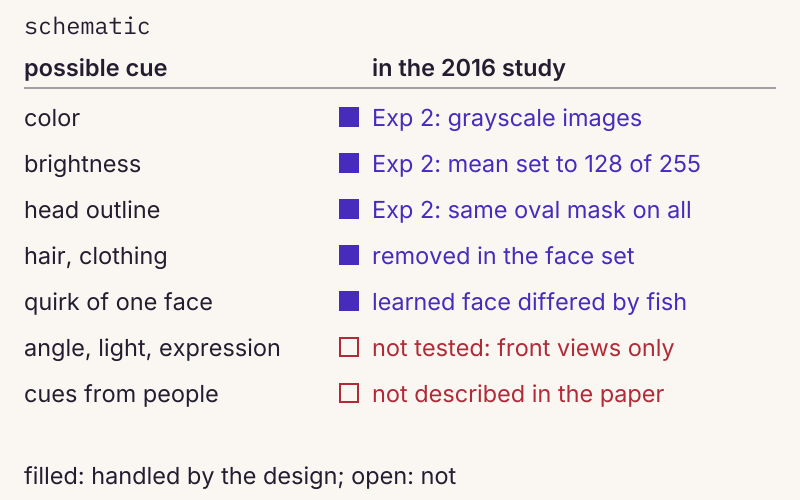
A schematic of other cues the fish could have used and how the 2016 study handled each one; open boxes mark what it did not control or did not report.
How the figure was made schematic; cues and controls from the methods and discussion of Newport et al. 2016; filled = handled by the design (grayscale, brightness 128 of 255, oval mask, database without hair or clothing, learned face varied by fish); open = not tested or not reported
The figure in words
- Color: removed in the second experiment by using grayscale images.
- Brightness: matched in the second experiment, all images set to a mean of 128 on a 0 to 255 scale.
- Head outline: hidden in the second experiment by the same oval mask on all faces.
- Hair and clothing: already removed in the face database.
- A quirk of one face: the learned face differed between fish.
- Viewing angle, lighting and expression: not tested; all images were front views.
- Cues from people: the paper does not describe where the experimenter was.
"Other cues the archerfish could have used" by Animal Brainwork, https://animalbrainwork.com/thinking/archerfish/. Licensed under CC BY 4.0: https://creativecommons.org/licenses/by/4.0/
Data: Newport C, Wallis G, Reshitnyk Y, Siebeck UE (2016), Scientific Reports 6: 27523, doi:10.1038/srep27523, CC BY 4.0
The 2016 study supports a narrow claim. Eight archerfish in one laboratory, shown front views of women's faces on a screen and paid in food pellets, separated a learned face from new ones above chance. The study did not test whether archerfish know particular people outside such a task. Cleaner wrasse, another small fish, faced a different question about recognition in one 2019 study, and sawfish and rays in a 2012 tank study turned toward faint electric fields, a sense humans lack.
Still unsettled
- Did the fish learn the whole face or one part of it? The 2016 authors suggest different fish may have used different features and propose testing altered faces, but the study itself did not test which features mattered.
- Would the result hold with new angles, lighting or expressions? All images were front views; the paper notes that such changes have yet to be tested in fish that do not live near people.
- Is the skill a side effect of hunting vision? The 2016 authors suggest that general visual skills used for finding food, mates and predators could be enough, but that is their reading, not something the experiments tested.
Studies cited
- Newport C, Wallis G, Reshitnyk Y, Siebeck UE (2016). Discrimination of human faces by archerfish (Toxotes chatareus). Scientific Reports 6: 27523. doi:10.1038/srep27523 pmc.ncbi.nlm.nih.gov/articles/PMC4895153/Read as: full text; read in full (PMC version), including the Results, Methods and DiscussionText license:CC BY 4.0 (terms)
- Vailati A, Zinnato L, Cerbino R (2012). How archer fish achieve a powerful impact: hydrodynamic instability of a pulsed jet in Toxotes jaculatrix. PLoS ONE 7(10): e47867. doi:10.1371/journal.pone.0047867 journals.plos.org/plosone/articleRead as: full text; read in full on the journal siteText license:CC BY (terms)
- Integrated Taxonomic Information System (ITIS). Toxotes chatareus (Hamilton, 1822), TSN 169493. Retrieved 2026-11-23. www.itis.gov/servlet/SingleRpt/SingleRptRead as: abstract or record; database record (ITIS single report page), not a full textText license:CC0 1.0 (terms)
Cite this page
“Archerfish: In a 2016 Study, Four Fish Told Faces Apart.” Animal Brainwork, published November 24, 2026. https://animalbrainwork.com/thinking/archerfish/. Accessed the day you read it.
How each claim is traced Retrials: every correction, dated Report an error on this page (contact@animalbrainwork.com)
Nearby questions in Animal Thinking
Experiment story
Clever Hans: In Pfungst’s Tests, the Horse Read the Asker
Picture credit
"Hans under test (Karl Krall, Denkende Tiere, 1912, plate 1), card crop" by Unknown author; Karl Krall, Denkende Tiere, Leipzig 1912, Tafel 1 — https://commons.wikimedia.org/wiki/File:Hans_Pr%C3%BCfung_1907.jpg — Public domain (published 1912 in Karl Krall's Denkende Tiere (Leipzig), plate 1; photographer unnamed; public domain in the US (published before 1931); EU: anonymous work, more than 70 years after publication; file page tags PD-old-70 and the Public Domain Mark 1.0; upstream not traced); modified: crop of the same original as clever-hans-pruefung-1912 (the page's first image, shown whole): cropped to 3:2, full width, rows 101 to 1900 of the 2699 x 1979 px file, which trims a strip of wall at the top and of courtyard at the bottom and cuts away the printer's monogram in the bottom-right corner, resized to 1440 x 960 px and saved as WebP; no color change
Myth, retested
Mirror Test: In a 2019 Study, 3 of 4 Wrasse Scraped the Mark
Picture credit
"Bluestreak Cleaner Wrasse" by Elias Levy — https://commons.wikimedia.org/wiki/File:Bluestreak_Cleaner_Wrasse_(6997583331).jpg — CC BY 2.0 (https://creativecommons.org/licenses/by/2.0/); modified: cropped to 3:2 (centered, whole fish kept), resized to 1440 px wide and converted to WebP, adjusted by Togabi: the current Commons version, a color adjustment of Elias Levy's photo uploaded by Togabi on 30 November 2017 (comment "Color Adjustment.", same 2,297 x 1,722 px as the 30 May 2015 transfer from Flickr), per the file history, is the one used
Experiment story
Crow Intelligence: Even a Visible Pipe Stumped 5 Test Crows
Picture credit
"Corvus moneduloides, Bourail, New Caledonia" by benkeen — https://commons.wikimedia.org/wiki/File:Corvus_moneduloides,_Bourail,_New_Caledonia_1.jpg — CC0 1.0 (https://creativecommons.org/publicdomain/zero/1.0/); modified: the Commons version used is adjusted by MPF (light levels, color balance and a crop to the bird, 6 April 2026, 1,400 x 1,054 px, from the 1,400 x 1,468 px first upload of benkeen's photo, which MPF also made that day), cropped to 3:2 (1400 x 933; 40 px off the top and 81 px off the bottom, whole bird kept), converted to WebP at the original 1400 px width