Mirror Test: In a 2019 Study, 3 of 4 Wrasse Scraped the Mark
In one sentence
The mirror test hides a mark an animal can see only in a mirror; in one 2019 study of cleaner wrasse, three of four fish marked on the throat scraped it only with a mirror, a pass by the study's criteria that its authors say does not show self-awareness.
- How it was asked
- Masanori Kohda and colleagues, 2019: would a cleaner wrasse try to scrape off a brown mark on its throat, and only when a mirror revealed it?
- Key study read as
- full text Kohda et al. 2019, PLOS Biology (PMC6366756)
- Sample
- 10 wild-caught fish, 4 of them marked on the throat small sample; the same laboratory ran the test again with 14 new fish in 2022
Small sample: 20 or fewer animals and not yet repeated, so this reads as a lead, not a conclusion.
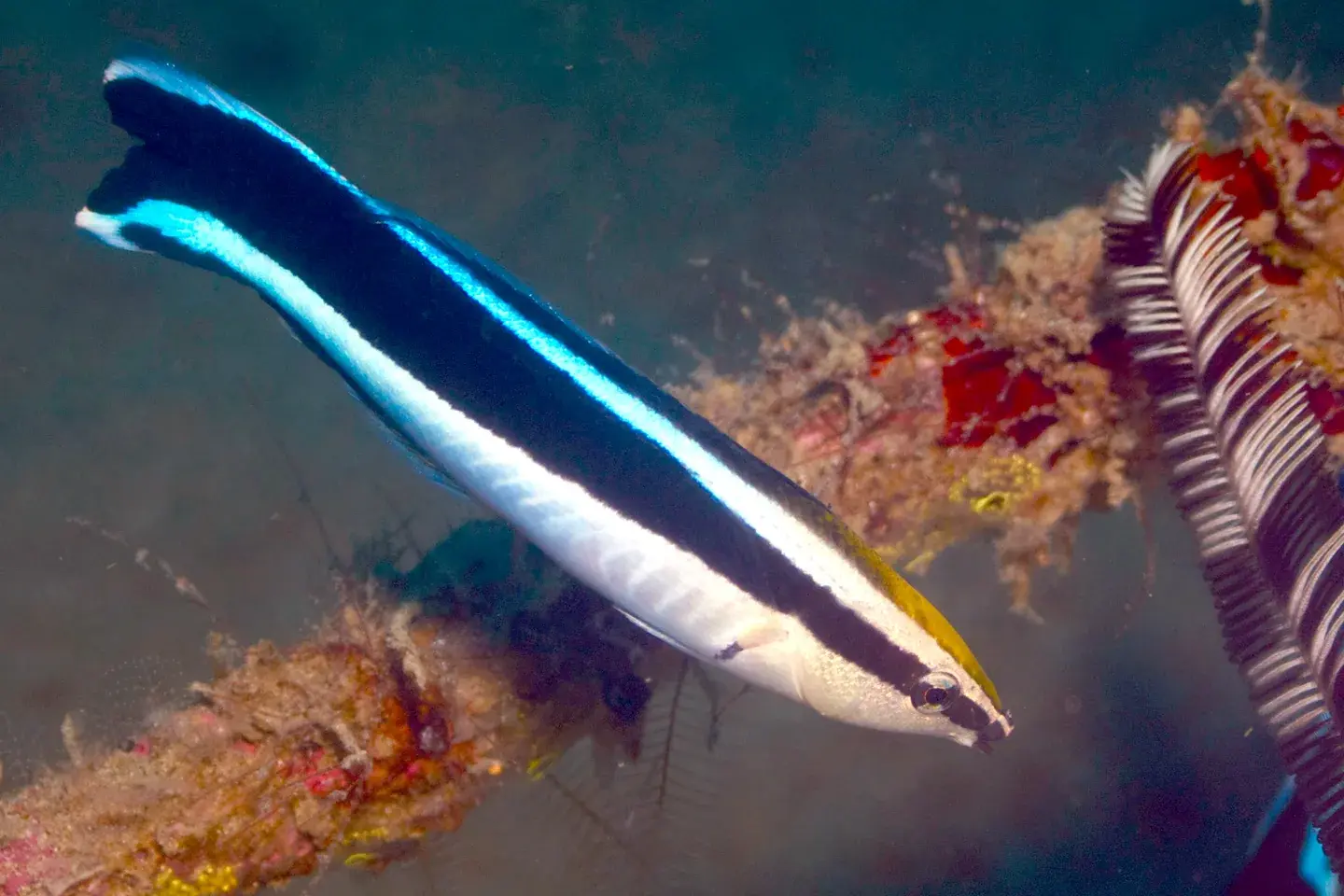
A bluestreak cleaner wrasse, Labroides dimidiatus as named on the photo's file page: the species tested in the 2019 and 2022 mark tests.
“Bluestreak Cleaner Wrasse”, Elias Levy; CC BY 2.0.
Full credit
"Bluestreak Cleaner Wrasse" by Elias Levy — https://commons.wikimedia.org/wiki/File:Bluestreak_Cleaner_Wrasse_(6997583331).jpg — CC BY 2.0 (https://creativecommons.org/licenses/by/2.0/); modified: cropped to 3:2 (centered, whole fish kept), resized to 1440 px wide and converted to WebP, adjusted by Togabi: the current Commons version, a color adjustment of Elias Levy's photo uploaded by Togabi on 30 November 2017 (comment "Color Adjustment.", same 2,297 x 1,722 px as the 30 May 2015 transfer from Flickr), per the file history, is the one used
You cannot see a smudge on your own throat without a mirror, and neither can a fish. That is the whole design of the mark test. A mark goes where an animal can see it only in a reflection, and the test records whether the animal then works at that spot on its own body.
In a 2019 study in PLOS Biology, Masanori Kohda and colleagues put a small brown mark under the throat skin of cleaner wrasse, reef fish that feed by picking parasites off larger fish. Three of the four throat-marked fish scraped their throats against the tank floor or a rock, and only once the mirror was uncovered.
By the study's own criteria, that counts as passing. The authors then argued that passing does not by itself show self-awareness, which moves the question from which animals pass to what a pass shows.
How does the mirror test work?
The test is usually traced to Gordon Gallup's 1970 report on chimpanzees in Science bibliographic, and the 2019 paper names him as its inventor. Read the test as a question put to the animal, in a loose sense only: is the body in the glass your own? Before any mark, the 2019 paper looks for three stages reported in other species: a social reaction to the reflection, then repeated odd movements in front of it, then long spells close to the mirror without aggression.
Two controls do most of the work. A clear sham mark, applied the same way, tests whether the feel of a mark alone sets off a response. A colored mark with the mirror covered tests whether the animal reacts without seeing it. Only a response that appears with the visible mark and the open mirror counts.
A cognition claim also owes the Clever Hans tax: the discount it carries until the chance that the animal was reading cues from people is ruled out. The mark test pays part of it by design, since no person signals where the mark is. Scoring the videos is a separate human judgment: in the 2019 study, two researchers outside the team timed the fish's postures in 15 percent of the videos blind, and their scores closely matched the main analysis. The name comes from Clever Hans, the horse that showed why tests must hide the answer.
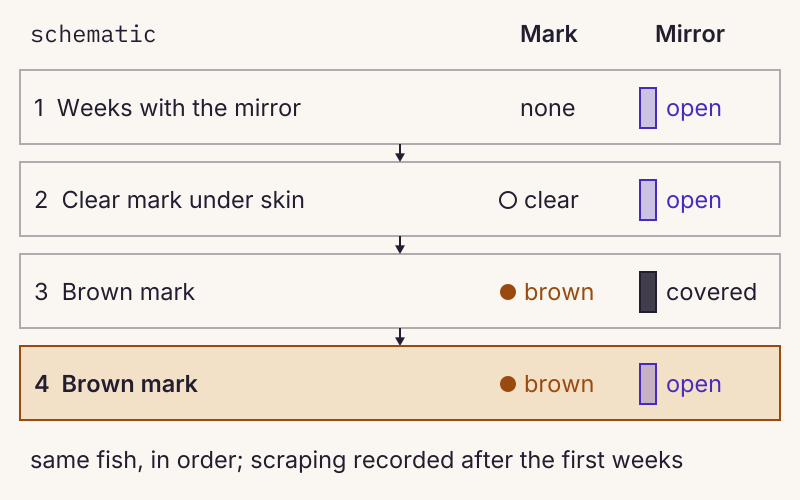
A schematic of the 2019 mark test with cleaner wrasse: the same fish went through four steps in this order, and throat scraping was recorded from the no-mark period on.
How the figure was made schematic; steps from the methods of Kohda et al. 2019; step 1 mirror open, no mark; step 2 clear mark under the skin, mirror open; step 3 brown mark, mirror covered; step 4 brown mark, mirror open
The figure in words
- Step 1: about two weeks with the mirror uncovered, then a period with no mark.
- Step 2: a clear sham mark under the skin, mirror open.
- Step 3: a brown mark under the skin, mirror covered.
- Step 4: the same brown mark, mirror open.
"Steps of the mark test with cleaner wrasse" by Animal Brainwork, https://animalbrainwork.com/thinking/mirror-test/. Licensed under CC BY 4.0: https://creativecommons.org/licenses/by/4.0/
Data: Kohda M, Hotta T, Takeyama T, Awata S, Tanaka H, Asai J, Jordan AL (2019), PLOS Biology 17(2): e3000021, doi:10.1371/journal.pbio.3000021, CC BY 4.0
What did the cleaner wrasse do?
The first reaction was hostile. Right after the mirror was uncovered, seven of the 10 fish attacked their reflection with mouth fighting, which the authors read as treating it like a rival. The attacks faded fast and had stopped by day 7, according to the paper.
Odd moves followed. Seven fish dashed along the glass, approached it upside down or made a quick quivering display, 274 times in all across short observation periods in the first five days. The paper reports that these moves did not appear without the mirror or toward a real fish behind glass. Three fish showed little of this stage, and the authors scored them as failing.
Then came the marks. Eight fish went on to the mark test, four of them marked under the throat, a spot a cleaner wrasse cannot see directly. With no mark, a clear mark, or a brown mark and the mirror covered, none of the four scraped its throat. With the brown mark and the mirror open, three of the four did, 37 times in total.
Identical marks placed on the mirror itself drew no attempt to remove them. The authors wrote that these fish “attempted to remove visually perceived coloured marks from their bodies after viewing them in the mirror.” With four throat-marked fish, the evidence suggests a pattern rather than settles one.
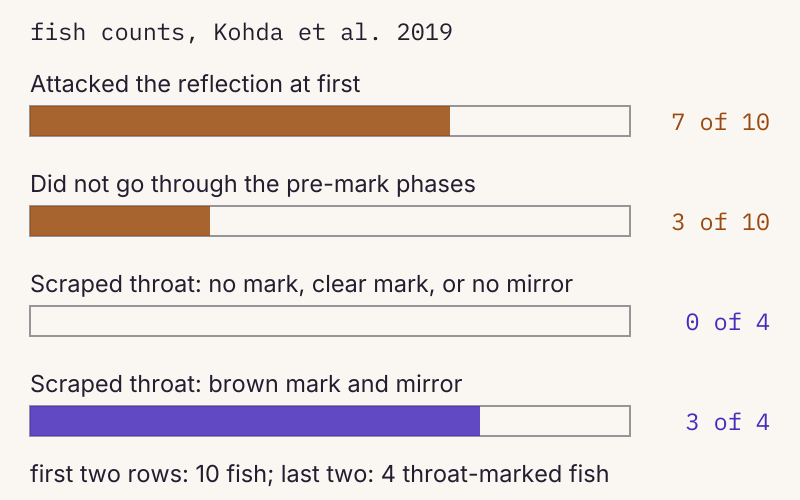
Fish counts from the 2019 study by Kohda and colleagues, by the study's criteria: early attacks on the reflection, fish scored as failing the pre-mark stages, and throat scraping with and without a visible mark.
How the figure was made bars = count / fish in that step; counts from Kohda et al. 2019 (CC BY 4.0): 7/10, 3/10, 0/4, 3/4; Table 1 per-fish totals sum to 274; throat scrapes 15 + 16 + 6 = 37
"What the cleaner wrasse did in the 2019 mark test" by Animal Brainwork, https://animalbrainwork.com/thinking/mirror-test/. Licensed under CC BY 4.0: https://creativecommons.org/licenses/by/4.0/
Data: Kohda M, Hotta T, Takeyama T, Awata S, Tanaka H, Asai J, Jordan AL (2019), PLOS Biology 17(2): e3000021, doi:10.1371/journal.pbio.3000021, CC BY 4.0
| Step (Kohda et al. 2019, by the study's criteria) | Fish | Count |
|---|---|---|
| Attacked the reflection right after first exposure | 10 | 7 |
| Atypical moves at the mirror, days 1 to 5 (all occurrences) | 7 | 274 |
| Scored as failing the pre-mark stages | 10 | 3 |
| Scraped the throat: no mark, clear mark, or mirror covered | 4 | 0 |
| Scraped the throat: brown mark, mirror open | 4 | 3 |
| Throat-scraping events with brown mark and mirror | 3 | 37 |
This table as CSV (mirror-test-kohda-2019.csv) (source and license notes) Data: Kohda M, Hotta T, Takeyama T, Awata S, Tanaka H, Asai J, Jordan AL (2019), PLOS Biology 17(2): e3000021, doi:10.1371/journal.pbio.3000021, CC BY 4.0
Does passing prove self-awareness?
Kohda's team laid out three readings: the scraping is not self-directed, so the fish fail; the fish pass and passing means self-awareness; or the fish pass by the test's criteria and that still does not mean self-awareness. They chose the third. In their view the fish may treat what they see of their own body, directly or in a mirror, as part of themselves without this involving self-awareness, a process they call self-referencing.
Frans de Waal, the paper's academic editor, wrote a commentary in the same issue arguing that the result falls short of mirror self-recognition. He objected that self-scraping is a fixed action pattern of many fish, and that a mark injected under the skin can be felt as well as seen. He placed the fish nearer monkeys that need a physical sensation to link body and reflection, which he called a “Felt Mark Test.”
The same laboratory answered in 2022 with a new experimenter and more fish. In that study, 14 of 14 new fish scraped a brown throat mark, but only with a mirror present; blue and green marks drew no scraping; and marks injected deliberately deeper made fish scrape even without a mirror. From that contrast the authors concluded that the standard, shallower mark is unlikely to be felt as painful or itching, while granting that each new experiment on its own could probably be explained without self-recognition.
How did elephants compare?
Mammals set the comparison. In 2006, Joshua Plotnik, Frans de Waal and Diana Reiss tested three Asian elephants at the Bronx Zoo with a mirror about 2.4 meters on each side, a painted X on one side of the head and a sham mark on the other. One elephant, Happy, repeatedly touched the visible mark with her trunk and not the sham, while the other two showed no rise in touching either mark. The 2019 fish paper set its three of four beside that result.
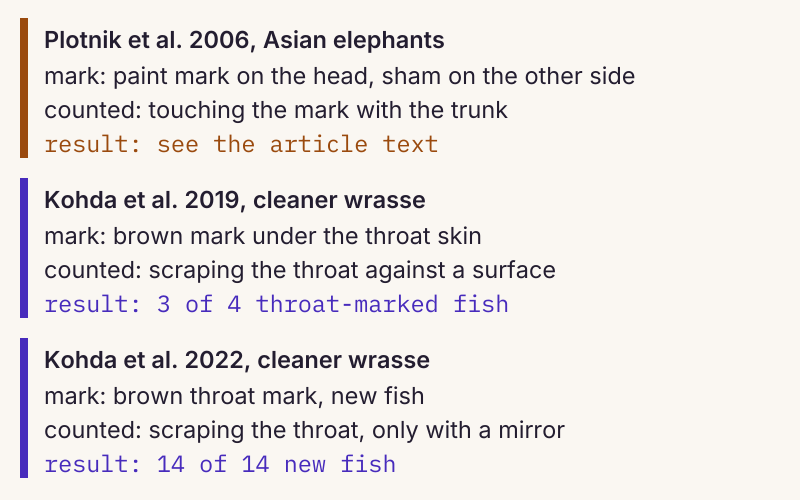
One row per study: the mark, the behavior counted, and the result as each study states it; the elephant numbers appear only in the text above.
How the figure was made one row per study, criteria as each study states; Kohda et al. 2019 and 2022 counts (CC BY 4.0): 3/4 and 14/14; Plotnik et al. 2006 numbers in text only
The figure in words
| Study | Animals | Mark | Counted | Result as stated |
|---|---|---|---|---|
| Plotnik, de Waal & Reiss 2006 | Asian elephants | Painted X on the head; sham mark on the other side | Touching the mark with the trunk | See the article text |
| Kohda et al. 2019 | Cleaner wrasse | Brown mark under the throat skin, after a clear sham mark | Scraping the throat against a surface | 3 of 4 throat-marked fish |
| Kohda et al. 2022 | Cleaner wrasse, new fish | Brown throat mark | Scraping the throat, only with a mirror | 14 of 14 new fish |
"Mark tests compared, one row per study" by Animal Brainwork, https://animalbrainwork.com/thinking/mirror-test/. Licensed under CC BY 4.0: https://creativecommons.org/licenses/by/4.0/
Data: Kohda M, Hotta T, Takeyama T, Awata S, Tanaka H, Asai J, Jordan AL (2019), PLOS Biology 17(2): e3000021, doi:10.1371/journal.pbio.3000021, CC BY 4.0; Kohda M, Sogawa S, Jordan AL, Kubo N, Awata S, Satoh S, et al. (2022), PLOS Biology 20(2): e3001529, doi:10.1371/journal.pbio.3001529, CC BY 4.0
None of this ranks a fish against an elephant. A test built around reaching a spot partly measures whether an animal has a way to reach it. Neuron counts are not a scorecard either, as the octopus intelligence page argues. Archerfish, another small fish, faced a different question about human faces, and bee vision experiments ran into the same problem of what a test is really detecting.
What the 2019 and 2022 studies support is narrow. Cleaner wrasse in tanks, given the standard shallow mark under the skin, scraped a brown throat mark after seeing it in a mirror and not otherwise. Whether that reflects recognizing a reflection as oneself, and whether other laboratories see the same, remains open.
Still unsettled
- Should the test count one scraping action, or a whole run of behavior? Kohda's team treats throat scraping as self-directed, as touching a mark is treated in mammals; de Waal's commentary asks for behavior seen only at the mirror, and scraping is a routine fish action.
- Will a laboratory outside the original group get the same result? The 2022 follow-up came from the same team with a new experimenter; that paper cites criteria calling for repeat studies, ideally by different laboratories, and as of November 2026 this site has not read the full text of one.
- How would a self-recognition test work for animals that rely less on sight? De Waal's commentary lists perception among the reasons an animal might fail, since a visual test may not suit a species that relies on smell, and the mark test also assumes a way to reach the mark.
Studies cited
- Kohda M, Hotta T, Takeyama T, Awata S, Tanaka H, Asai J, Jordan AL (2019). If a fish can pass the mark test, what are the implications for consciousness and self-awareness testing in animals? PLOS Biology 17(2): e3000021. doi:10.1371/journal.pbio.3000021 pmc.ncbi.nlm.nih.gov/articles/PMC6366756/Read as: full text; read in full (PMC version), including Table 1 and the methodsText license:CC BY 4.0 (terms)
- Kohda M, Sogawa S, Jordan AL, Kubo N, Awata S, Satoh S, et al. (2022). Further evidence for the capacity of mirror self-recognition in cleaner fish and the significance of ecologically relevant marks. PLOS Biology 20(2): e3001529. doi:10.1371/journal.pbio.3001529 journals.plos.org/plosbiology/articleRead as: full text; read in full on the journal siteText license:CC BY 4.0 (terms)
- Gallup GG Jr (1970). Chimpanzees: self-recognition. Science 167(3914): 86-87. doi:10.1126/science.167.3914.86 doi.org/10.1126/science.167.3914.86Read as: bibliographic; known from the reference list of Kohda et al. 2019
- de Waal FBM (2019). Fish, mirrors, and a gradualist perspective on self-awareness. PLOS Biology 17(2): e3000112. doi:10.1371/journal.pbio.3000112 journals.plos.org/plosbiology/articleRead as: full text; read in full on the journal siteText license:CC BY 4.0 (terms)
- Plotnik JM, de Waal FBM, Reiss D (2006). Self-recognition in an Asian elephant. Proceedings of the National Academy of Sciences of the USA 103(45): 17053-17057. doi:10.1073/pnas.0608062103 pmc.ncbi.nlm.nih.gov/articles/PMC1636577/Read as: full text; read in full (PMC version); paraphrased only
Cite this page
“Mirror Test: In a 2019 Study, 3 of 4 Wrasse Scraped the Mark.” Animal Brainwork, published November 24, 2026. https://animalbrainwork.com/thinking/mirror-test/. Accessed the day you read it.
How each claim is traced Retrials: every correction, dated Report an error on this page (contact@animalbrainwork.com)
Nearby questions in Animal Thinking
Experiment story
Clever Hans: In Pfungst’s Tests, the Horse Read the Asker
Picture credit
"Hans under test (Karl Krall, Denkende Tiere, 1912, plate 1), card crop" by Unknown author; Karl Krall, Denkende Tiere, Leipzig 1912, Tafel 1 — https://commons.wikimedia.org/wiki/File:Hans_Pr%C3%BCfung_1907.jpg — Public domain (published 1912 in Karl Krall's Denkende Tiere (Leipzig), plate 1; photographer unnamed; public domain in the US (published before 1931); EU: anonymous work, more than 70 years after publication; file page tags PD-old-70 and the Public Domain Mark 1.0; upstream not traced); modified: crop of the same original as clever-hans-pruefung-1912 (the page's first image, shown whole): cropped to 3:2, full width, rows 101 to 1900 of the 2699 x 1979 px file, which trims a strip of wall at the top and of courtyard at the bottom and cuts away the printer's monogram in the bottom-right corner, resized to 1440 x 960 px and saved as WebP; no color change
Experiment story
Crow Intelligence: Even a Visible Pipe Stumped 5 Test Crows
Picture credit
"Corvus moneduloides, Bourail, New Caledonia" by benkeen — https://commons.wikimedia.org/wiki/File:Corvus_moneduloides,_Bourail,_New_Caledonia_1.jpg — CC0 1.0 (https://creativecommons.org/publicdomain/zero/1.0/); modified: the Commons version used is adjusted by MPF (light levels, color balance and a crop to the bird, 6 April 2026, 1,400 x 1,054 px, from the 1,400 x 1,468 px first upload of benkeen's photo, which MPF also made that day), cropped to 3:2 (1400 x 933; 40 px off the top and 81 px off the bottom, whole bird kept), converted to WebP at the original 1400 px width
Myth, retested
Octopus Intelligence: By One Count, Most Neurons Are in Arms
Picture credit
"Octopus vulgaris (Merculiano, in Jatta, I Cefalopodi viventi nel Golfo di Napoli, 1896)" by Comingio Merculiano in Jatta Giuseppe — https://commons.wikimedia.org/wiki/File:Octopus_vulgaris_Merculiano.jpg — Public domain (published 1896 in Giuseppe Jatta's I Cefalopodi viventi nel Golfo di Napoli (Italy); public domain in the US (published before 1931); EU: Merculiano's death year not verified from a library or Project Gutenberg catalog record, so this rests on publication in 1896 and the file page's PD-old-100-expired tag; scan tagged PD-scan; upstream not traced); modified: whole plate kept; white margins in the plate's paper color added at left and right to make a 3:2 frame, resized to 1440 px wide and converted to WebP